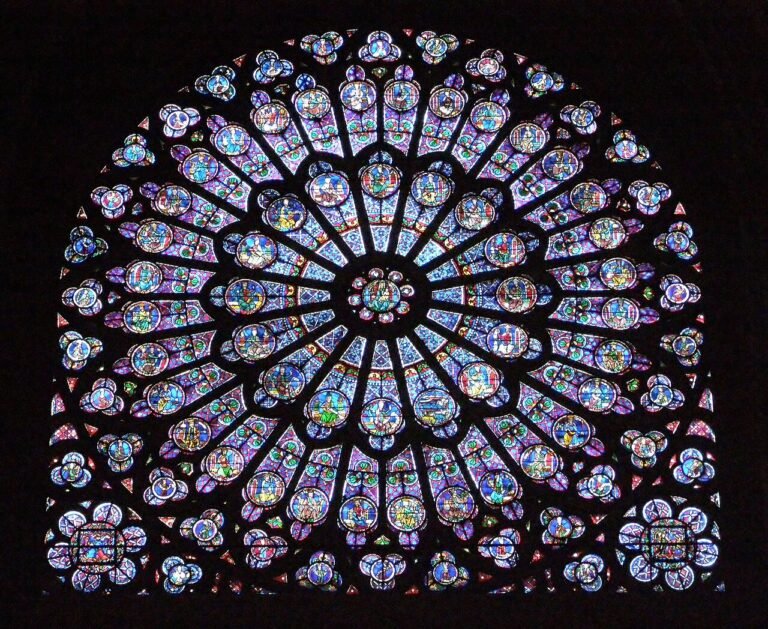
Sleeping Lion: The Strength That Never Needed to Roar
There is another way to be a lion. The one the centuries have most often chosen to show in full action: jaws open, mane raised, claws tearing. But there has also long existed another image, quieter, one that never needed to roar to convince. A lion lying down, eyes closed or nearly so, its mane resting on outstretched front paws: nothing moves, and it is precisely this absolute calm that impresses. From the Egyptian temple to a pope’s tomb, from the foot of a stone recumbent effigy to the window of a New York antique dealer, this lion has crossed the centuries without ever having to prove anything. It was content simply to be there, and to remain.
It is no accident that the two images, the lion that leaps and the lion that sleeps, developed side by side, almost like two faces of the same coin. A power that can only show its strength in action always leaves room for doubt: what happens when it rests? The reclining lion answers that question in advance. It says that between vigilance and sleep there is no gap through which danger could slip. It is an almost paradoxical proposition: to show power precisely at the moment it is not being exercised. It took centuries of sculpture, and several civilizations that had nothing else in common, to learn how to hold it.
Before meaning, rest
Sculpting a lion in attack is, in a way, easier than sculpting a lion that does nothing. Movement dictates the composition: the open jaws guide the eye, the claws set the rhythm, muscular tension fills the stone. A motionless lion, by contrast, has only the accuracy of its mass and the silence of its posture to hold the viewer’s attention. This is the challenge taken up, as early as Egypt’s Old Kingdom, by one of the oldest reclining lions still in existence: a granite block two meters long, carved between 2575 and 2450 BCE, now held at the Metropolitan Museum of Art. Nothing moves: the front paws are stretched flat, the head rests in line with the body, and yet the mass of the granite alone imposes an authority that no open jaw could have made more certain.
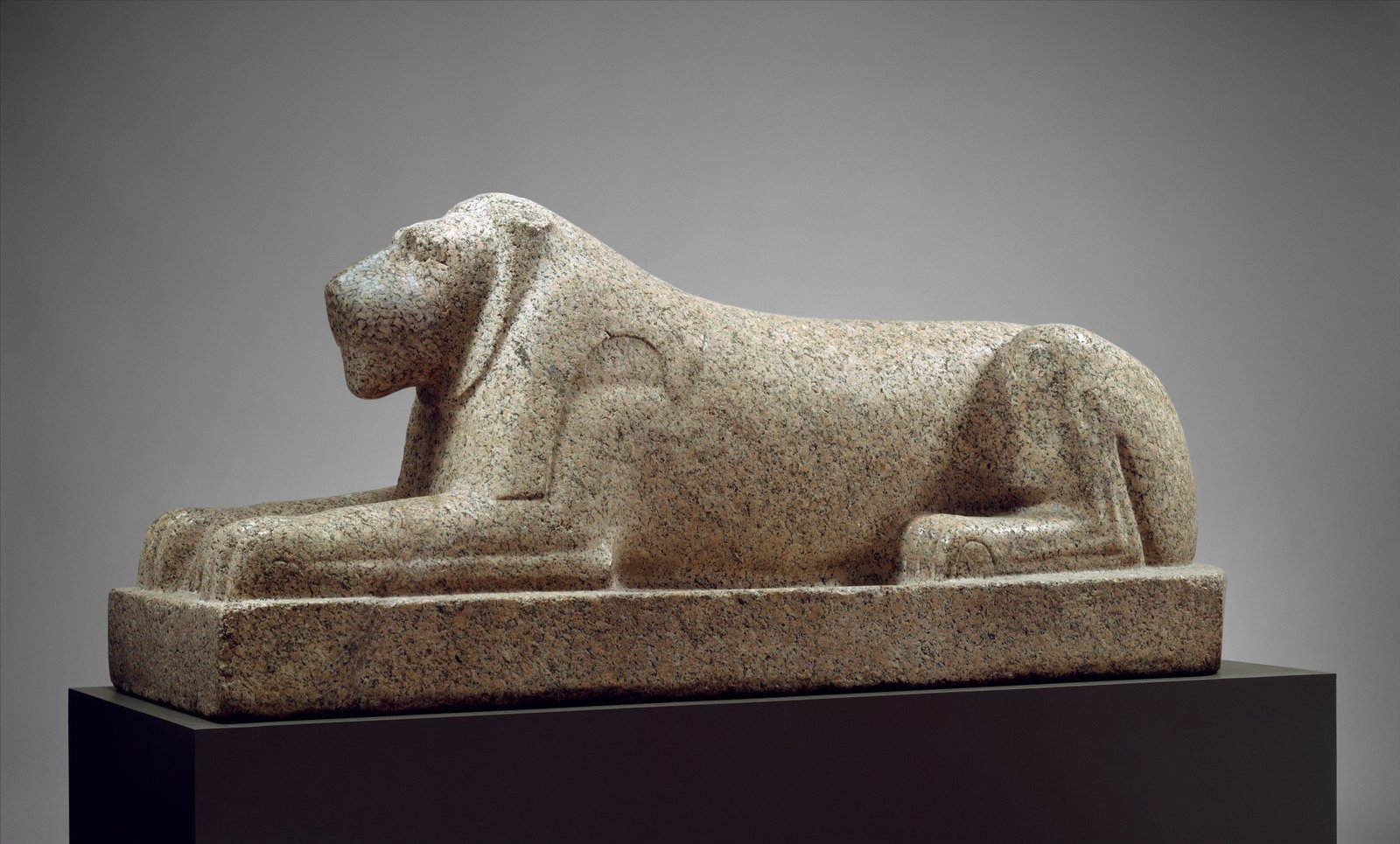
That lion, in fact, did not end its career where it began. Carved at the very start of the Old Kingdom, it was, centuries later, moved and reinstalled in a temple at Herakleopolis Magna, in Middle Egypt, where a civilization no longer quite the one of its original sculptors nonetheless saw fit to preserve it, transport it, and honor it anew. It was not until 1891 that the British Egypt Exploration Fund unearthed it from this second site. Few motifs can claim to have been judged worthy of relocation and reuse centuries after being carved: this is, in its own quiet way, the best proof that the posture of rest was never seen as a diminishing of strength, but as one of its most stable forms.
The pair, precisely, is pharaonic Egypt’s other great lesson on this motif. Around 1370 BCE, King Amenhotep III had two red granite lions carved for the temple at Soleb, in Nubia, lying on their sides, front paws crossed, heads turned to one side in an attitude far more relaxed than the sphinx’s usual frontal rigidity. These two lions, today known as the Prudhoe lions and held at the British Museum, were moved and re-inscribed repeatedly for over a millennium: Tutankhamun had his name recarved on them, his successor Ay had them transported, then a third-century BCE Meroitic ruler, Amanislo, had them brought further south to Gebel Barkal to add his own titulary in turn. Four different rulers, separated by more than a thousand years, thus chose to claim not an image of battle, but a pair of motionless lions: proof, once again, that a motif at rest can cross dynasties precisely because it never fully belongs to the one who had it carved.
Rest that has nothing to prove
Elsewhere in the Mediterranean, the reclining lion takes on an even more specific role: it becomes a guardian of the tomb. In Cyprus, during the fifth and fourth centuries BCE, the pediments of funerary stelae are frequently crowned with a lying lion, watching from the top of the monument over the funerary banquet scene carved just below. One of these pediments, now held at the Metropolitan Museum in the Cesnola collection, shows exactly this composition: the resting lion overlooking the deceased seated at the table for eternity.
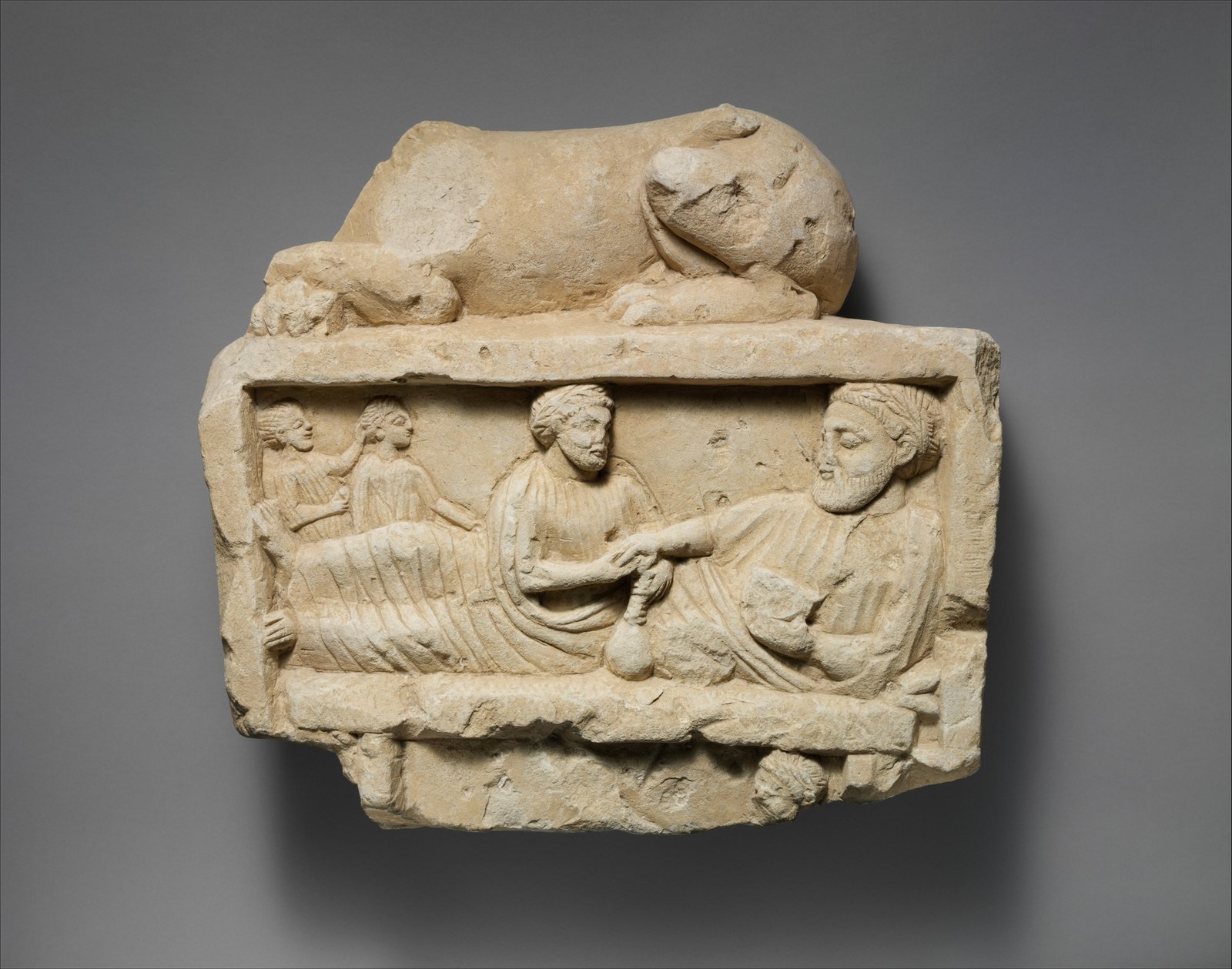
This choice is far from incidental. Other funerary traditions of the same era, in Mesopotamia in particular, favor standing, threatening lions instead, meant to frighten off anyone who might think of desecrating the tomb: there, the guard operates through deterrence. The Cypriot lying lion proposes a different pact with death: it does not threaten, it watches. Its stillness says that nothing will trouble this place again, not even the lion itself. This is a guard that has already won, and so no longer needs to show it. Rest, here, is not the absence of power: it is proof that there is nothing left to fear.
This funerary pediment owes its place in American collections to a history nearly as eventful as that of the Egyptian lion of Herakleopolis. It comes from the collection assembled by Luigi Palma di Cesnola, an Italian soldier who became United States consul in Cyprus in the 1860s and 1870s, who excavated and gathered tens of thousands of objects across the island before selling them as a single lot to the then young Metropolitan Museum, of which he became the first director in 1879. Cesnola’s methods, questionable by today’s archaeological standards, have long been a subject of controversy; this takes nothing away, however, from what this lying lion continues to say from its stone pediment, thousands of miles from the island where Greek stonecutters carved it twenty four centuries ago.
The knight, the lion, and the sleep that fears nothing
Medieval Europe takes up this pact and makes it personal. On tomb effigies, which become widespread from the twelfth century onward in northern Europe, the knight is frequently shown with hands joined in prayer, head resting on a cushion, feet resting on a small lying lion. One of the best preserved examples of this convention is the effigy of the knight Jean d’Alluye, a nobleman from the Loire Valley who died in the mid thirteenth century, now at the Met Cloisters. The lion there is tiny compared to the knight, almost an afterthought, and that is precisely what makes it eloquent: it needs no scale at all to mean what it means.
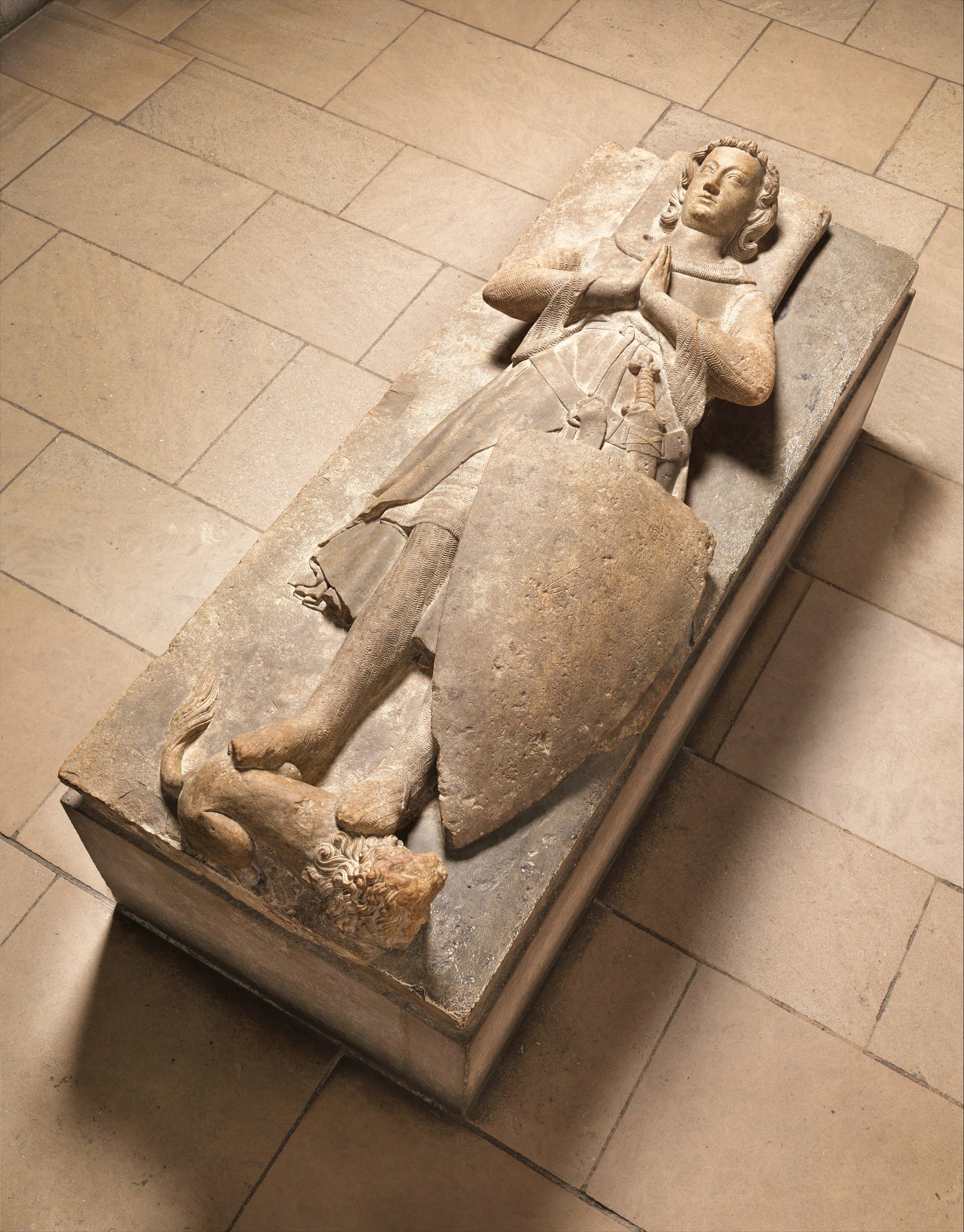
A lion placed at the feet of a tomb effigy is read, in medieval funerary vocabulary, as a sign of courage and strength: in stone, the dead continue to master what in life they would have had to fight. This grammar of animals lying at the feet of the deceased is, moreover, gendered with almost systematic rigor: the knight gets the lion, his wife, on the neighboring effigy, a small dog lying in the same pose. Strength and valor on one side, fidelity on the other, each laid, literally, at the feet of the one it describes. But unlike the heraldic lion rearing up, claws bared, the knight’s lion no longer fights anything: it lies at rest, at peace, as though the valor it embodies no longer needed to be exercised to be its own.
Heraldry, which likes to sort out what funerary sculpture still leaves blurred, eventually drew a precise line between these two states of the recumbent lion. The lion termed “couchant” remains stretched out but keeps its head raised, in a posture of watchfulness: this is, in essence, still the pose of Jean d’Alluye’s lion. The lion termed “dormant,” far rarer in coats of arms, has its head lowered and eyes closed: this is, in the strict heraldic sense, the fully asleep version of the motif, and its very rarity says enough about how hard it was, for a power meant to be displayed on a shield, to choose to show itself drowsing rather than alert. A coat of arms exists to be recognized from a distance, on a battlefield or at a tournament: a sleeping lion necessarily serves that purpose less well than a watchful one, which no doubt explains why the dormant posture remains, even today, one of the rarest in the entire heraldic vocabulary.
The pope, the sculptor, and the two states of strength
It took until the late eighteenth century for a sculptor to stage, side by side, the lion’s two regimes as a single thought. Between 1783 and 1792, Antonio Canova composed, at St. Peter’s in Rome, the funerary monument of Pope Clement XIII. At the base of the tomb, two life-size lions, each carved from a single block of travertine weighing three and a half tons, flank the figure of the kneeling pope. The one on the left, sculpted by Francesco Benaglia, is awake, representing the energy of papal government. The one on the right, carved by Rinaldo Rinaldi, sleeps, representing its moderation. Canova does not choose between the two: he sets them facing each other, because the virtue he wants to celebrate lies precisely in this alternation between action and rest, not in either term taken alone.
The choice, moreover, is nothing like a gratuitous academic exercise: it answers the most burning political question of the pontificate it commemorates. The eleven years of Clement XIII were almost entirely occupied by the measured but constant defense of the Society of Jesus against the courts of France, Spain, and Portugal, all of which demanded its suppression. The pope holds firm without ever yielding to open confrontation: neither total rupture nor capitulation. Canova’s two lions, one keeping watch and the other asleep, quietly express this ridgeline: a power that knows, depending on the hour, how to show firmness or restraint, without either state ever betraying the other.
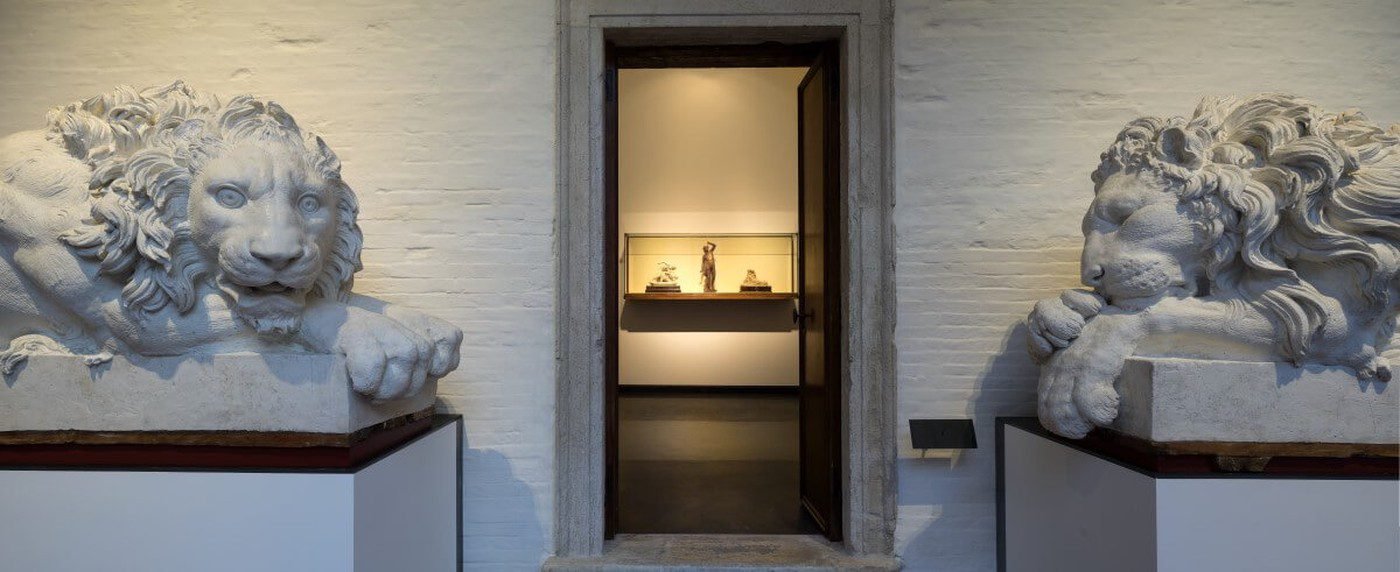
Canova’s plaster models for these two lions are today held at the Gallerie dell’Accademia in Venice, where they still flank a doorway, as if still carrying out, a little, their old function as guardians. A generation later, the recumbent lion shifts register one last time. In 1820-1821, the Danish sculptor Bertel Thorvaldsen designed for Lucerne a monumental lion in an altogether different mood: no longer asleep, but dying, a broken spear driven into its side, one paw covering a fleur de lis shield. Carved directly into the sandstone cliff by the stonemason Lucas Ahorn, the monument measures ten meters long and commemorates the roughly seven hundred sixty Swiss guards killed on August 10, 1792 defending the Tuileries, out of the thousand who made up the regiment; a Latin inscription, “Helvetiorum Fidei ac Virtuti” (to the fidelity and valor of the Swiss), accompanies the list of fallen officers. Mark Twain, who visited in 1880, would call it “the saddest and most moving piece of rock in the world.” Rest here is no longer the ease of a force that has won: it is the last posture of a force that has just lost everything. Between Canova’s drowsy lion and Thorvaldsen’s dying lion lies the whole gap between the classical eighteenth century, which saw rest as a virtue, and the romantic nineteenth, which already saw in it a form of mourning.
At rest, today, in the interiors that matter
Canova’s recumbent lion never really left high end interiors. Pairs of Grand Tour lions inspired by the tomb of Clement XIII, carved in Italy during the nineteenth and twentieth centuries for wealthy Grand Tour travelers, still circulate today on the market of specialized antique dealers who supply architects and interior designers. The New York house Nicolò Melissa Antiques, which has worked for several generations with Italian families in the antique art trade, regularly offers pairs of recumbent marble lions in this neoclassical vein, meant to flank the entrance of a library or the foot of a staircase.
What still circulates today in this highly specialized trade is never the lion in full charge: it is invariably the recumbent lion, the one that rests on a low plinth without demanding extra space around it, the one you can place on either side of a door without it overwhelming the rest of the room. Interiors looking for a discreet nod to antiquity or classicism, rather than a spectacular statement, sit more comfortably with a still pair than with a leaping beast. The pattern never needed to reinvent itself to endure: it still does what it already did at the foot of a papal tomb, lining a threshold without ever raising its voice.
And, finally, set on a drawer
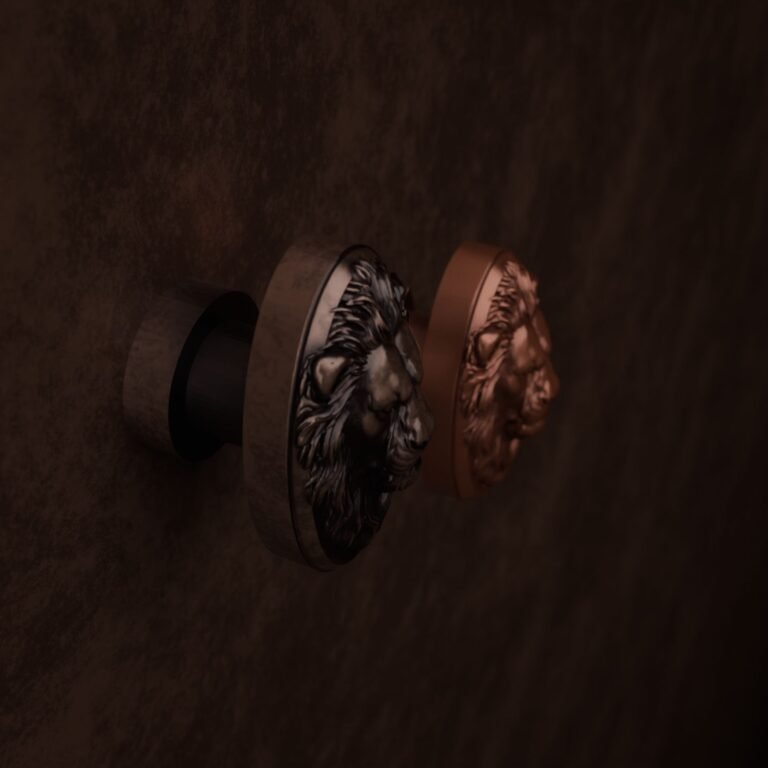
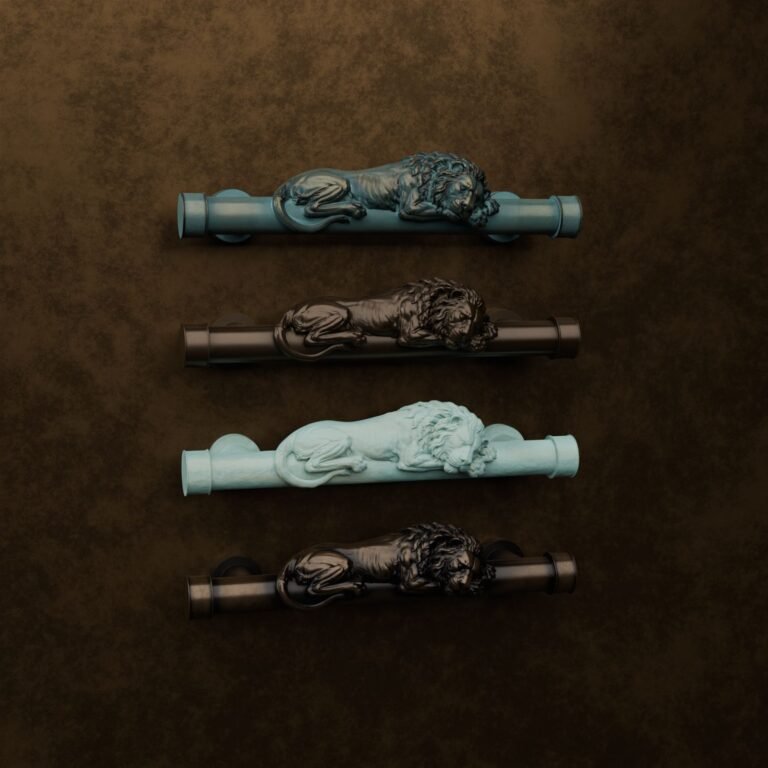
One last threshold remained for this calmed lion to reach: the modest one of a bedroom or living room piece of furniture. That is what Holdon’s Sleeping Lion works with: eyes closed, mane settled, the same restraint as the tomb guardians and the Venetian casts, scaled down to the size of a handle. It is no accident that this pattern turns up so naturally on bedroom, closet, or dresser fronts, where the more frontal Roaring Lion asserts itself more readily on an entry door or a kitchen island: the recumbent lion never needed to take over the whole room to command respect.
That is precisely what the pattern’s lineage teaches, from the Egyptian Old Kingdom to the Grand Tour antique dealers: a sleeping lion never asks to be given the whole room. It settles on a threshold, at the foot of a tomb, beneath the feet of a recumbent effigy, on either side of a door, and it waits, for all eternity if need be, without ever raising its voice to be noticed. A dresser, a closet, a bedroom door suit it by nature better than an entryway meant to impress right away: these are pieces where character is sought without confrontation, exactly what this lion has always known how to offer.
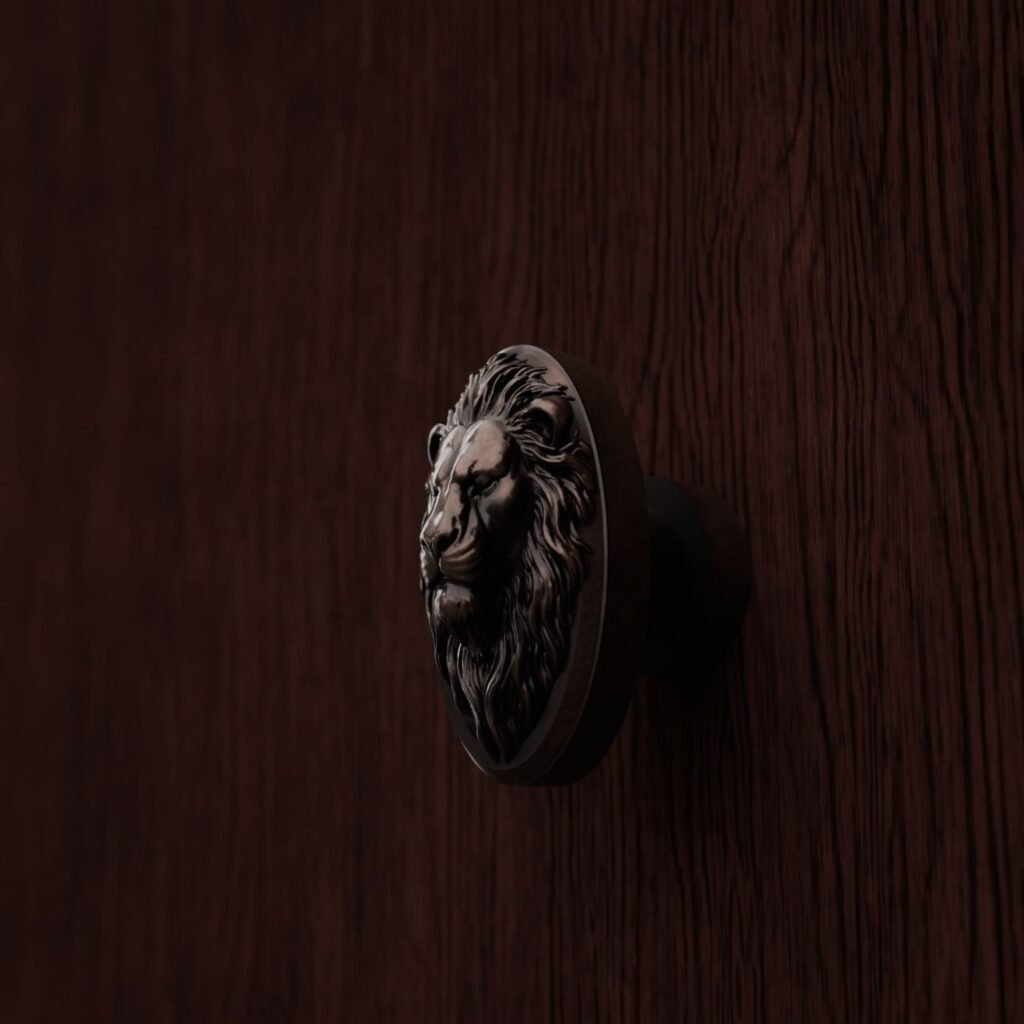
On this antique copper silhouette, the mane keeps that warm patina already well suited to old bronzes and marbles. Carried over to other silhouettes, in bronze or in brass, the pattern always keeps the same lowered head, the same closed eyes: only the design of the body that carries it changes.
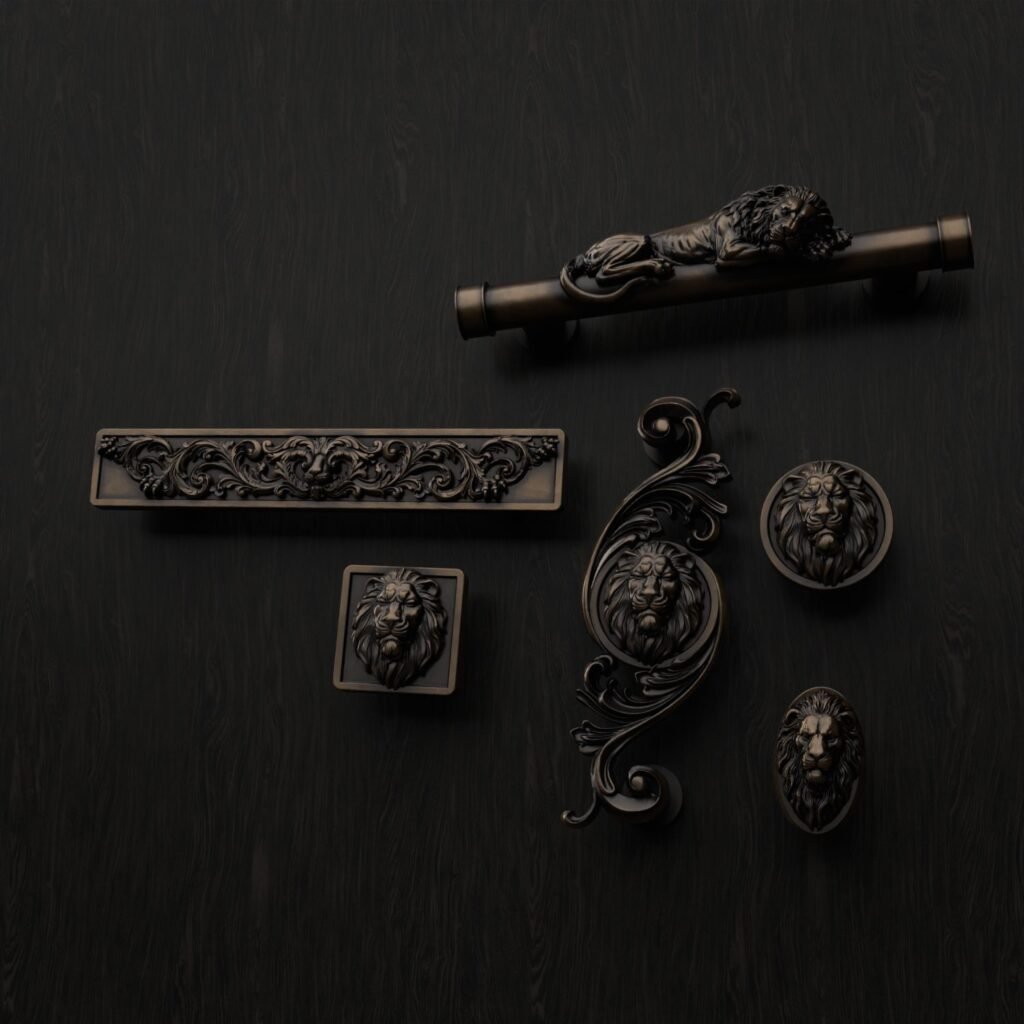
From the granite of an Egyptian temple to the marble of an apartment entryway, the recumbent lion never needed to roar to be taken seriously. It only had to stay still long enough that no one dared doubt it anymore.
Sources and further reading
- Recumbent Lion, Egyptian Old Kingdom, The Metropolitan Museum of Art.
- Prudhoe Lions, Temple of Soleb, The British Museum.
- Limestone finial of a funerary stele with a recumbent lion, Cesnola collection, The Metropolitan Museum of Art.
- The Cesnola Collection at The Metropolitan Museum of Art, Met essay on the Cypriot provenance.
- Our Wandering Knight, on the effigy of Jean d’Alluye, The Metropolitan Museum of Art.
- Attitude (heraldry), on the distinction between lion couchant and lion dormant.
- Monument to Clement XIII, on Canova’s tomb at St. Peter’s in Rome.
- The Lion of Lucerne, by Thorvaldsen, Web Gallery of Art.