The Roaring Lion, or the Authority That Never Backs Down
The lion never needed anyone to draw it to be frightening. It took millennia, however, to learn how to sculpt it without letting it bite: at Mycenae, at Babylon, at Nineveh, the first question that ancient Near Eastern art asked of the great beast was not aesthetic, it was strategic. How do you place, at the entrance to a city or at the foot of a throne, the most feared force in the known world, in a way that it protects instead of devours? Humanity has never really stopped answering that question. It made the lion a gatekeeper, a king’s emblem, a city’s coat of arms, a jewel on a dressmaker’s bodice. Most recently, it made it a cabinet handle.
Before meaning, the guard
Before it meant anything at all, the sculpted lion first served to guard. The Lion Gate of Mycenae, erected around 1250 BCE on the site’s acropolis, is the oldest surviving monumental sculpture in Europe. Two lionesses face each other on either side of a central column, their heads now lost (they were likely fashioned separately in bronze or steatite), keeping watch over the entrance to the citadel. The message needs no translation: it lies entirely in the posture, upright, symmetrical, irrevocable. The lintel bearing this relief weighs some twenty tons on its own; the relieving triangle above it, by shifting the weight of the masonry onto the jambs rather than the horizontal stone, is as much a feat of engineering as a support for a symbol. Here, guarding and architecture are one and the same act.
This choice of image is, in fact, anything but a purely decorative import. The Asiatic lion (Panthera leo persica), today confined to the Gir Forest in India, once roamed as far as the gates of mainland Greece. Herodotus recounts that Xerxes’ army, crossing Macedonia in 480 BCE, lost pack camels every night to the jaws of very real lions, which curiously attacked only these beasts of burden they themselves had never tasted. The species would not vanish from the Peloponnese until close to the end of the first millennium BCE. The lion of gates and thrones is thus not, in its origin, a pure invention of imagery: it was first and foremost a feared neighbor, one that art learned to cage long before zoology finally forced it into one for good.
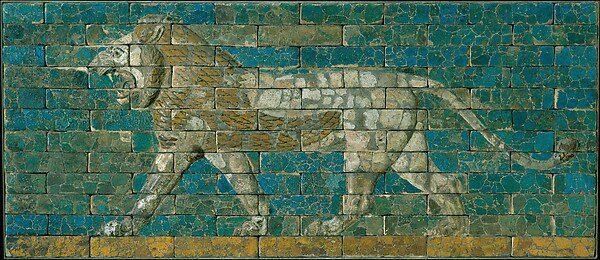
Three thousand kilometers to the east and seven centuries later, Babylon pushes the same reflex to decorative intoxication. The Ishtar Gate, built around 569 BCE under the reign of Nebuchadnezzar II, opened onto a processional way lined with about a hundred and twenty glazed brick lions, each repeated identically, ochre and gold manes against a deep blue ground imitating lapis lazuli. These are not lions of nature: they are lions of power, tied to the goddess Ishtar, and their rhythmic parade, brick after brick over several hundred meters, turned the walk of the worshipper or the sovereign into a procession under the close protection of the beast. The gate has been reconstructed with its original fragments at the Pergamon Museum in Berlin, where visitors can now walk through it as a Babylonian would have, twenty-six hundred years ago.
The violence of the animal, beneath this stylization of brick and stone, is never far away. A simple piece of Assyrian furniture is enough to recall it: a lion’s head carved in ivory, its jaws open wide on fangs still sharp despite twenty-eight centuries, shows just how much this threshold guardian remains, structurally, a predator that people learned only to direct rather than deny.
The King, the Chaos, and the Beast That Had to Be Defeated
The next step is no longer merely decorative, it becomes political. In Assyria, hunting the lion remained, for more than a thousand years, a strictly royal privilege. The reliefs from the North Palace of Nineveh, now held at the British Museum, carved around 645 to 635 BCE under the reign of Ashurbanipal, unfold across several dozen meters of gypsum the same scene, repeated and varied: the king standing in his chariot, bow drawn, finishing off with his sword a lion that has just leapt onto his team, while another takes its first arrow full in the face. This was no royal pastime. In Mesopotamian thought, the lion embodies the chaos at the gates of the cultivated world; by defeating it ritually, in an arena rather than in the wild, the king reenacts and guarantees the gods’ victory over disorder. The lion that is slain is therefore not a trophy, it is proof: proof that the crown still deserves the world it governs.
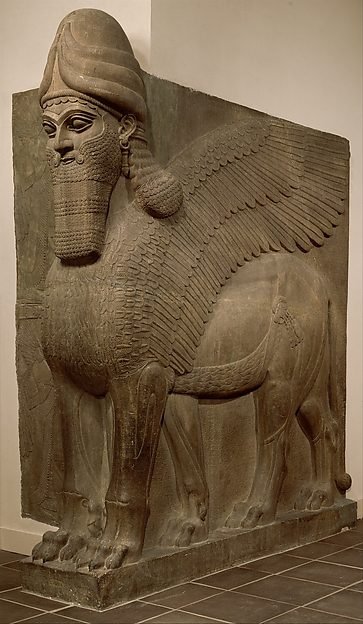
This transfer of the beast onto the authority that masters it finds, at almost the same period, an equally clear biblical echo. Solomon’s throne, as described in the First Book of Kings, featured two lions standing at the armrests and twelve more posted on the six steps leading to the royal seat: nothing like it, the text notes, had ever been made for any other kingdom. Here the lion no longer merely guards a gate, it literally frames the power to judge. A little earlier in Genesis, Jacob’s blessing of his son Judah spins the same image in an entirely different register: “Judah is a young lion (…) he crouches, he stretches out like a lion, like a lioness: who will rouse him?” From this phrase comes the Lion of Judah, which became the emblem of a tribe and then, in Jewish tradition, a messianic figure. Two distinct traditions, one royal and cosmological, the other tribal and theological, thus converge on the same conclusion: to express power that never retreats, there is no better image than the lion that never retreats.
Greece, which shares neither the gods nor the writing of its eastern neighbors, nonetheless invents its own version of the same obligatory combat. The first of the twelve labors imposed on Heracles is to defeat the Nemean lion, whose golden pelt is said to be impervious to any deadly weapon: the hero must finally strangle it bare-handed before skinning the beast with its own claws to make himself a breastplate. Whether at Nineveh, Jerusalem, or Nemea, the structure of the story never changes: an exceptional being confronts the lion without a conventional weapon, and emerges from the ordeal clothed, literally or figuratively, in its strength. The motif belongs to no civilization in particular; it belongs to the very idea of what a sovereign, a hero, or a patriarch must prove in order to deserve his rank.
From Theology to Heraldry
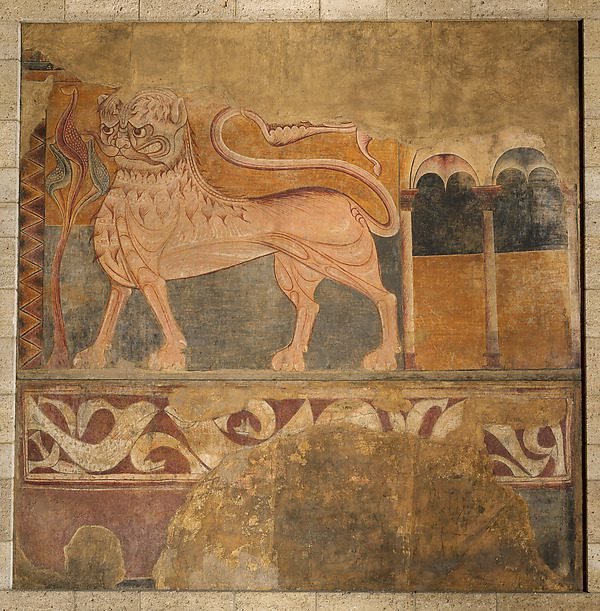
In medieval Europe, the lion completes its transformation: from a beast defeated or worshipped, it becomes a sign worn. It can be found painted, like this Romanesque lion now held at the Metropolitan Museum, its tail knotted into a scroll and its mane stylized into small flames, on the wall of a thirteenth-century Spanish church, a decorative vocabulary that Romanesque painters reproduced almost identically from one monastery to another, proof that a shared grammar of the decorative lion already existed even before heraldry proper.
It is in Venice that the motif takes its most unexpected turn. The winged lion that crowns one of the two columns of the Piazzetta, adopted in the twelfth century as the symbol of the evangelist Mark (the attribution of the four evangelists to the four creatures of Ezekiel goes back to Saint Jerome), has for eight centuries been the very statue of the Serenissima. A recent isotopic analysis of the bronze has nonetheless revealed that a substantial share of the metal comes from the Yangtze River basin in China, and likely dates from the Tang dynasty (seventh to tenth century). The most Venetian lion of all would therefore be, in part, a Chinese statue carried along trade routes before being reassembled and christianized in the lagoon. The fact remains debated among specialists, but it says something essential about the motif itself: the lion travels farther and faster than the borders it is credited with.
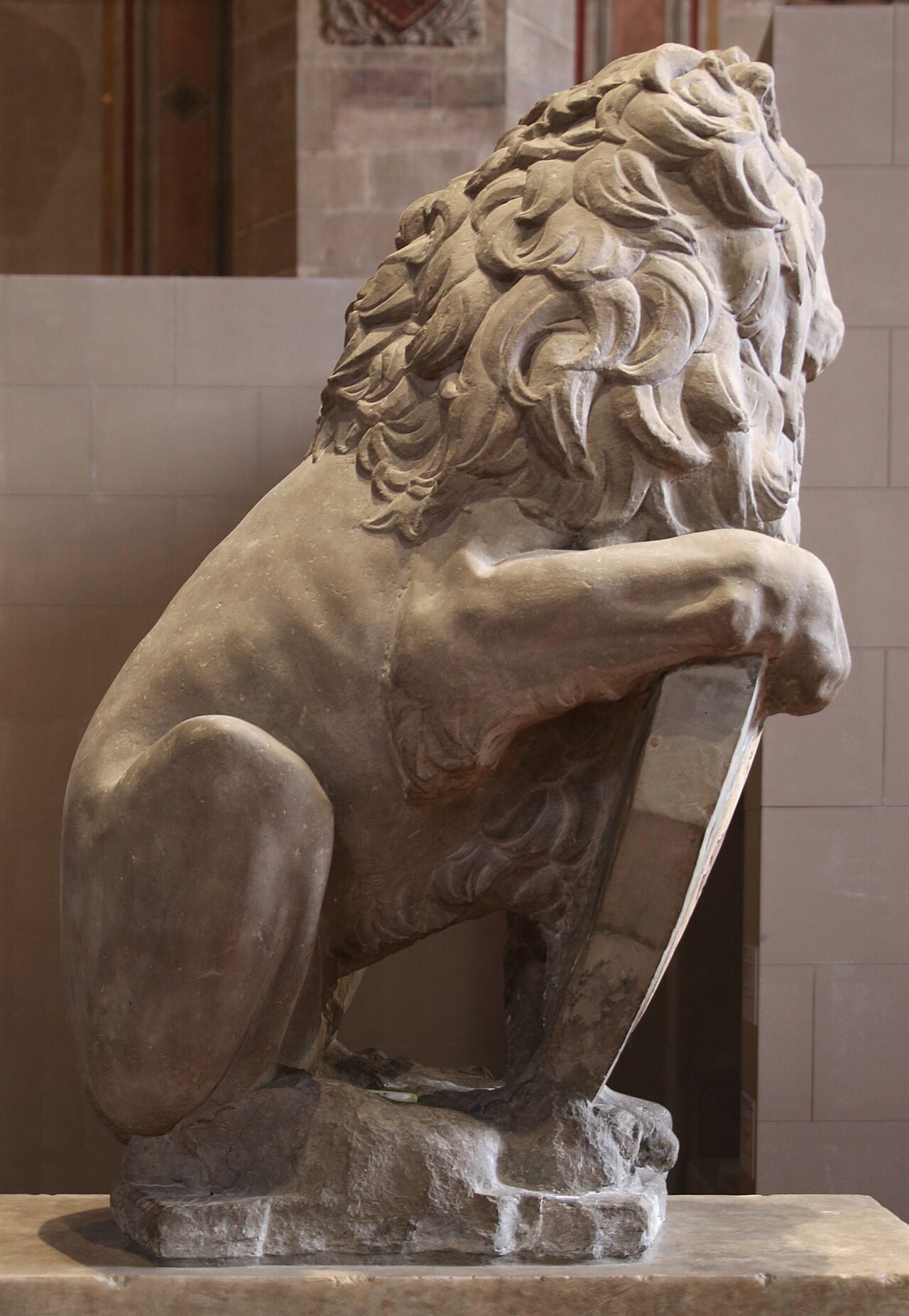
Florence chooses a more sedentary lion, but no less political. The Marzocco, a seated lion resting one paw on the city’s lily shield, became the official emblem of the Florentine Republic by the end of the fourteenth century. The most famous version, carved by Donatello between 1418 and 1420 for the apartments of Pope Martin V, is now held at the Bargello Museum.
The neighboring Medici duchy completes the bestiary with the pair of lions in the Loggia dei Lanzi: one an ancient Roman piece, the other commissioned in 1598 from the sculptor Flaminio Vacca to serve as its exact match, since the symmetry of the heraldic pair mattered more than the authenticity of each piece taken on its own. Placing a lion at the entrance of a palace, at this point, is no longer merely guarding a door: it is signing a territory.
England pushes this language as far as making it a national identity. The seal of Richard the Lionheart, which bore one or two rampant lions in the 1190s, settled in 1198 into its definitive version: three gold lions passant guardant on a field of gules. The exact origin of this number three remains debated among heraldry historians, between the hypothesis of a merger of Richard’s duchies (England, Normandy, Aquitaine) and a striking resemblance to the contemporary arms of the Hohenstaufen or the kings of Denmark. The heralds themselves, eight centuries later, have not settled the question, which has not kept these three lions from becoming one of the most recognizable coats of arms in the world.
Heraldic vocabulary distinguishes with precision the beast’s postures: lion rampant, reared in profile with all claws bared, versus lion passant, walking with its head turned toward the viewer, like the three English leopards. This grammar of attitudes, as strict as an alphabet, allowed a rider to recognize from a distance, on a battlefield or at a tournament, which side the approaching shield belonged to. The heraldic lion, in each of its codified postures, remains above all a signal of recognition: the medieval version of a visual signature.
The motif eventually made its way down from the coat of arms to the threshold of the ordinary home. Georgian Britain, roughly between 1714 and 1830, popularized the brass lion’s head door knocker, its jaws gripping a ring struck against a metal plate: a sign of sturdiness and comfort for those who could afford it, and a decorative vocabulary so firmly established that it has never really left English front doors since. From Solomon’s throne to the Georgian door knocker, the lion thus completed the entire journey traveled by great motifs: descending from the sacred to everyday use without losing, along the way, an ounce of its authority.
The lion, today, on the bodice
The motif never left the great repertoire of luxury, it merely changed vocabulary. Coco Chanel, born August 19, 1883 under the astrological sign of Leo, made it her most intimate signature long before turning it into a collection: lion figurines filled her apartment at 31 rue Cambon, in Paris, mingled with Coromandel screens and camellias. The house has since devoted two major high jewelry collections to the motif: “Sous le Signe du Lion” in 2012, fifty-eight pieces drawing on Byzantine mosaics and Venetian ornament, and “L’Esprit du Lion” in 2018, fifty-three creations this time inspired directly by the decor of the founding apartment, where the mane tightens into a pavé of diamonds and the jaw sometimes closes around a colored stone.
This choice is anything but incidental in the history of the motif. A house that could call on any emblem of prestige, the fleur-de-lis, the eagle, the crown, chooses precisely the figure that, since Mycenae, speaks of strength that does not yield. And it does so without ever quite stiffening it into a coat of arms: the Chanel lion keeps a mane in motion, a jaw that could roar as easily as it could smile. This is exactly the tension the motif has carried since its origin: a power never fully tamed by the very decor that claims to contain it.
And, to close, a jaw on a drawer
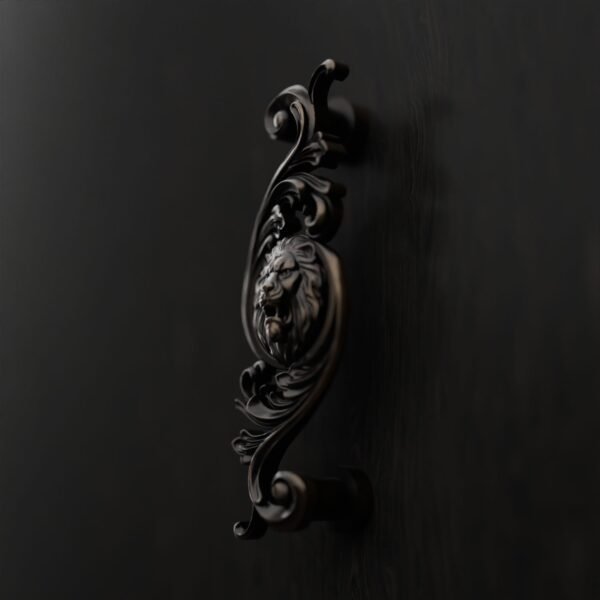
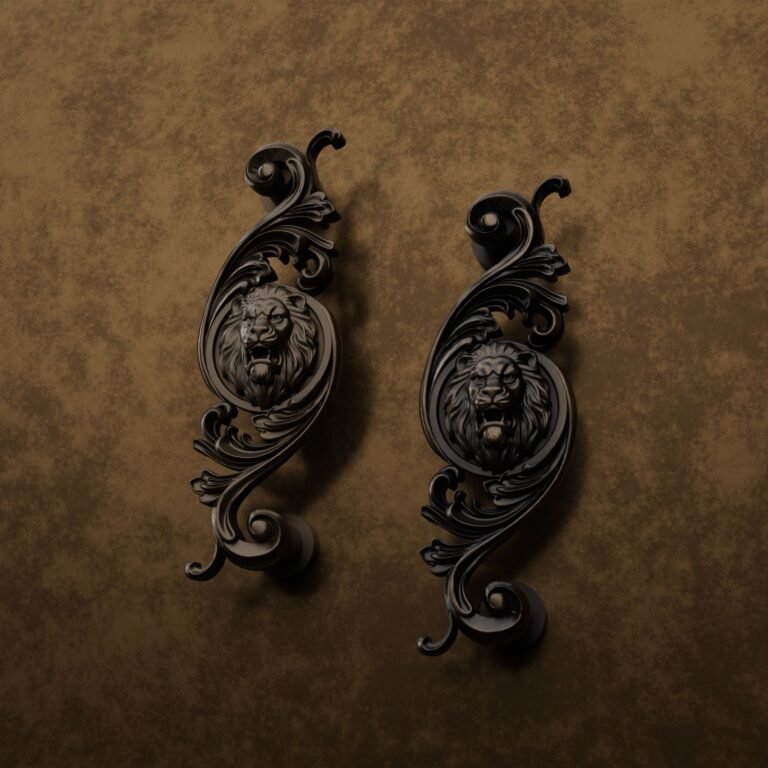
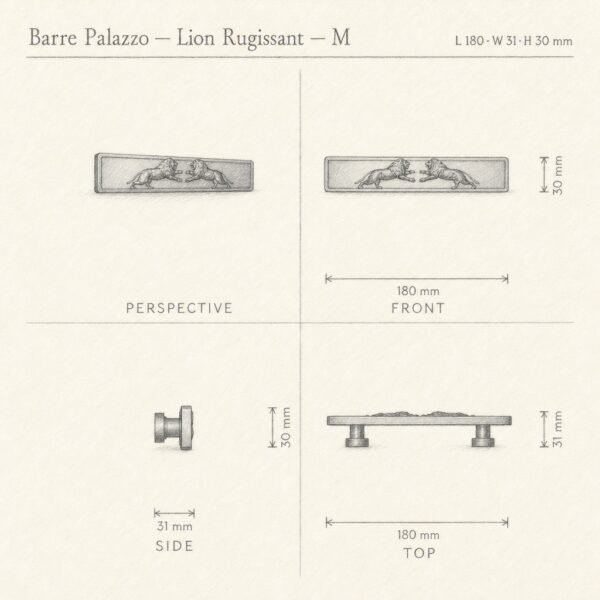
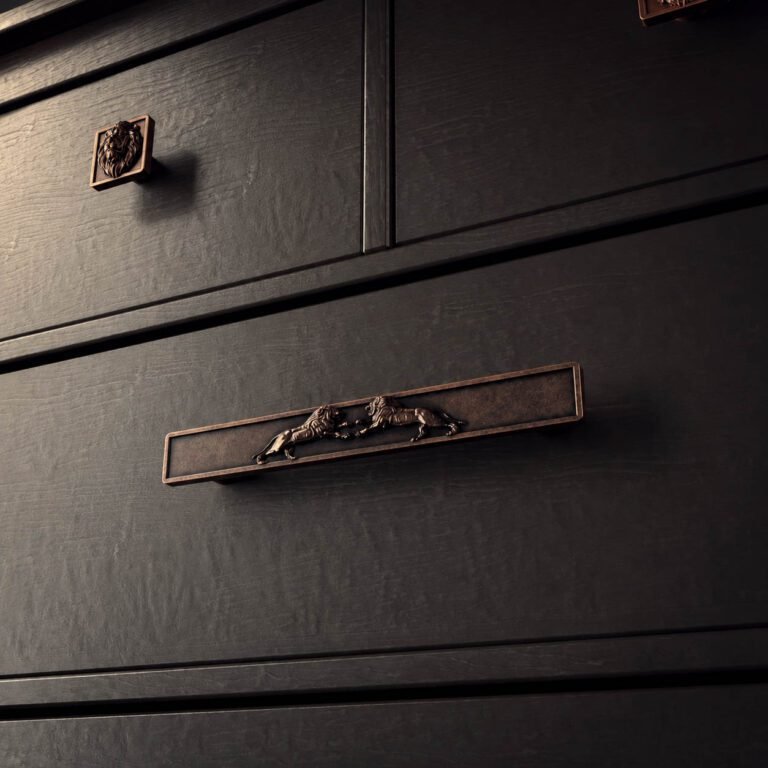
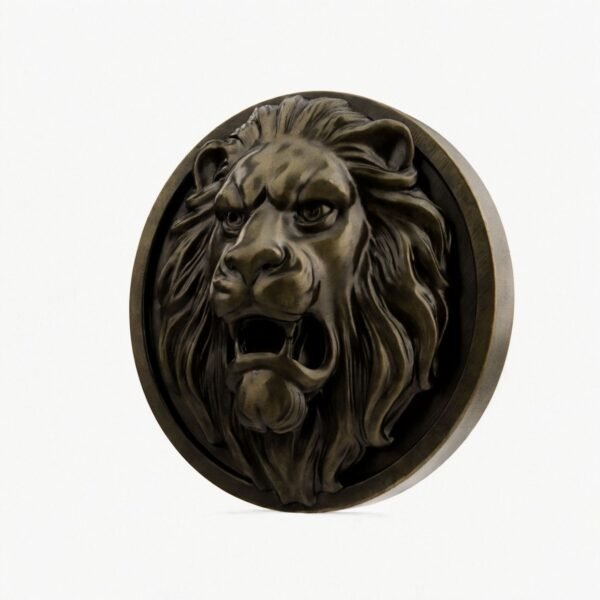
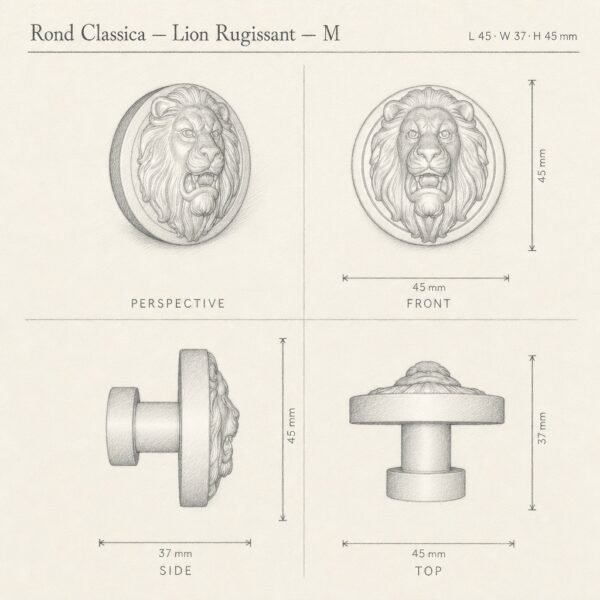
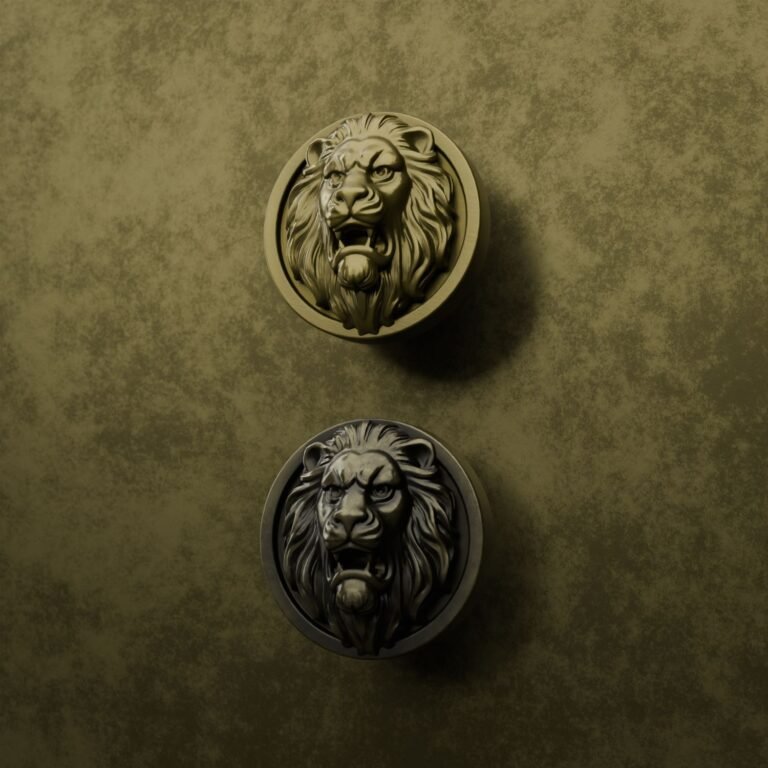
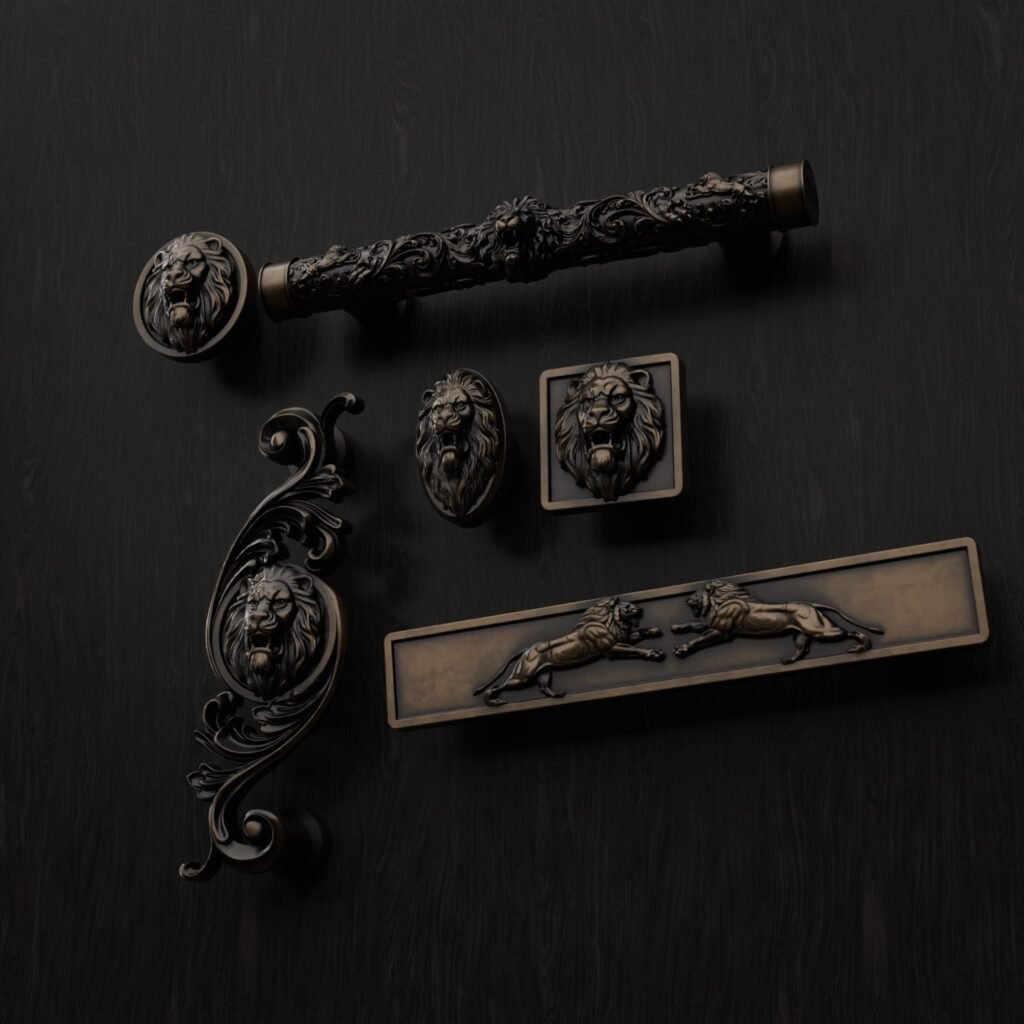
One last threshold remained for this genealogy to cross: the tiny one of a drawer or a kitchen door. The lion had guarded citadels, framed thrones, signed republics, and adorned bodices; it had not yet had to be held, literally, between two fingers. This is the shift in scale that Holdon’s Roaring Lion works with: the same raised mane, the same open jaws, the same fixed gaze as the Georgian door knockers and the Florentine marzocchi, reduced to the size of a handle a hand closes several times a day.
This is no lazy miniaturization. The Roaring Lion’s sculpted level of detail, the individual texture of every lock of the mane, the modeling of the muzzle and the gaze, pushes the piece closer to small sculpture than to mere decorative relief. For that very reason, it is a motif that holds itself in reserve: it is placed on a single front rather than repeated everywhere, precisely because it has always worked as a statement rather than as a background.
Reducing does not mean diminishing. On a front that matters, the entry door of a cabinet, the main piece of a bookcase, a kitchen island, the motif keeps working exactly as it did atop a column or on the arm of a throne: it does not repeat, it stands alone, a single well-placed lion enough to set the tone of an entire room. It is an accent motif, not a background one, which makes it less akin to everyday decoration than to those coats of arms once reserved only for what deserved to be signed.
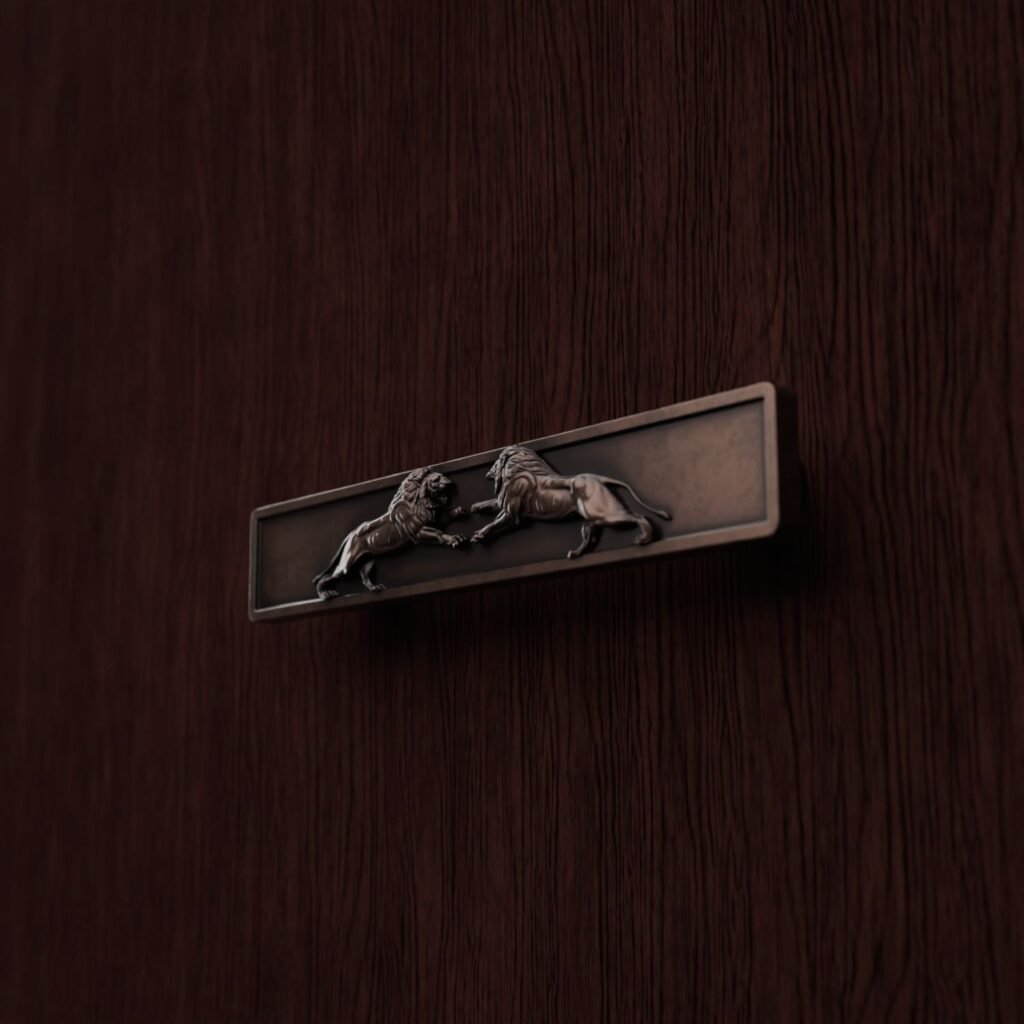
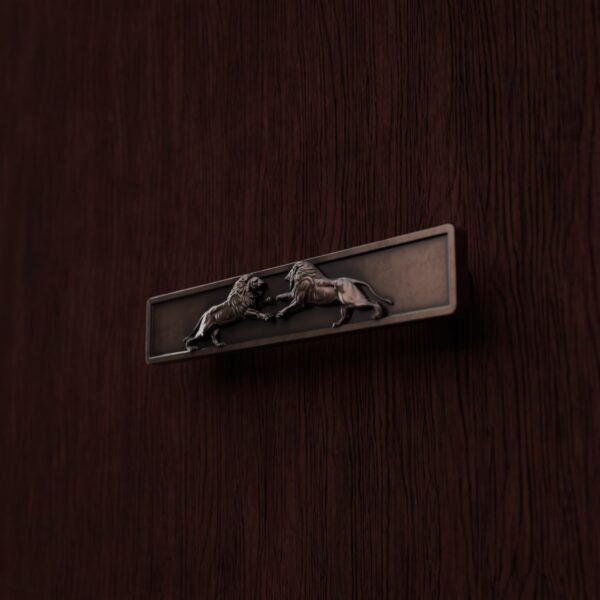
On this antique copper silhouette, the lion recovers the warm patina that already suited Florentine bronzes so well. Rendered on other silhouettes, it keeps the same open jaws each time: only the line of the body that carries it changes.
From the threshold of a Mycenaean citadel to that of a contemporary kitchen, the motif’s trajectory has, at its core, never changed nature. It has only shrunk in scale, without ever losing an ounce of what it had to say.
Sources and further reading
- The Lion Gate of Mycenae, Greek Ministry of Culture (Odysseus portal).
- From Fragment to Monument: The Ishtar Gate in Berlin, Staatliche Museen zu Berlin.
- Lion Hunt of Ashurbanipal, reliefs at the British Museum (North Palace, Nineveh).
- 1 Kings 10:19-20 and Genesis 49:9, Sefaria, library of primary texts.
- The Chinese Identity of St Mark’s Bronze Lion, journal Antiquity, Cambridge University Press.
- The Origin of the Royal Arms of England, The Heraldry Society.