Patinating Bronze, or the Art of Making Time
Bronze does not become beautiful on its own. We like to imagine it, in the common assumption, as a material that ages nobly while the craftsman looks the other way: time would do the work, the patina would fall like a slow rain. The reality is almost the opposite. For at least three thousand years, hands have watched over, provoked, halted, and sometimes disguised this aging, to the point that today it takes a specialist to tell a patina that the centuries truly laid down from one that someone, one day, chose to make in a single afternoon. Patinated bronze is not an accident of time. It is a chemistry, tuned by a hand, that has learned to imitate time so well that we can no longer always tell which of the two signed the color.
What the earth does, without meaning to
Before it was a choice, patina was first a happy accident. The great ritual vessels that ancient China cast under the Shang and Zhou dynasties, between the sixteenth and third centuries BCE, were never designed to be green. Fresh from the mold, they gleamed with the reddish yellow proper to the copper and tin alloy, polished to dazzle the ancestors to whom the wine and grain they held were offered. It was the tombs, the damp soil, the millennia of burial that gave them this mineral crust, by turns emerald green, deep brown, or dark blue, beneath which the original chiseled decoration can still be made out today. The patina admired in museum cases was, for those who commissioned these vessels, only a promise of distant, invisible rust: it did not yet exist when a vessel entered service.
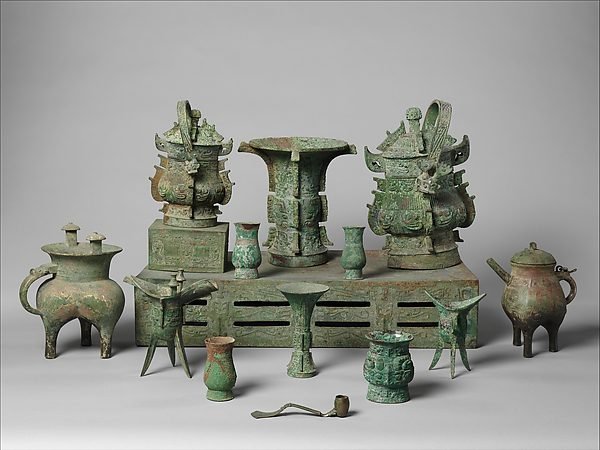
Chemically, this transformation is not mysterious, even if it takes its time. The copper in the alloy first reacts with the oxygen in the air to form a thin layer of reddish oxide, then, in contact with water and dissolved carbon dioxide, this oxide evolves into basic copper carbonates, green malachite and blue azurite, sometimes joined by sulfates when the atmosphere is heavy with sulfur. The generic term verdigris describes this family of compounds more than a single precise color: depending on humidity, soil composition, or proximity to the sea, the same bronze can turn soft green, deep blue, or almost black brown. Nothing in this chemistry, though, foretold that it would one day become an aesthetic goal.
It is worth being wary, too, of a misleading appearance: if museum cases overflow with green or brown bronzes, it is partly because the bronze that does not have this color has, more often than not, disappeared. Ancient Greece and Rome cast, by archaeologists’ estimates, tens of thousands of bronze statues; only a handful survive today, most of them retrieved from the sea or unearthed at exceptional sites such as Herculaneum. Bronze, a noble and recyclable material, was melted and remelted over the centuries, turned into cannons, bells, or coins, whenever a power needed metal more than art. What survived is almost always what the earth or the sea hid from the next generation of founders, and which therefore had every chance to cover itself with a patina no one came to scrape away. The rarity of ancient bronze and the beauty of its patina share, at bottom, the same cause: neglect.
This crust, moreover, is neither uniform nor guaranteed. Conservators have long distinguished two families of corrosion on an ancient object: one that stabilizes into a thin, continuous layer and actually protects the sound metal beneath it like a skin, and another, active and crystalline, soberly nicknamed “bronze disease,” which keeps eating away at the object from within if it is not stopped. The distinction matters, because it already tells the whole paradox to come: the green the eye loves is not always the one the metal can afford. It took learning to tell the patina that beautifies from the one that destroys before anyone could, one day, make one at will.
When the workshop starts imitating tombs
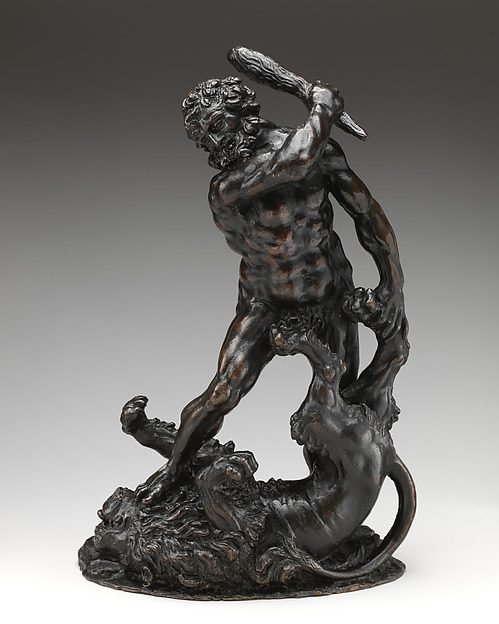
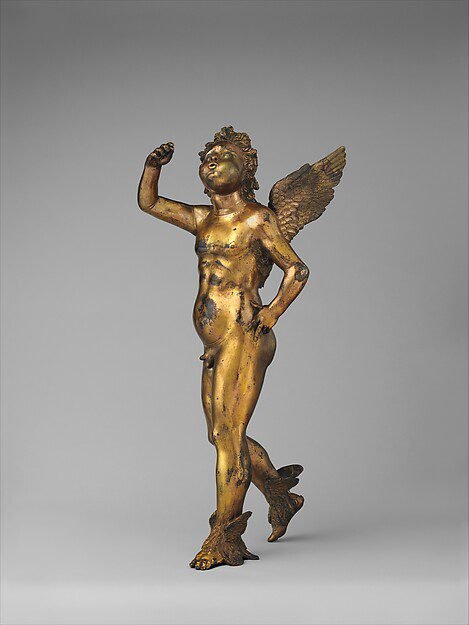
The shift happens in Italy, during the Renaissance, and it fits almost entirely into one sentence: why wait two thousand years when you can get the same color in one night? Florentine and Roman founders, rediscovering the ancient bronzes then being unearthed by the cartload, did not want only to imitate their poses and proportions. They also wanted to steal their color, that dark patina which, to their eyes, authenticated an object as surely as a signature. Giorgio Vasari, in the technical introduction to his Lives published in the mid sixteenth century, notes that bronze naturally takes on, over time, a hue that tends toward black, and he describes plainly the recipes the craftsmen around him used to get ahead of that time: some blacken with an oil, others green with vinegar, still others darken with varnish, each according to the result they are after. Benvenuto Cellini, goldsmith and sculptor, and before him the Paduan humanist Pomponius Gauricus in his 1504 treatise De Sculptura, attest to the same concern: by this date, the color of a bronze was no longer left to chance.
What strikes you, reading these technical texts, is their total lack of self-consciousness. Cellini, in his Treatise on Goldsmithing, describes his methods for coloring metals with the same cold precision he reserves for casting or chasing: to him, there is no difference in kind between sculpting a form and making a color, both belong to the same craft. It is a quiet but total reversal of Antiquity itself, where patina was never claimed as an author’s gesture: among the Florentines of the Cinquecento, coloring becomes a skill that is taught, refined, and sometimes kept secret from one workshop to another. Bronze, already worked twice (once by the sculptor, once by the founder), now finds itself worked a third time, by the chemistry of its surface alone.
The clearest instance of this deliberate manufacturing of time plays out two centuries later, a few miles from Naples. When excavations conducted from 1738 under the patronage of the Bourbons unearth, at Herculaneum, an entire hoard of ancient bronzes buried since the eruption of Vesuvius in 79 CE, restorers find disparate pieces, broken, covered in uneven corrosion. To unify the group and hide the repairs, a single dark, greenish black patina was, it is said, applied to all of them, one that would become so distinctive it was named “Herculaneum black” and would go on being reproduced on new bronzes throughout the nineteenth century. The loop is then complete: a patina born from an act of restoration in turn invents a style, now sought for its own sake, on objects that never knew the ash of Vesuvius.
It would take a nineteenth-century English critic to turn this color stolen from time into an actual morality. John Ruskin, in The Seven Lamps of Architecture published in 1849, refuses to let old buildings be restored by erasing their outrages: to his eyes, it is precisely in the wear that the truth of a building resides. He writes, in the chapter devoted to the “Lamp of Memory,” that one must seek in “that golden stain of time”, that gilding which only time can bestow, the true light, the true color, and the true worth of architecture. Ruskin is not speaking of bronze in particular, but his phrase could serve as an epigraph for the entire history of deliberate patina: the goal is not to erase age, it is to obtain its color without paying its price in years. It is as much a confession as a tribute. Beauty, here, is not the old: it is what looks old.
A single gesture, four crafts
Once invented, deliberate patina does not stay confined to sculpture. Over two or three centuries, it flows into crafts that share nothing but metal and fire.
In art foundries, it becomes a craft in its own right. The patineur, in France, works last, once the piece has been cast, chased, and sanded: they heat the bronze, then apply chemical salts until the desired hue is reached, warm brown, deep black, or verdigris, before fixing the result under a layer of wax that protects the surface over time. This hot process, reserved for bronze sculpture, is distinct from cold patina, a more discreet technique used for medals. The skill, highly concentrated, is passed down today almost exclusively within workshops, so rare have practitioners capable of carrying it out alone become: the Institut national des métiers d’art lists it among the French crafts that rest entirely on the eye and hand of a handful of people. There is, in fact, no diploma that certifies this gesture on its own: it is learned by watching it done, year after year, until one can recognize the instant the salt has finished acting, just before it starts eating away at what it has just colored. This moment of judgment, measured by neither stopwatch nor thermometer, remains the most irreducibly human part of the entire process.
In French furniture, patina takes on an almost political value. Under the waning Ancien Régime, gilded bronze, ormolu, covered court furniture in an unabashed solar glow. The Directoire, in reaction, cultivated instead a deliberate sobriety: this is the moment when bronze with an antique green patina, a more discreet brownish green, becomes the signature of a taste that openly rejects the splendors of the Ancien Régime. The contrast is so sharp that, at the time, wood was sometimes painted in trompe l’oeil to give it the look of that antique green bronze: the Musée des Arts Décoratifs holds a guéridon whose base, actually painted, imitates bronze patina rather than bearing a real one. That a fake patina would be painted onto wood says a great deal: the color, here, no longer stands only for the material it covers, it stands for itself, as a mark of taste that can be detached from the metal. The Empire, which succeeded the Directoire, did not entirely abandon this sobriety either: on many pieces of furniture from the period, patinated bronze continues to hold the grounds and the low reliefs, while gold is reserved for the figures and ornaments meant to catch the eye, as if the two colors divided, on a single piece, the roles of decoration and restraint.
Jewelry making applies the same chemistry on an entirely different scale. Liver of sulfur, a potassium sulfide that workshops dissolve in hot water, blackens silver and copper within seconds through a surface reaction that forms dark sulfide compounds. Jewelers have long used it to artificially deepen the contrast of an engraving, darkening the background of a chased pattern so that the polished relief keeps catching the light: the technique remains today one of the most taught in contemporary jewelry workshops, at the scale of a ring rather than a statue. The chemical principle is exactly the one that already blackened Florentine bronzes, simply transposed to a lukewarm bath and a few seconds of immersion: potassium sulfide knows no scale, it acts as readily on a medal plate as on the bezel of a ring.
Architecture, finally, offers the case where no one patinated anything at all, and yet everyone remembers it as a deliberate color. Delivered to New York in 1886, the Statue of Liberty was then the reddish orange of raw copper. Over some thirty years, without human intervention, the humid sea air took it through a series of oxidations: first a reddish-brown cuprite, then a darkening on contact with atmospheric sulfur, before carbon dioxide and water finally formed the blue-green copper carbonates we know today. The National Park Service places the complete patina around 1906. This layer, today, does more than adorn the statue: it protects the copper beneath from the corrosion that would otherwise continue. The green of Liberty was never chosen by anyone, and yet it has become so essential to the monument that repainting it in raw copper would rightly be experienced as a mutilation. This one example alone measures the distance traveled since the Florentine founders: they made a patina to save centuries of waiting, while this same green, once it arrived unbidden, has in turn become too precious to correct. Deliberate patina and accidental patina end up, on this precise point, converging: in both cases, we now refuse to touch it.
The gesture still holds today
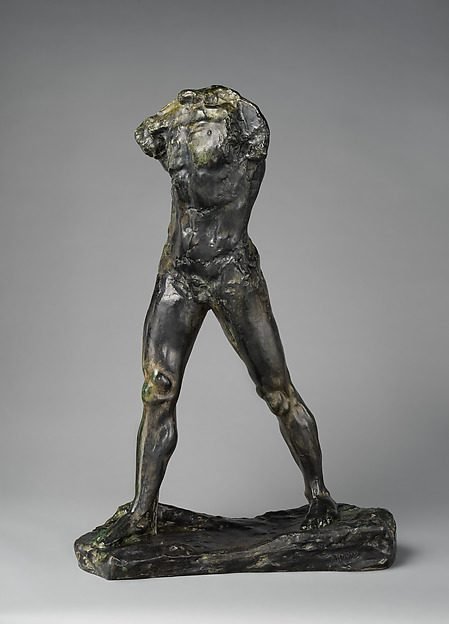
None of this has disappeared from the textbooks. About twenty miles from Paris, the Fondation de Coubertin has run an art foundry since 1963 that still works today, casting and then patinating bronzes for contemporary sculptors, museums, and public commissions. Nearly seventy years of continuous workshop practice have refined a craft found, in France, in only a handful of comparable places: patina there remains a hand gesture, redone for every piece, never fully industrialized and never fully transmissible in writing. This isn’t nostalgia. It’s simply that no one, to this day, has found a reliable shortcut for the eye of a patina artist who knows when to stop, when the salt has bitten the metal just enough without starting to eat away at it. The foundation, officially recognized as a public-interest organization, actually functions as a kind of workers’ university for seasoned craftspeople: the gesture is passed down there less through manuals than through mentorship, not unlike the way Florentine workshops jealously guarded their recipes five centuries earlier. What has changed between the two eras isn’t the method; it’s simply that no one tries anymore to make a piece look like it came from somewhere else. We accept that it’s new, and that it carries a patina because we wanted it to.
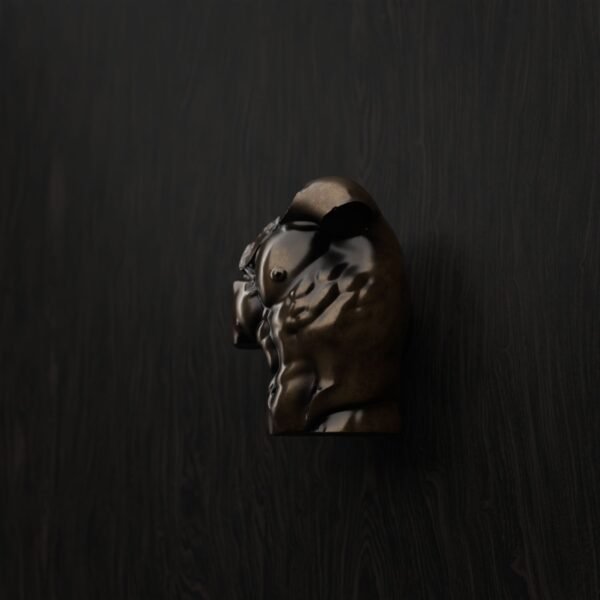
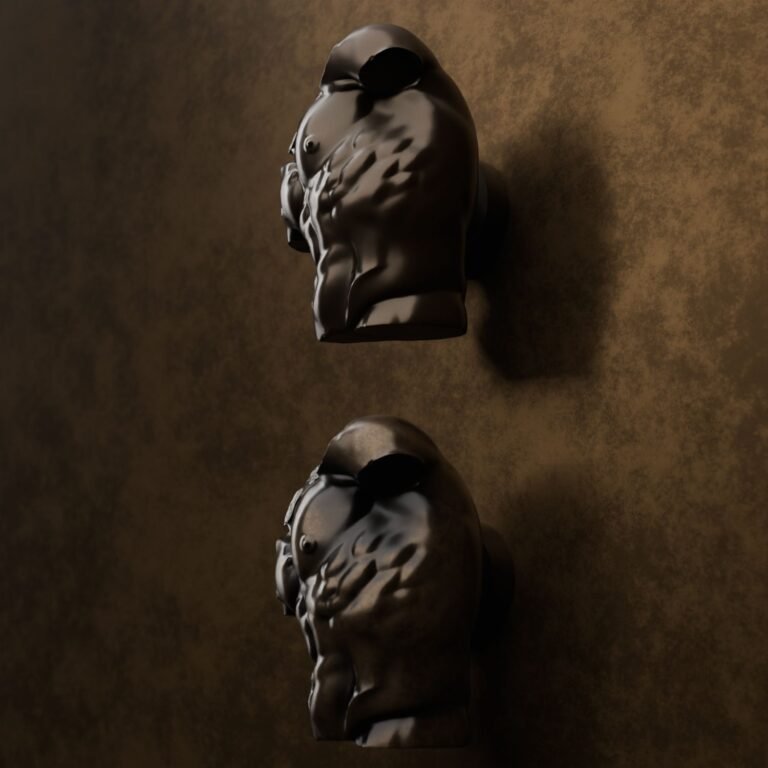
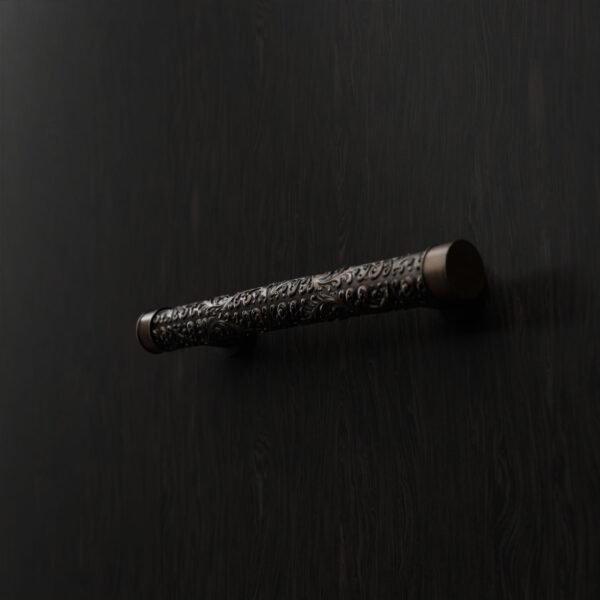
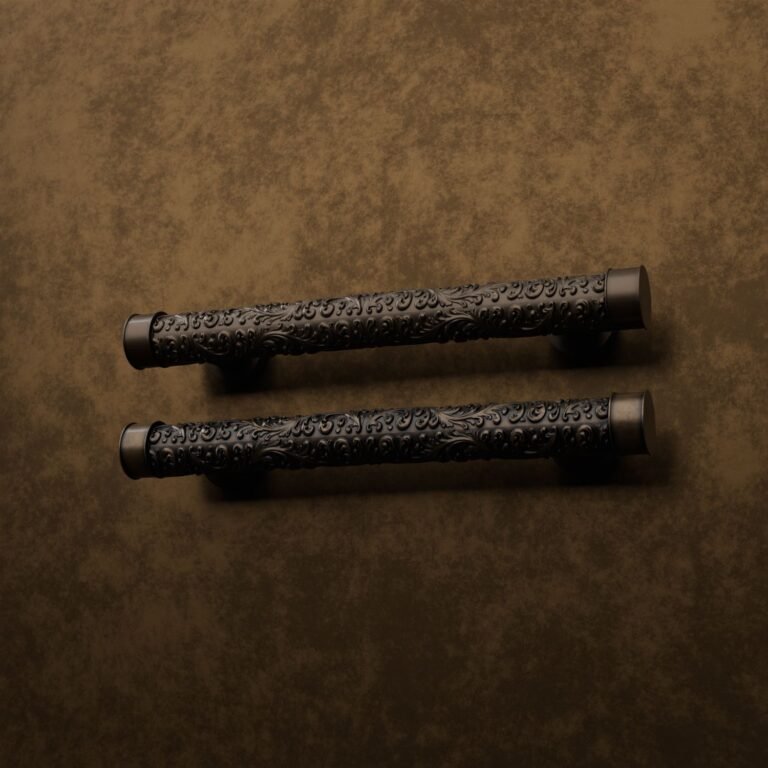
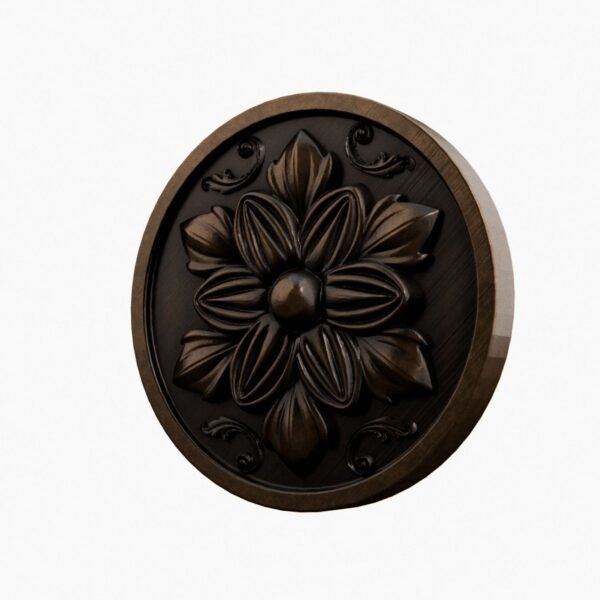
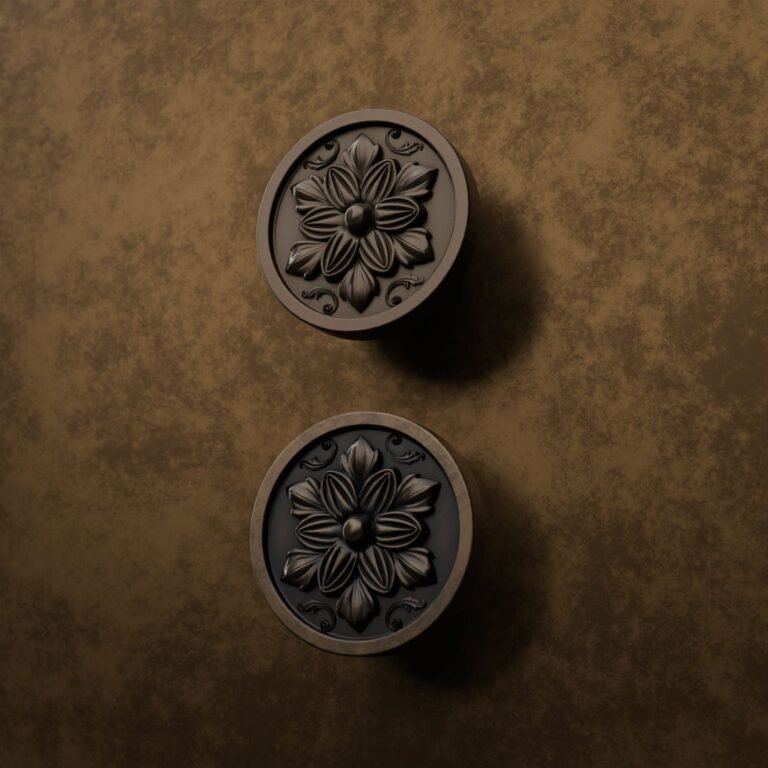
It’s that same hand, at bottom, that you find in our Paris workshop when we patinate the antique bronze that dresses some of our handles. Nothing there is left to chance, and nothing pretends to imitate an object pulled from a tomb: we accept, on the contrary, that this patina is made, gesture after gesture, exactly as Florentine founders accepted theirs. Each piece, once cold cast in its mold, is sanded and then hand patinated, so the color settles deeper into the relief of the pattern and polishes naturally along the raised edges, the way decades of use would. The result isn’t trying to fool anyone about its age: it’s only trying to carry, from day one, the same brown and golden warmth that time would eventually have left behind, given the chance. On the scale of a door handle rather than a statue, it’s exactly the same bet a Florentine workshop was already making in the sixteenth century: manufacturing, with consistency and a bit of chemistry, the color you don’t have time to wait for.

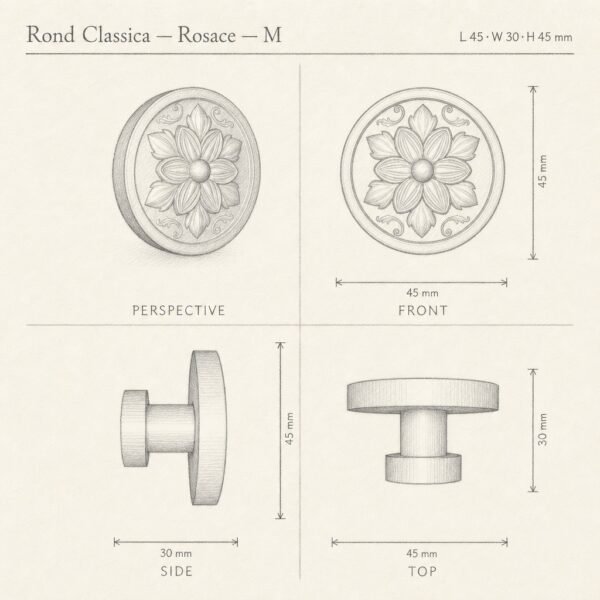
The same patina appears on other silhouettes in the catalog, on a scrollwork column as much as on a round rosette, each time darker in the recesses, more golden on the edges, never quite identical from one piece to the next, since no hand repeats exactly the same gesture twice. That’s probably the only honest promise you can make for a manufactured patina: not that it equals time, but that it resembles it closely enough that, very soon, you stop telling the difference.
Sources & further reading
- The Metropolitan Museum Journal, “Organic Patinas on Small Bronzes of the Italian Renaissance” (v.45, 2010).
- Giorgio Vasari, Vasari on Technique (trans. Louisa S. Maclehose, 1907), chapter on bronze casting and coloring.
- John Ruskin, The Seven Lamps of Architecture (1849), “The Lamp of Memory”.
- Institut national des métiers d’art, occupational profile “Patineur” (patina artist).
- Musée des Arts Décoratifs, Paris, History of Styles portal, Directoire/Consulat section.
- National Park Service, Statue of Liberty National Monument, “Statue of Liberty Facts”.