
Catalog · Patterns
All our patterns
The pattern is the ornament or sculpture that settles onto the geometry of the handle. The same knob, the same bar reads differently each time what’s inscribed on it changes: nothing, a scrollwork, a lion. The pattern isn’t the shape, it’s what transforms it.
Understand
One silhouette, ten expressions
In the Holdon catalog, the silhouette stays fixed: you choose your square, your round, your rectangle. The pattern is what changes, it’s the ornament or sculpture engraved on top, transforming the handle each time.
For anyone outfitting an entire piece of furniture, this is the simplest way to hold a cohesive visual set together while giving every piece its own singularity. Just the silhouette on the everyday drawers, a lion on the center door, scrollwork on the entryway dresser: the rhythm of an interior is composed this way, in alternation, never in accumulation.
Our catalog
Discover our patterns
Ornamental
Ornamental Patterns
Ornament as grammar: scrollwork, festoons, friezes. A decorative presence that engages with the furniture without imposing itself. Rendered mostly in low relief, so it lives with the material without overpowering the front.

Ornemental
A radiating carved flower: a central boss from which two crowns of petals unfurl, framed by four small acanthus scrolls. The rosette is one of the oldest ornaments in the Western repertoire, from the ceilings of ancient temples to Renaissance coffers, from the stone rose windows of cathedrals to the plaster rosettes that once held chandeliers. A radial, orderly motif with no top or bottom, one that falls right in any direction.
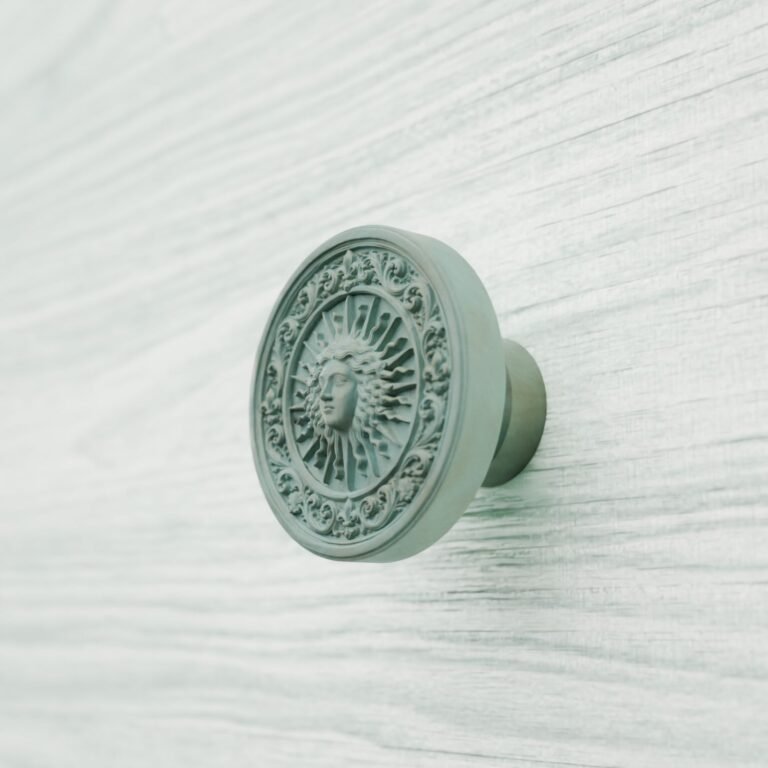
Ornemental
An Apollo face at the center of a burst of rays, some straight, some flame-cut. This is the emblem Louis XIV set on the gilded gates, pediments and paneling of Versailles, down to the sterns of his warships. On a door or drawer front, the pattern returns to its original role: holding the center, catching the light, ordering everything around it.
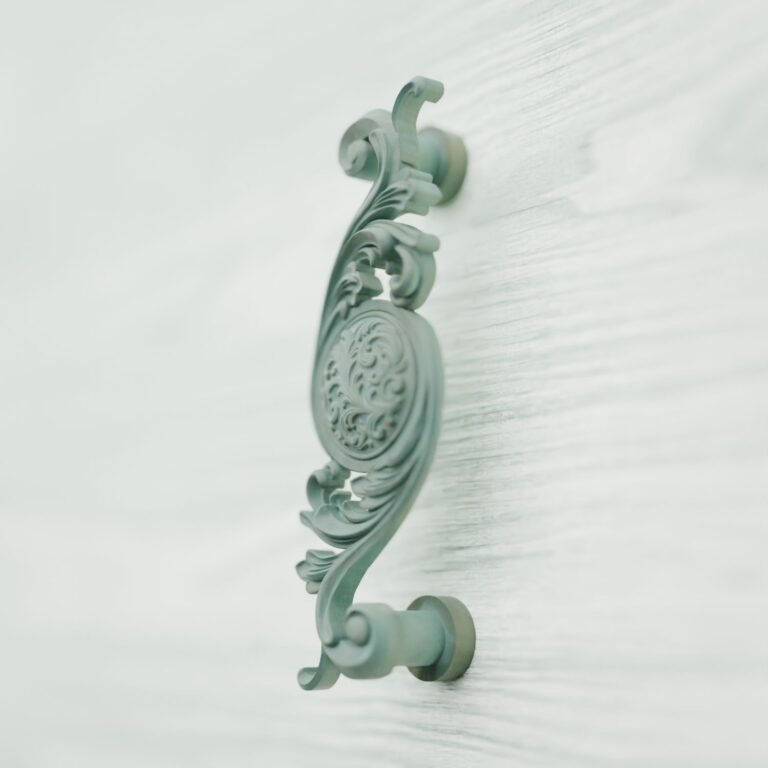
Ornemental
Acanthus leaves in scrolling volutes, curled and layered in a composition that brims with energy without ever losing its rigor. Scrollwork is the oldest motif in the Western ornamental vocabulary, found on Roman friezes, Versailles woodwork, Art Nouveau ironwork. Four centuries of presence in the world’s finest interiors, and it remains, remarkably, contemporary.
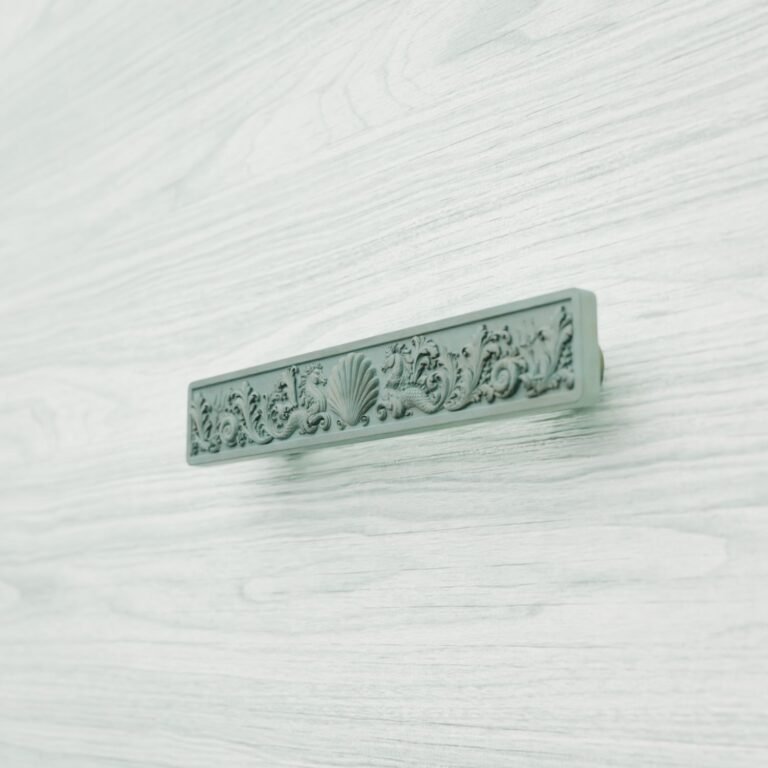
Ornemental
A scallop shell opened like a fan: deep ribs radiating from the hinge, resting on two scrolls. The seashell runs through the entire history of ornament, the pilgrim’s emblem on the road to Compostela, the crown of Renaissance niches, the seed of eighteenth-century rocaille. A crisp relief that reads at first glance and catches the light across the whole front.
Sculptural
Sculptural patterns
The sculpture as a deliberate choice: animal figures, masks, high reliefs. The handle becomes a character, a statement. Use sparingly, like a piece of jewelry for furniture: a centerpiece rather than a repetition.
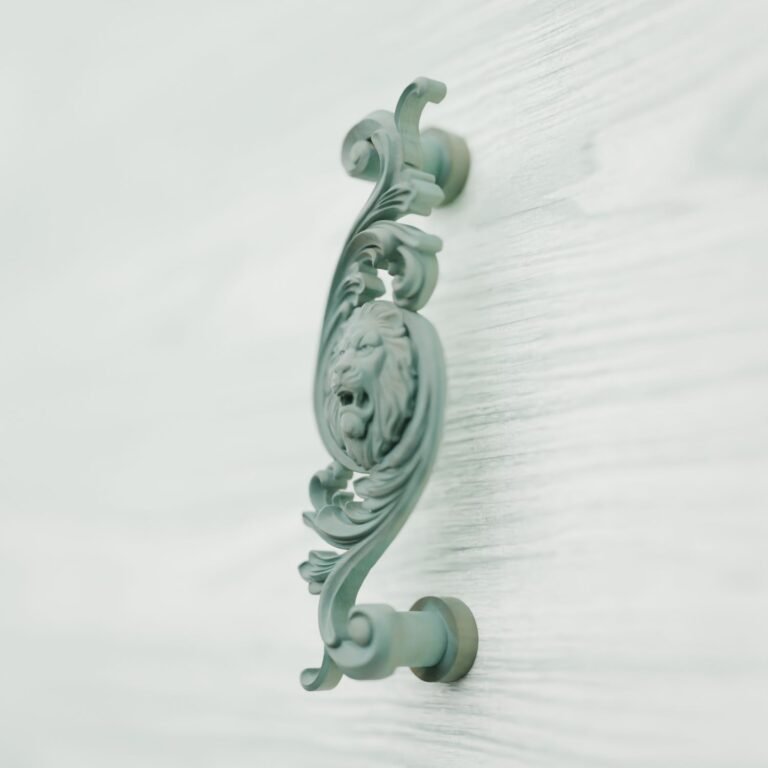
Sculptural
The lion roaring has long guarded thresholds: door knockers, fountain masks, heraldic figures, always where the eye lands first. On a piece of furniture, it takes up that same role with the same candor: open jaw, fixed gaze, living mane. The level of sculpted detail pushes the piece toward small sculpture, and the handle becomes a statement.
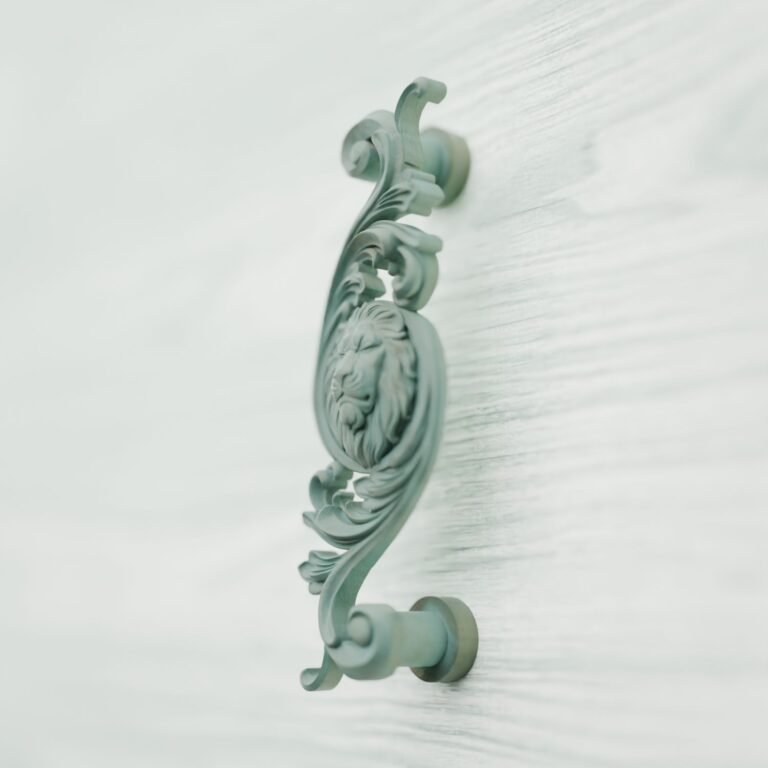
Sculptural
Eyes closed, mane at rest, an expression somewhere between serenity and quiet nobility. The Sleeping Lion is a strong sculptural motif, yet a composed one: an assertive presence without ostentation. For interiors that want character without provocation.
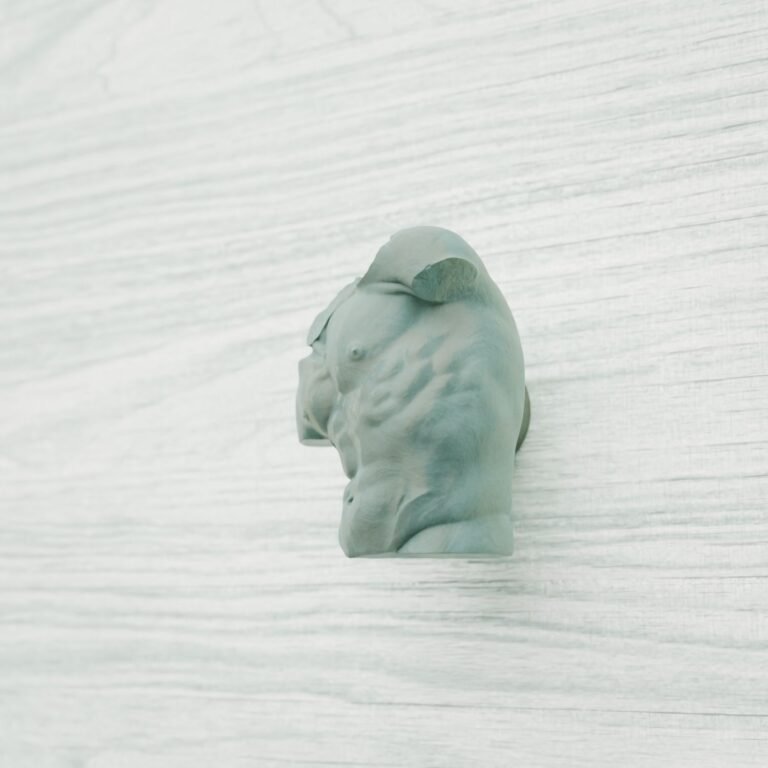
Sculptural
Here, ornament isn’t applied to a shape: the sculpture is the handle. A body captured like an antique fragment, brought down to the scale of the hand. The exceptional piece reserved for the front that deserves a second look, not the drawer that gets repeated.
Approfondir
Our essays on the history of ornament
Discover Cahiers d’Holdon, in-depth essays exploring the history of the patterns found on our handles and throughout the history of art.
Anatomy
What defines a pattern
The pattern is not the handle’s overall shape, it’s what sits above it: the ornament or sculpture carved into the material. Four markers structure our patterns.
The register
Clean, ornamental (scrollwork, festoons, friezes), or sculptural (animal figures, masks, reliefs). The register sets the handle’s expressive character from the outset.
The relief
Flat (engraved), in bas-relief (slight elevation), or in high relief (sculpted volumes). The relief determines the depth of shadow and the physical presence of the pattern on the front.
The reference
Every pattern conjures an imagined world: clean modernism, classical European ornament, Renaissance heritage, Art Deco geometry. Choosing a pattern also means choosing an era.
The repetition
A pattern can be placed once or repeated across the entire front. Holdon encourages alternation: Essential for the everyday, a bold pattern for the centerpiece; the rhythm builds, it never piles up.
The atelier · Holdon Paris
How is our catalog built?
At Holdon, every handle is designed as a piece of jewelry for furniture, born in our Paris atelier from a dialogue between three voices.
The material
The shape
A true shape, chosen the way one chooses a goldsmith’s line, taking form in a precise silhouette.
The collections
Each pattern belongs to a collection
A collection brings together a coherent set of patterns and finishes, built around a single vision: Classica Europa, Atelier, and so on. Choosing a collection means choosing the vocabulary your handles will speak.
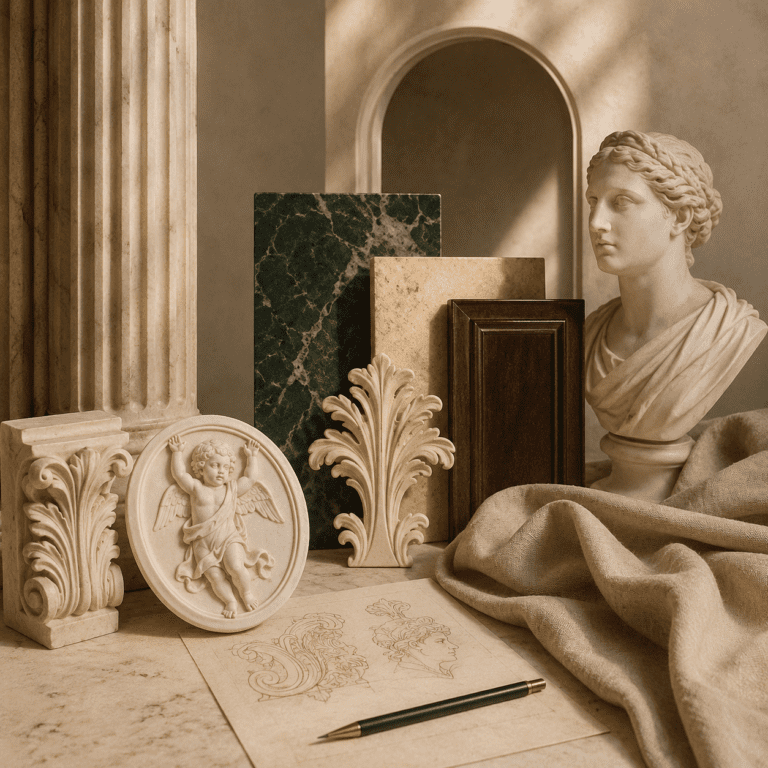
Classica Europa
From Florence to Vienna, from the Baroque to the Enlightenment: five centuries of European ornament distilled into a single collection. Scrollwork, mythological figures, generous curves and confident symmetries: the vocabulary of Europe’s grand houses, reinterpreted for furniture today. For interiors that aren’t afraid of character.
Choose with confidence
How to choose a pattern ?
Three angles to guide your choice: the register you’re after, the role you want the pattern to play, and the collection that ties it all together.
The register
Clean, ornamental (scrollwork, friezes, festoons), or sculptural (figures, masks, high reliefs). The register immediately sets the handle’s expressive character, understated, decorative, or theatrical.
The function
Repeat (a motif recurring across the whole piece), sign (a single motif on a central element), or accent (alternating between Essential and a bold motif). The role determines where the motif is placed within the piece.
The collection
Each collection groups a coherent vocabulary of patterns: same spirit, same stylistic register, same available finishes. Choosing a collection means choosing the universe in which the pattern will speak.
Explore differently
Three entry points into the catalog
Pattern is a first filter. You can also browse by silhouette, by themed collection, or by finish.
By collection
Each collection brings together several patterns sharing a common vocabulary of motifs and finishes.
By silhouette
Each pattern applies to one or more silhouettes, square, round, rectangle. The silhouette gives the geometry, the pattern the expression.
By finish
The same pattern reads differently in patinated bronze, satin copper, or colored lacquer. Finish is what brings the relief to life.
Frequently asked questions
Everything about our handle patterns
Find your handles
Understanding the pattern
What is a pattern on a Holdon handle?
The pattern is the ornament or carving applied to the handle’s front face, without changing its geometry. The same knob, the same bar, can take on different patterns: Essential (nothing, just the silhouette), Scrollwork (acanthus scrollwork in bas relief), Roaring Lion or Sleeping Lion (figures in high relief). The pattern thus transforms the handle’s look while keeping the same base shape. It’s the ornament that gives the piece its character.
Motif, silhouette, and shape
What difference between a pattern, a silhouette, and a shape?
The shape is the broad category: square, round, rectangle, cylinder. The silhouette is a precise variation within a shape, like the Palazzo Square or the Classica Round, with its own proportions and character. The pattern, in turn, sits over the silhouette: it’s the ornament or sculpting that makes each handle different, without touching the geometry. The same pattern can dress several silhouettes this way, each keeping its own underlying line.
Choosing your pattern
How to choose a handle pattern for your furniture?
The pattern is chosen based on how much presence you want the front to have. An Essential fades into the background and lets the silhouette speak, an ornamental pattern like Scrollwork adds a quiet detail, a sculptural figure like a lion becomes a true focal point. Look at the piece and its setting: on an already busy ensemble, a calm pattern holds its own, on a understated piece, the pattern can carry more relief. There’s no wrong choice, only the intensity you’re after.
Composing multiple patterns
How to Combine Multiple Patterns on the Same Piece of Furniture
Alternating is ideal. An Essential on the everyday drawers, a sculptural pattern on the center door, Scrollwork on the entryway dresser: each piece then tells its own story. On a single silhouette, the same knob repeated a dozen times would quickly feel monotonous; varying the patterns lets the whole ensemble breathe. Keep one common thread, the material and finish, so the front stays coherent despite the variety of ornament.
Motif and silhouette compatible
Does a pattern go on every silhouette?
Not always. Some ornamental and sculptural patterns need enough front surface to register visually: a Roaring Lion on the smallest size of the slimmest silhouette ends up illegible. Subtler patterns, on the other hand, adapt to nearly every silhouette and size. Each pattern's and silhouette's page shows the combinations that are actually available.
Delivery, Customs, Payment, and Support
How Long Will It Take to Receive My Handles?
Each handle is made to order in our Paris atelier. Allow an average of 5 to 10 business days for production, plus the carrier's delivery time, which varies by address. You'll receive an email with the tracking number as soon as the shipping label is issued, generally between the 5th and 10th business day after your order.
Are Your Payment Methods Secure? What Payment Options Do You Offer?
We accept all major credit cards (Visa, Mastercard, American Express) via Stripe, as well as PayPal. Transactions run through these two international references in online payment: Holdon Paris never sees and never stores your card number, all sensitive data is transmitted encrypted to the platform. The site runs entirely on HTTPS. For large professional orders, bank transfer with a deposit is possible (see architects and professionals).
Can I Return My Order if I Don't Like It?
Yes. French law gives you 14 days from receipt to exercise your right of withdrawal, with no need to justify it. The handles must be returned in their original condition, uninstalled, and return shipping is at your expense unless the error is ours: the refund is issued within 14 days of receipt at our workshop. To start a return, write to us via contact Holdon Paris: we'll send you the address and the process. Custom and personalized pieces are not eligible for the right of withdrawal, since they are made specifically for you.
Selection tool for handles
A quick tool that asks a few questions to help you quickly find the handles you need and that match your taste.