Which Cabinet Handles for an Industrial Style Interior
Industrial style wasn’t born in decorating. It was born from a fact, in New York, in the nineteen fifties. Artists began moving into former manufacturing warehouses in the SoHo neighborhood, abandoned by industry that had relocated farther out. The structure was already there: poured concrete floors, riveted steel beams, exposed ceiling ducts, factory windows with small panes. They didn’t decorate these spaces. They just stopped hiding them.
Seventy years later, the movement has made its way through Western interiors. Its vocabulary has entered the everyday repertoire: exposed brick, black metal, raw wood, filament bulbs, repurposed workshop furniture. It has become a genre, with its own codes, its excesses, and its pitfalls. The first of these pitfalls, and the most stubborn, is believing that an industrial interior is recognized by an absence of detail. Yet original lofts are full of it. A rivet, a forged hinge, an exposed hex bolt: these are details. They’re just structural details, the kind that show how the thing holds together. The grammar of the style doesn’t reject ornament, it rejects ornament that serves no purpose.
Hence the question, when it comes to fitting out a piece of furniture: which handle speaks that language? Not the invisible knob, which denies its own function, nor the rosette of an antique sideboard, which falls outside the register. Something in between, that reads like a worked piece of metal, that occupies its function without apologizing, and that adds a presence without asking permission.
The Palette Begins With Cold Metal
Industrial style speaks two languages. The cold one, which dominates: matte black, concrete gray, brushed steel, satin aluminum. Everything that recalls a foundry, a framework, a dry workshop. The surfaces reflect little, catch the light without bouncing it back, and let the marks of fabrication show through.
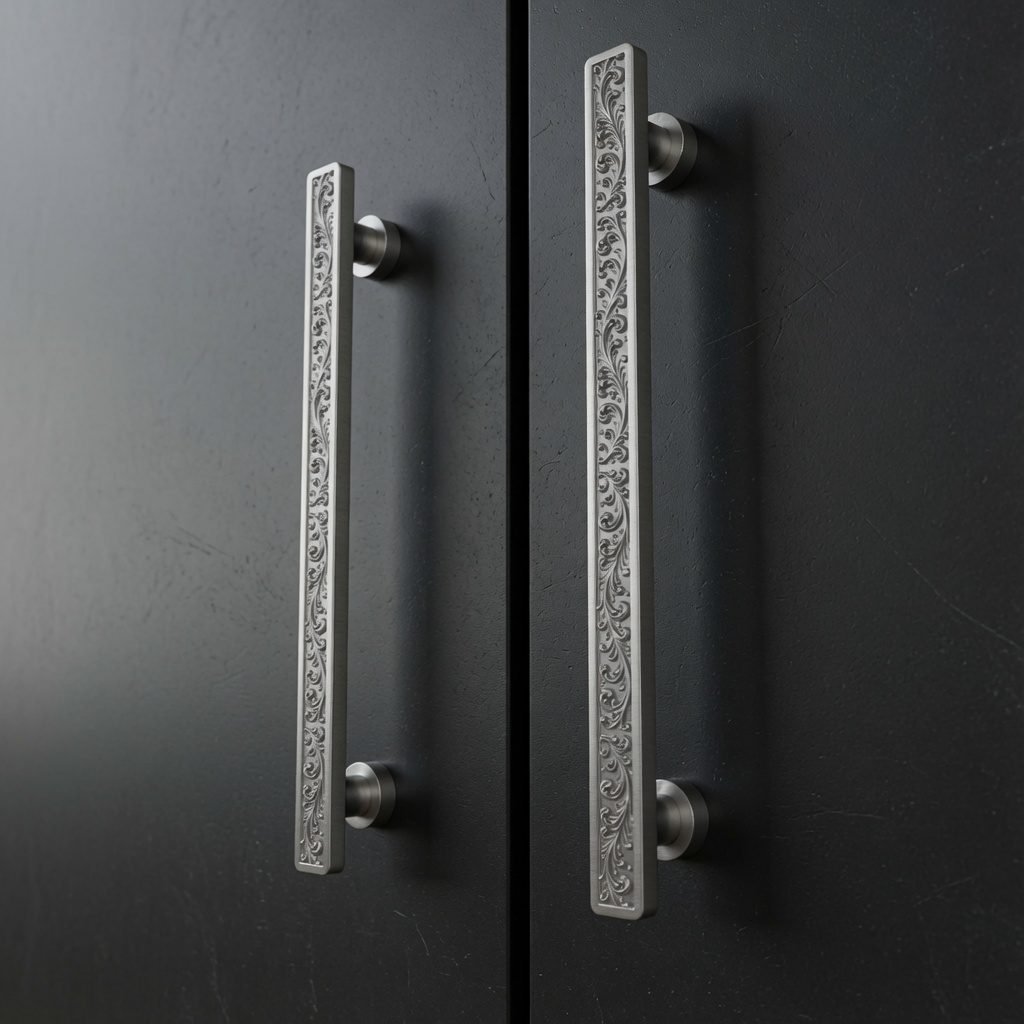
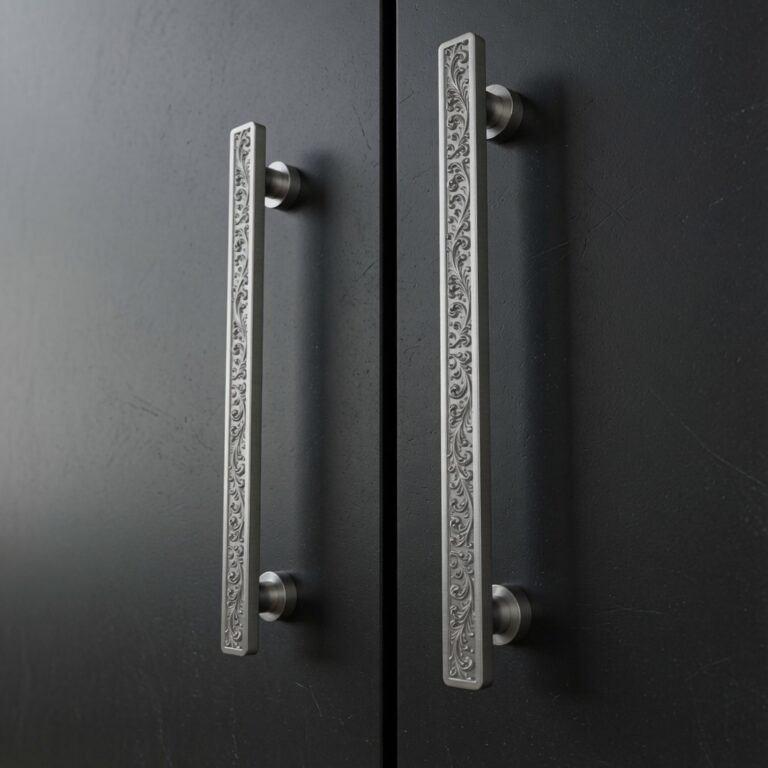
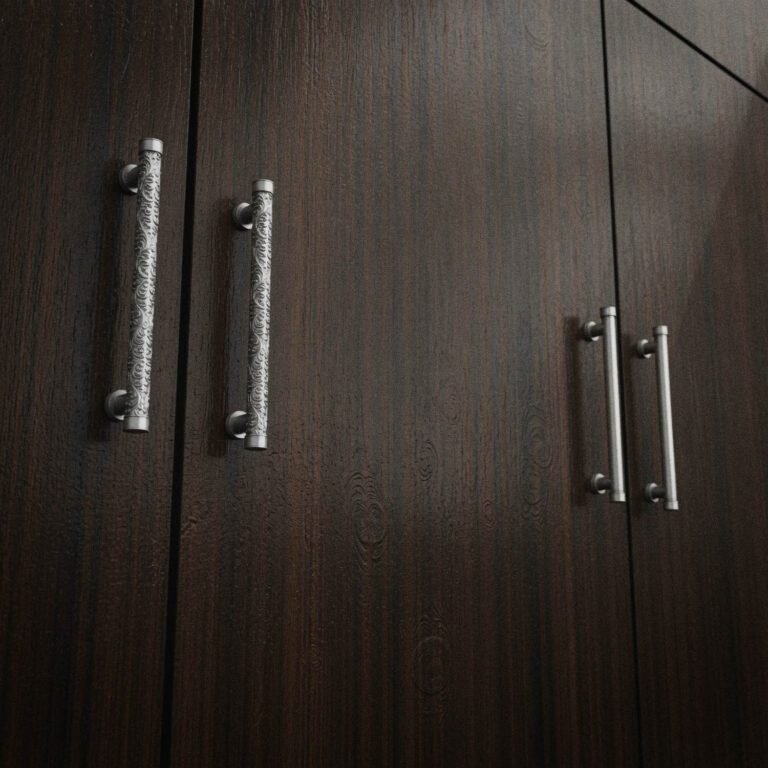
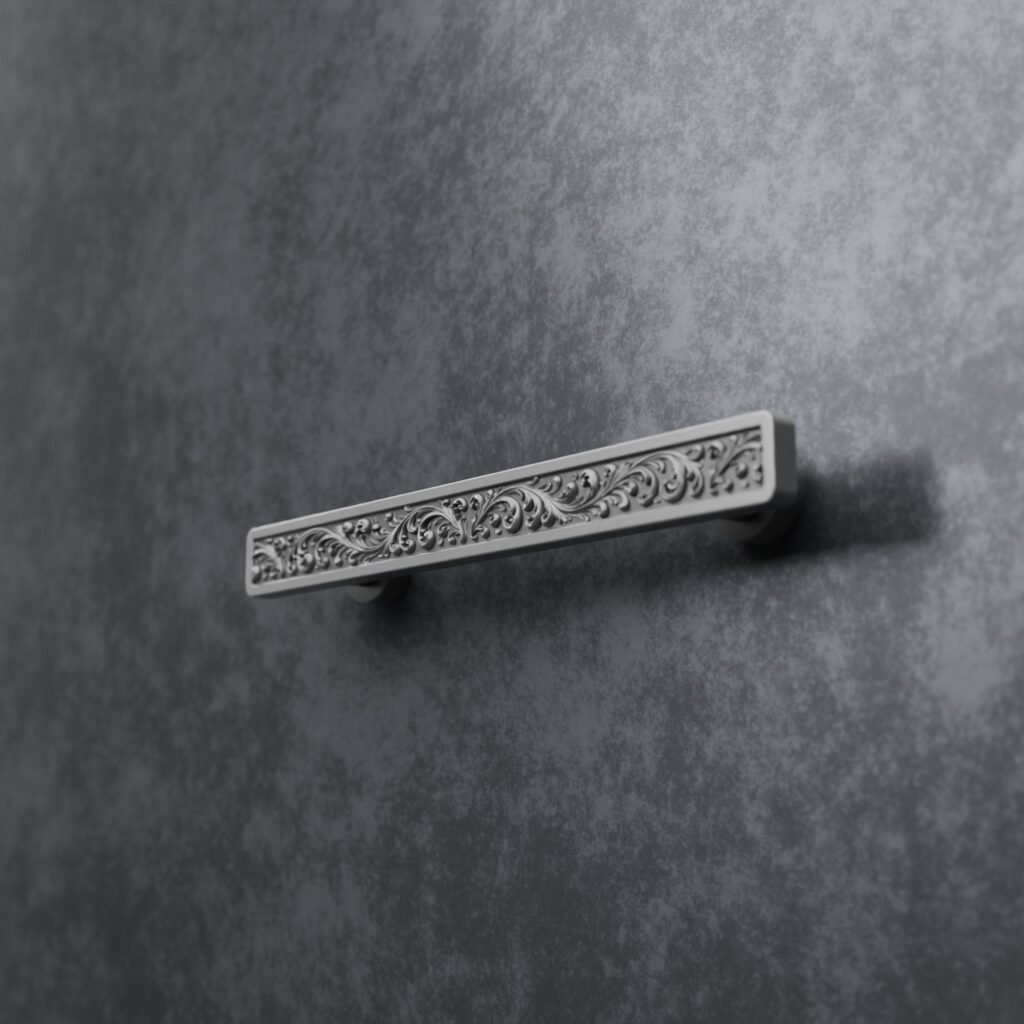
Satin aluminum settles naturally into this palette. Its surface diffuses light evenly and softly, neither mirror nor pure matte, in an in-between territory that product photography struggles to capture and that you understand by touching the piece. Set against an anthracite front, it catches a thread of silvery light along the bar, and fades where the material turns to texture. In terms of use, it’s one of our most versatile finishes: it holds up to impact, indoor humidity, and heat, so nothing stands in the way of installing it in a kitchen, a bathroom, or a low living room cabinet.
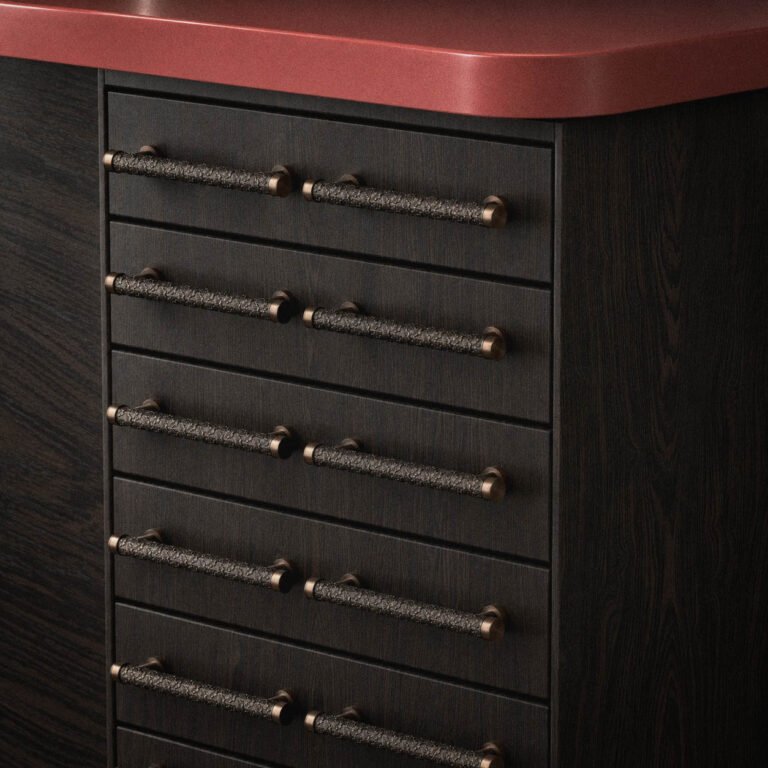
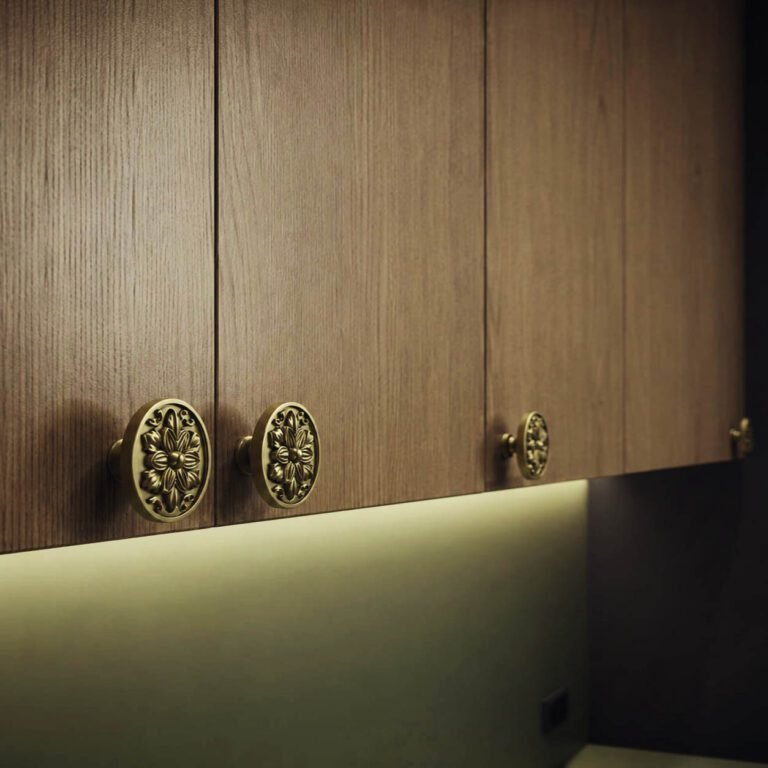
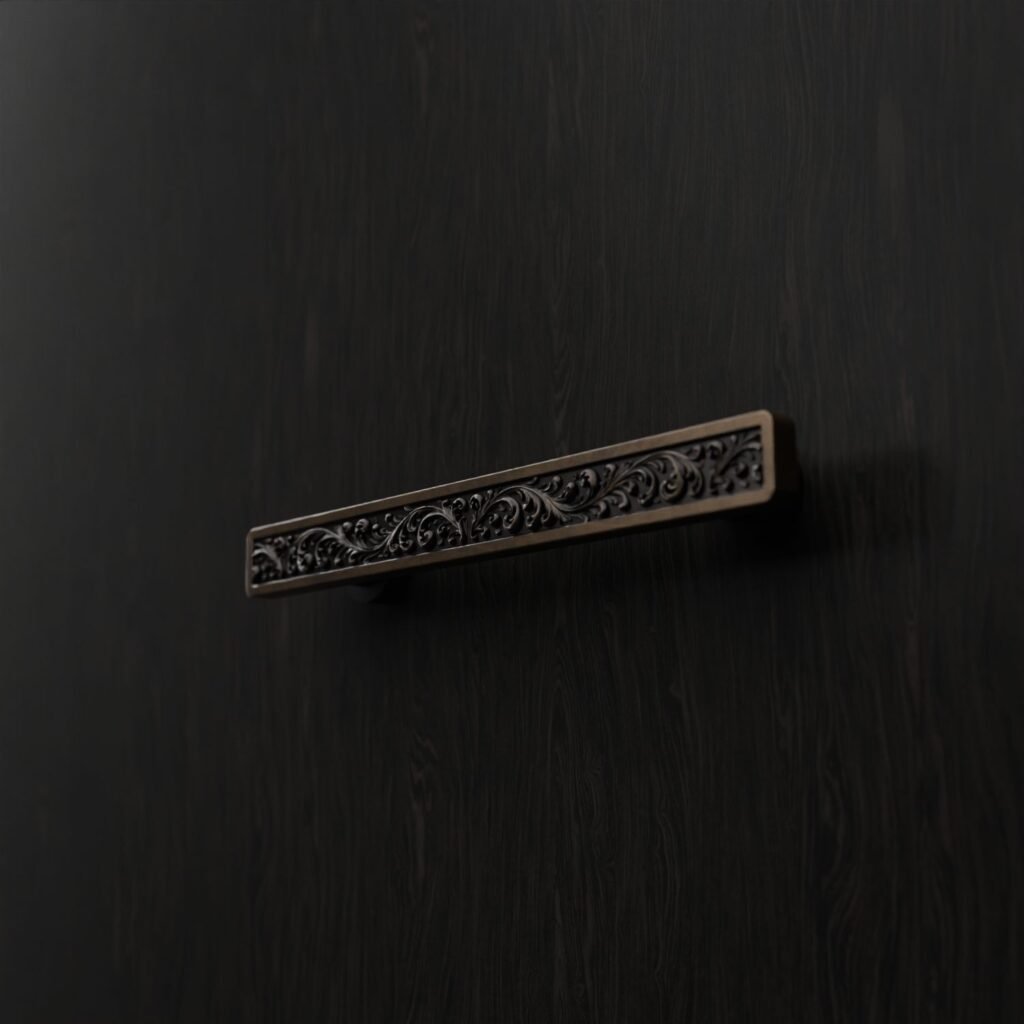
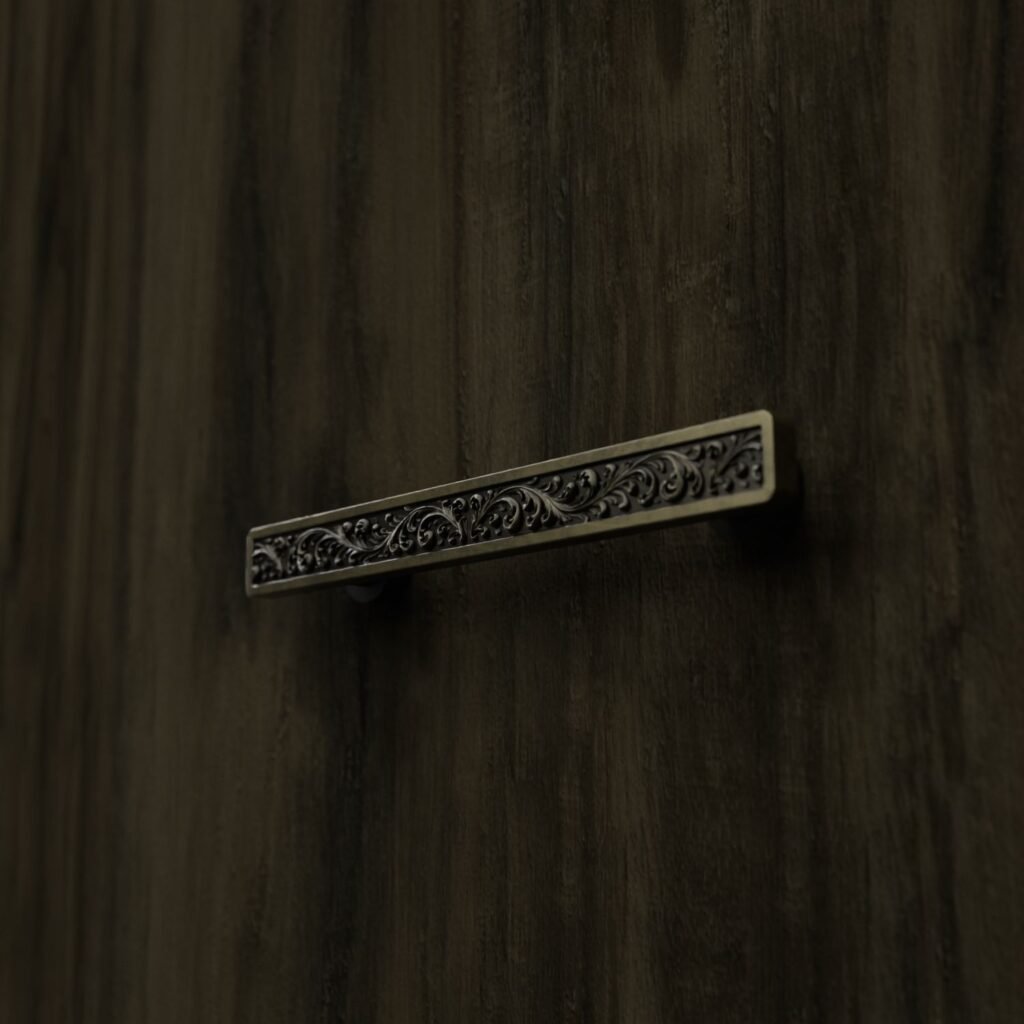
The other language, rarer and warmer, is that of the loft at the end of a renovation, where the red brick was left unpainted, where the old parquet was sanded without being stained, where copper piping was left exposed along the ceiling. There, antique bronze and antique brass take over. Patinas applied by hand in our atelier, tones settled into the relief, a surface that looks like it has always been there. These patinas come alive when the light is low, the wood dark, and industrial style warms up without denying its framework.
The Silhouette That Stands Up to Raw Materials
A matte black metal front forgives nothing. It doesn’t hide, it doesn’t flatter, it holds up whatever sits on it to its own rigor. A poorly proportioned handle shows immediately. That’s why the industrial client asks for architectural silhouettes rather than decorative curves. A straight line, a geometry that aligns with the front’s grid, a frame that speaks to the room’s other frames (factory window, steel shelving, raw wood batten).
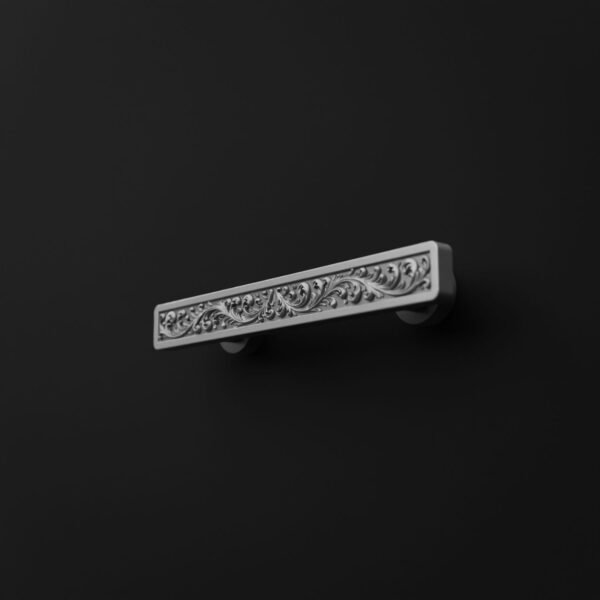
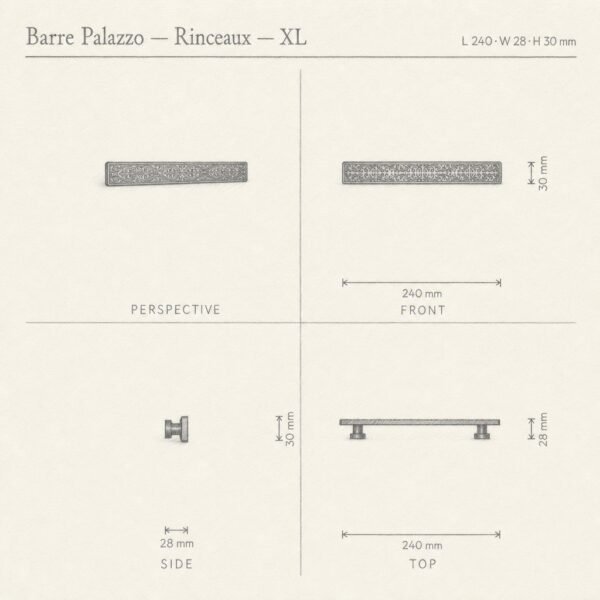
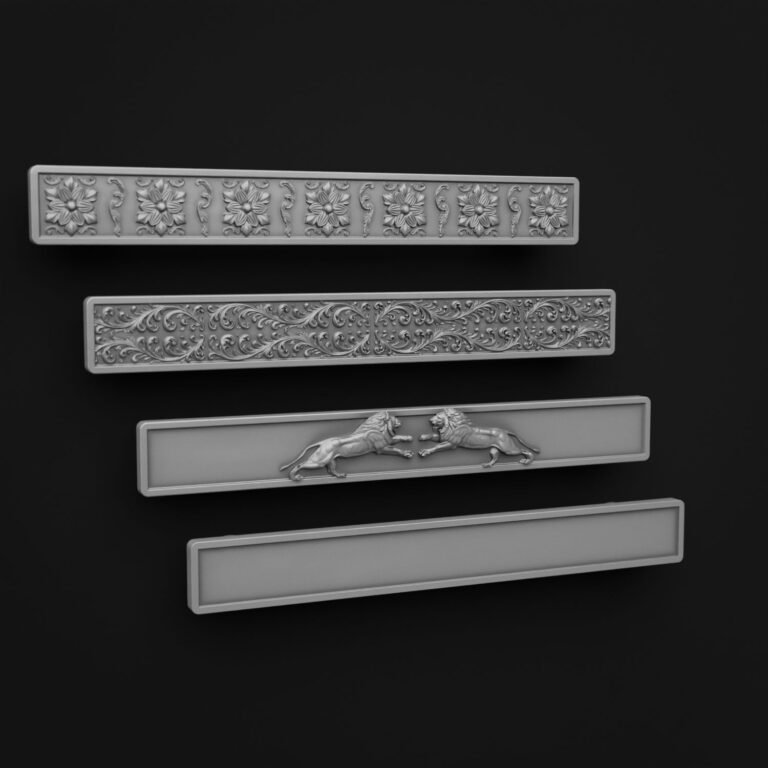
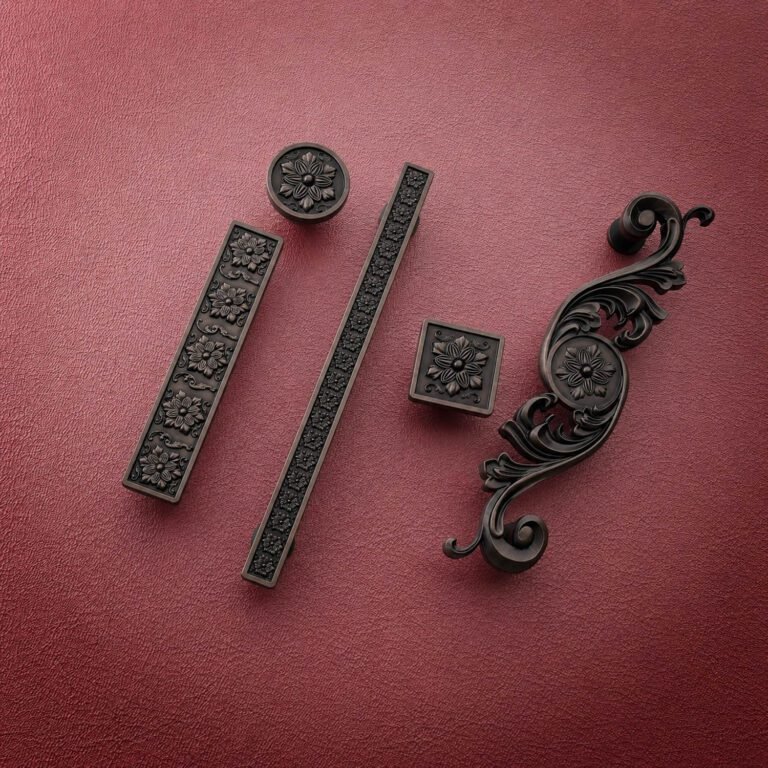
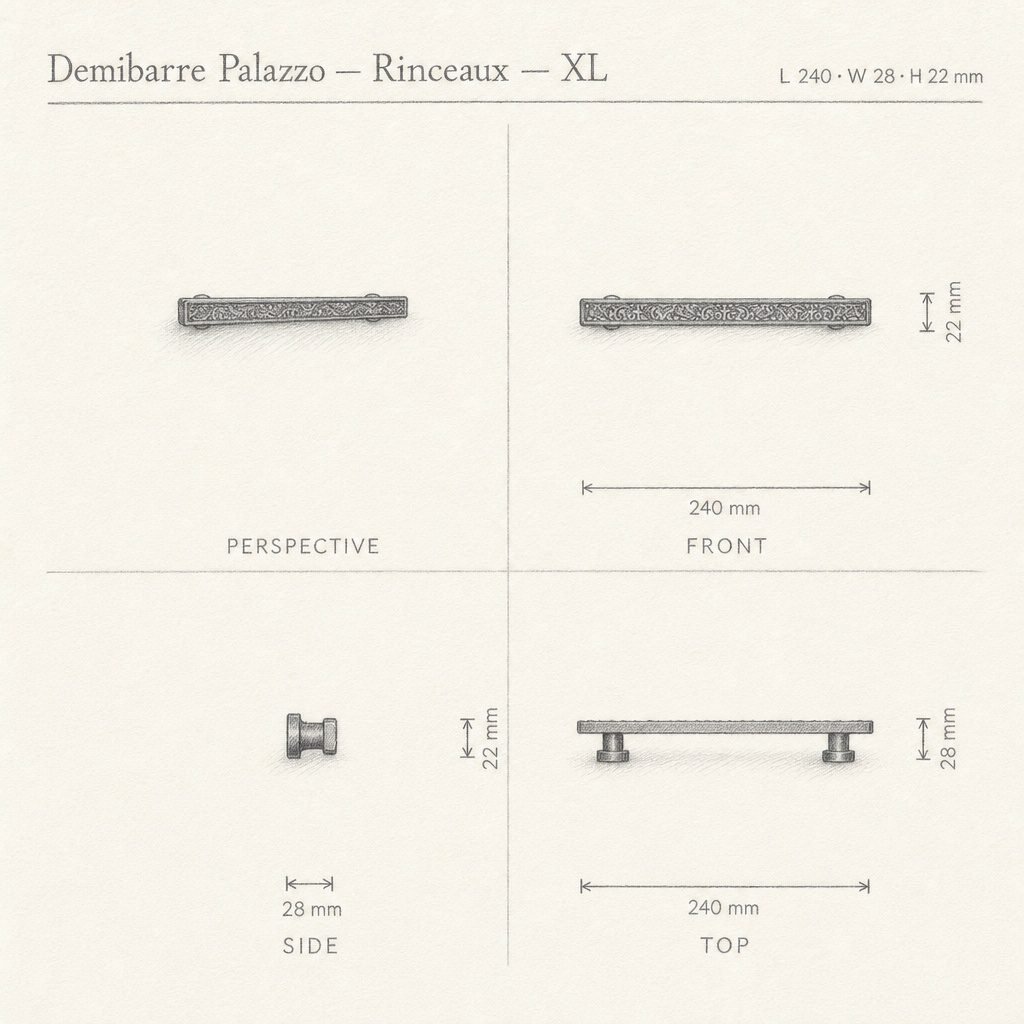
The Palazzo Slim Bar speaks this language. Its raised frame casts a crisp shadow along the edge, its slightly recessed face carves out depth without overloading the volume. You can read an architect’s cut here more than an ornamentalist’s line. Gathered on two attachment points, it carries the same signature as a solid bar, but on more modest formats: a drawer, a kitchen cabinet door, a row of narrow fronts to give rhythm without overwhelming them.
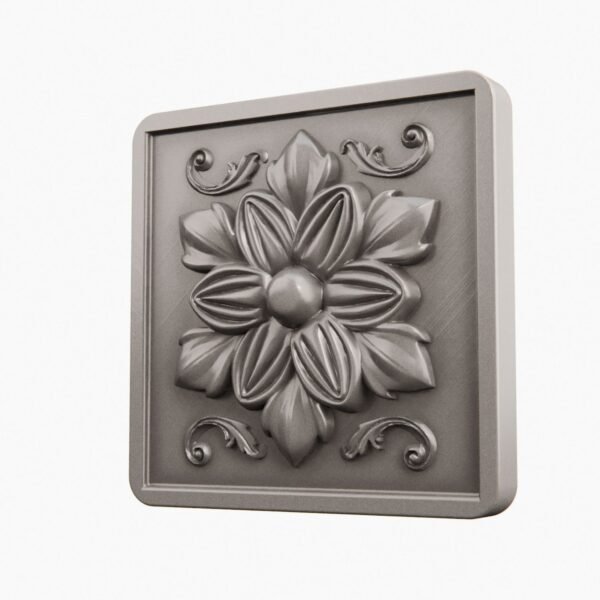
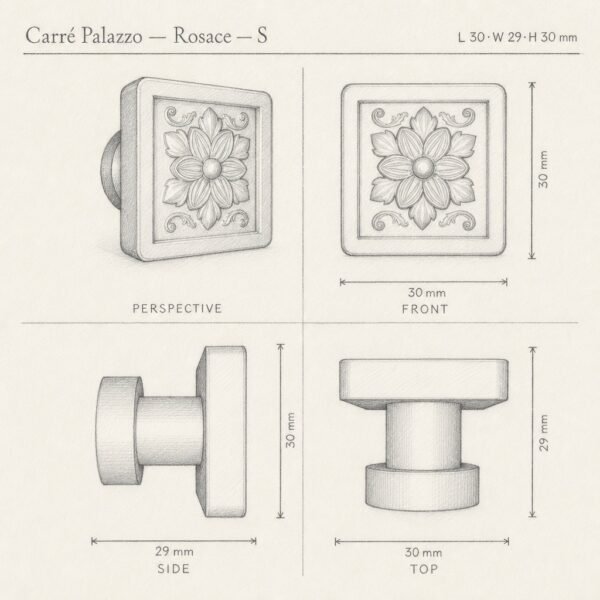
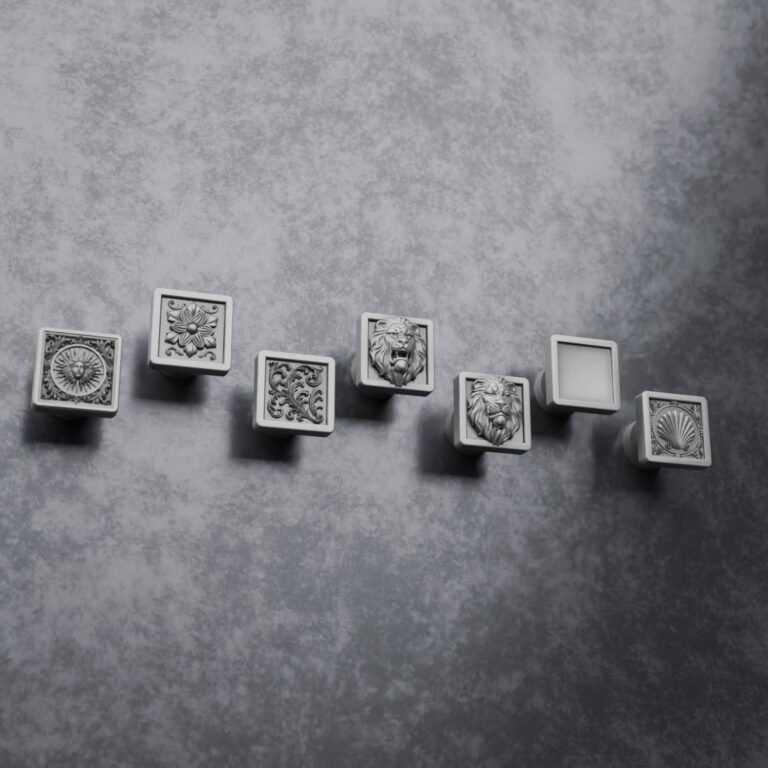
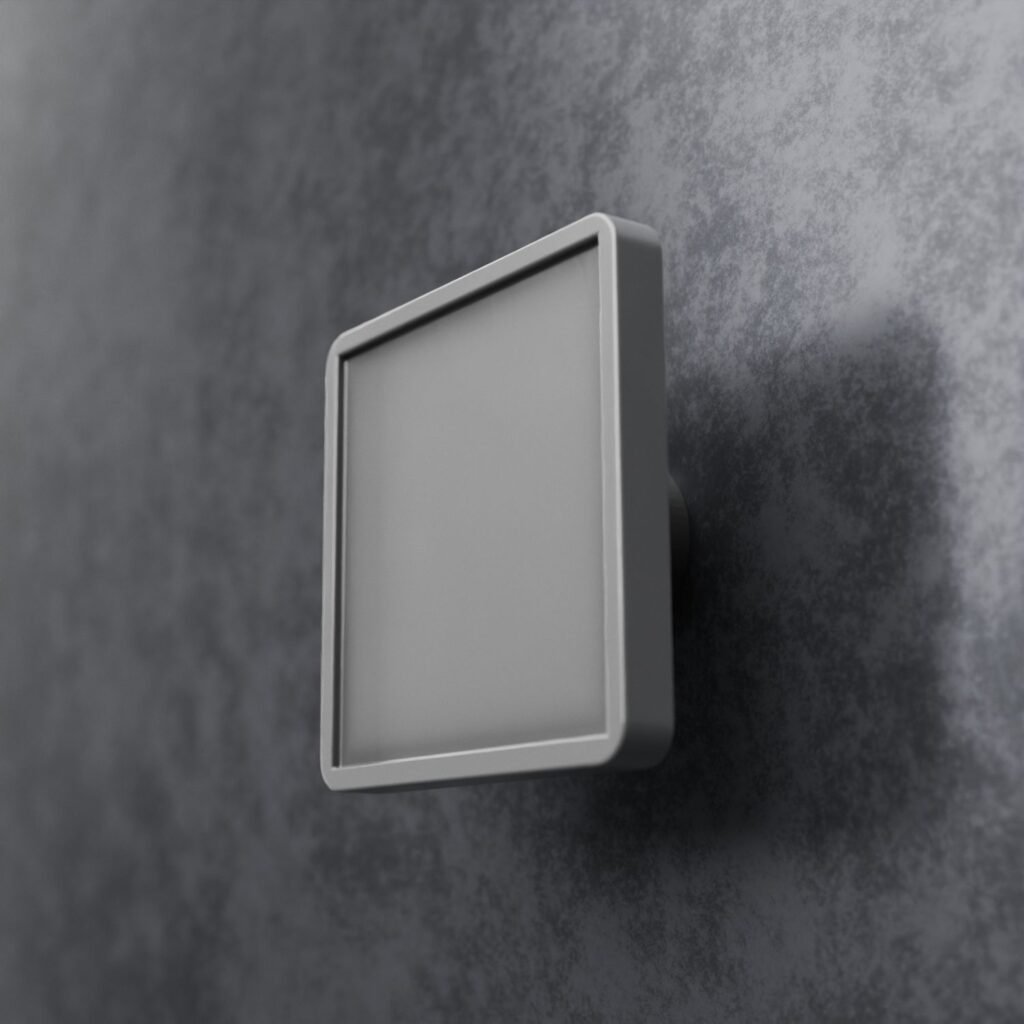
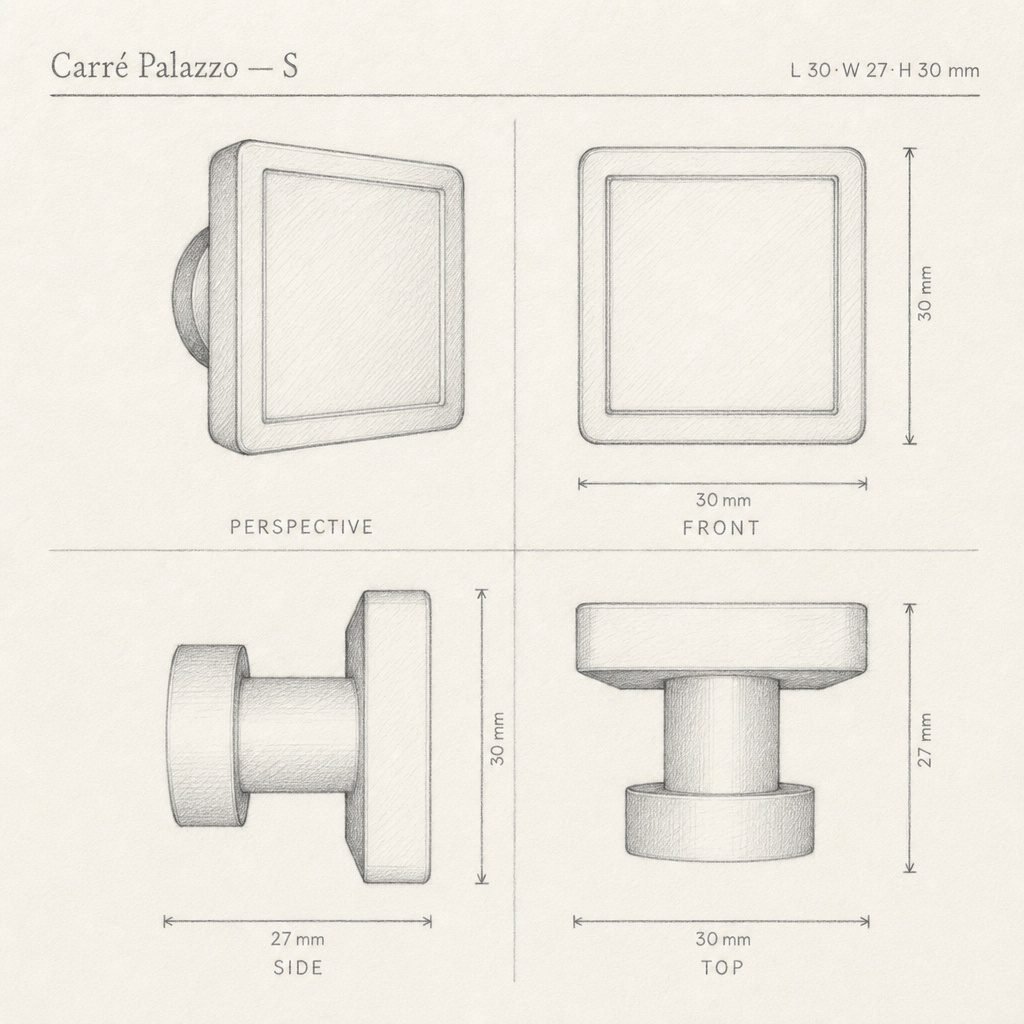
The Palazzo Square takes up the same vocabulary at knob scale, for small doors and drawers that call for a single attachment point. Same softened angles, same raised frame, same recessed face. Square geometry holds its ground better than a round shape in this register: it aligns with the axis of the front, it keeps an orientation, it never floats.
The pattern that becomes texture
There remains the question of pattern. Asked too head-on, it discourages: industrial and ornament seem to stand in opposition. Except that at close range, certain patterns don’t read as patterns at all. They read as texture, as metal that has been worked with a chisel.
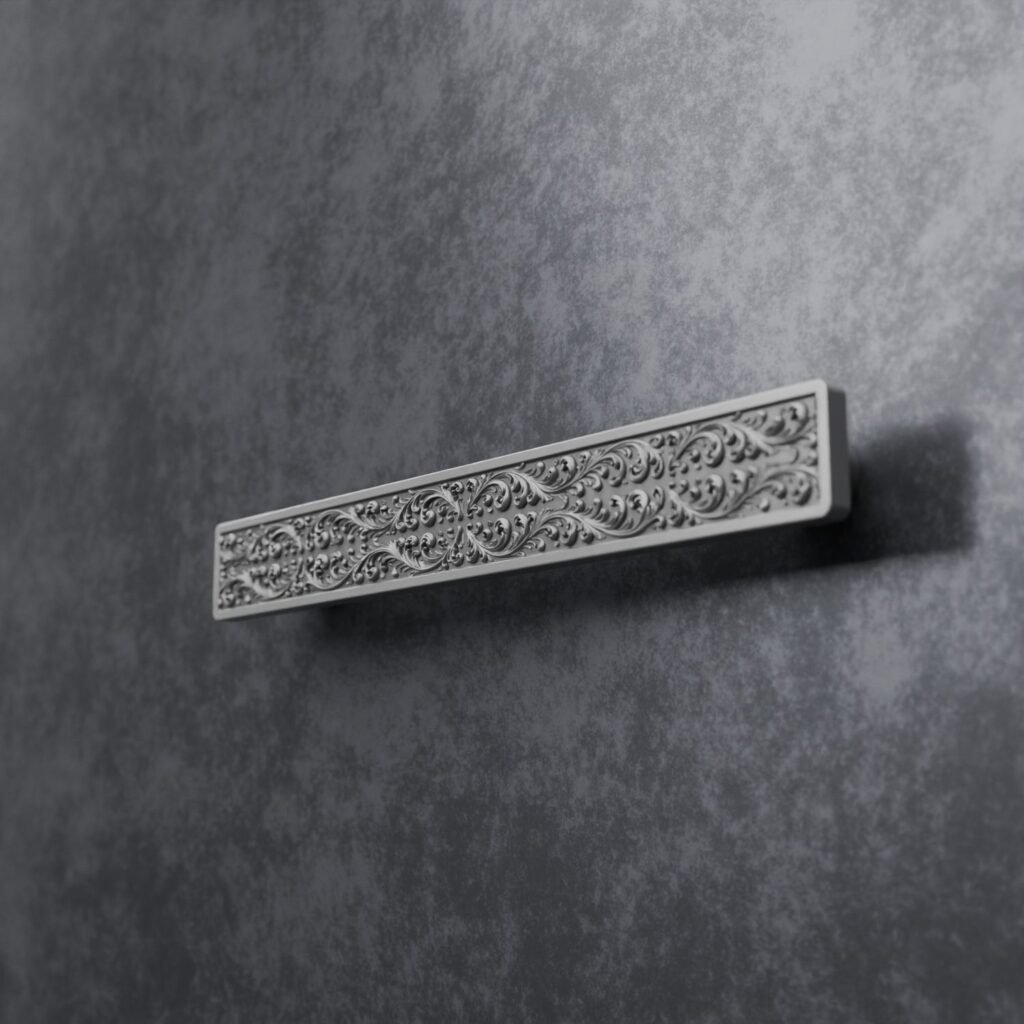
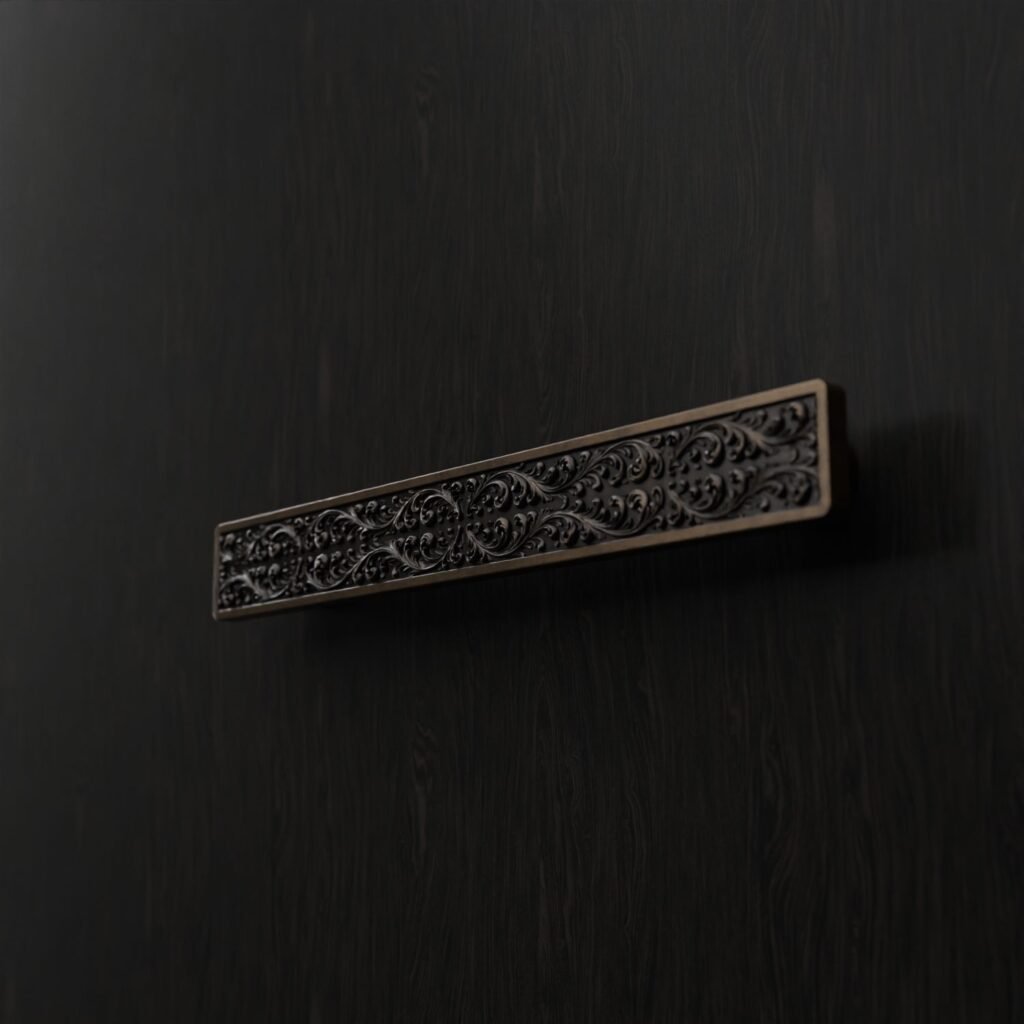
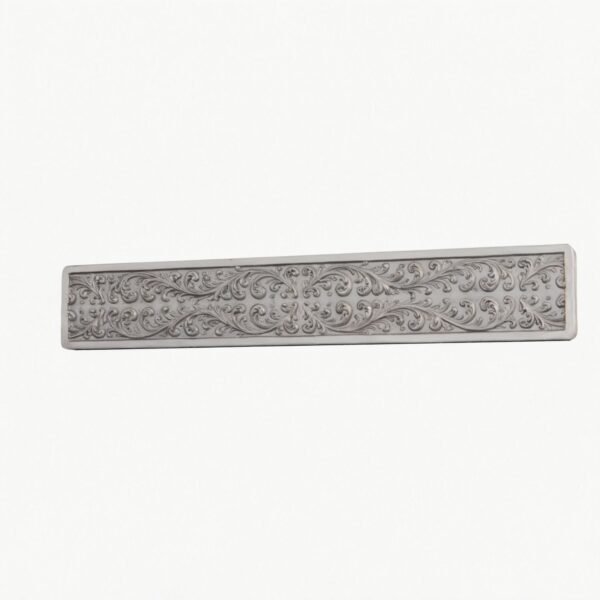
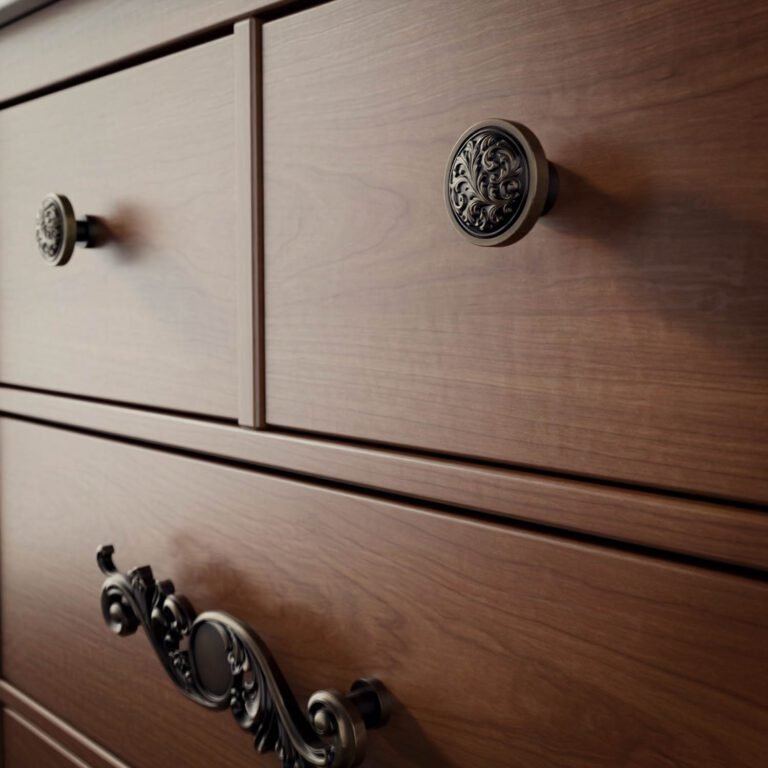
That’s what happens with a Scrollwork engraving on a slim bar. Seen up close, you recognize the sequence of acanthus leaves in tight scrolls, the oldest ornamental grammar in the Western repertoire, the one found in Roman friezes and Art Nouveau woodwork. Seen from three feet away, that is, at the distance where the eye registers a fitted piece of furniture, the pattern no longer stands out. It becomes a dense, irregular surface, almost hammered. Twenty centuries of ornament turned into a grain of material. Scrollwork earns this rare double reading: ornament up close, texture from afar, and the industrial core stays coherent at the right distance.
For quieter furniture, where the silhouette should speak on its own, the Essential pattern does without a figure. The handle plays its part as a sober piece, the finish does the rest, and the eye moves on elsewhere.
Fastening: the only measurement to take before buying
Industrial style lends itself well to a targeted refresh of an existing kitchen or an already assembled closet, provided the new handles fit the holes already drilled. On furniture fitted with IKEA, Plum, or Superfront doors, the fronts are pre-drilled to the 32 mm standard known as “system 32,” which accommodates common center-to-center spacings. A bar mounts on two points at a fixed distance: 96, 128, 160, or 192 millimeters. That’s what’s called the center-to-center (c/c), and it’s the only measurement to take before ordering.
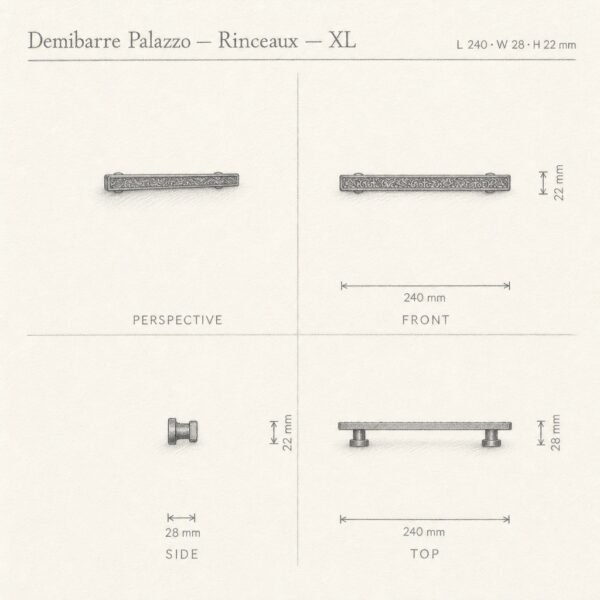
If you’re fitting out new furniture, choosing the center-to-center opens up a range of sizes. The same Palazzo Slim Bar comes in S (15 cm), M (18 cm), L (21 cm), and XL (24 cm). The wider the front, the more the bar can stretch without throwing off the composition. For a knob, the measurement is simpler: one point, one hole, one drill bit, and you choose the size that suits the surface.
For a related read, you can revisit our Chronicle on design handles for an IKEA kitchen, which details material and center-to-center pairings, or the one on dresser handles to carry the idea into the bedroom.
A few frequently asked questions
Which Holdon finish works best for an industrial interior?
Satin aluminum is the finish most aligned with the cool palette of industrial style. Its surface diffuses light without mirror shine or flat matte, and installs without dissonance on anthracite or matte black fronts. For a warmer industrial loft, antique bronze and antique brass take over on dark wood and exposed brick.
Does satin aluminum hold up in a kitchen or bathroom?
Yes. Satin aluminum is one of our most versatile finishes in terms of use: it holds up to impact, indoor humidity, and heat. It installs without reservation in a kitchen, a bathroom, or on a living room piece.
Which center-to-center spacing should you choose for IKEA or Plum fronts?
IKEA, Plum, and Superfront fronts are pre-drilled to the 32 mm standard, which accommodates the most common center-to-center spacings. Our pulls come in 96, 128, 160, and 192 millimeters. The only measurement to take is the distance between two existing holes, center to center.
Is a pattern like Scrollwork compatible with industrial style?
Yes, as long as you look at it from the right distance. Up close, scrollwork reads as a piece of woodwork ornament. At the usual distance of use, around a yard away, it becomes a dense surface that recalls metal worked with a chisel. The visual coherence with raw materials holds without effort.
In conclusion
Industrial style isn’t won by stacking workshop references. It’s won by choosing, in every detail, what reads as a structural piece and what reads as an addition. The handle belongs to the first category. It’s made to be gripped dozens of times a day, so it should look like what it is: a piece of worked metal that holds the door.
At Holdon Paris, we make catalog handles in Paris, ready to ship in 5 to 10 days. Satin aluminum, antique bronze, antique brass, and several finish ranges applied to silhouettes designed like architectural drawings. The simplest way to start a project is still to see the whole collection, then filter by finish, silhouette, or center-to-center spacing.