Statuary, or the Art of the Body Left Unrepaired
A torso has no face. Of all sculptures, it is the only one that has never needed a gaze to exist: neither its own, which is missing, nor the one lent to it in restoration. In the storerooms of Western art, a few dozen of these headless, limbless bodies hold a place apart, not as accidents tolerated while awaiting something better, but as works completed in their very mutilation. This essay follows that curious path: how a fragment, born of an accident of stone or of time, came to form a genre in its own right, sturdy enough to lend its name, today, to an object held in the hand.
There is something counterintuitive about preferring the less than complete. A headless statue should, by all logic, be worth less than a whole one: it shows less, it tells less, it raises more questions than it answers. And yet, from the Renaissance to today, it is often the fragments that have fascinated most, sometimes more than the intact works displayed in the very same room. This paradox is worth dwelling on before we follow it across the centuries.

The body left unrepaired
Most ancient sculptures reach us incomplete, and that is hardly an accident of chance. Great bronze figures were melted down by the thousand to recover their metal, in late antiquity as in every lean century since; marbles, for their part, ended up in the lime kiln just as often as in a museum, ground to powder to make mortar. What survived owes much to accident: a collapse that buries rather than destroys, a buried villa, a garden where a fallen statue lies half buried for fifteen centuries, protected by the very earth that maims it. The archaeology of the fragment thus begins before any artistic intention: it is first a statistic of survival, the little that remains of a very great number.
The most famous of these survivors bears a garden’s name: the Belvedere Torso, named for the courtyard of the Vatican where it was installed in the 16th century. It is a marble figure 1.59 meters tall, the seated bust of a man, muscles taut, head missing, arms broken off at the shoulders. Carved into its base is the signature of a certain Apollonios, otherwise unknown to history. We know it was found in Rome at the end of the 15th century and entered the papal collections between 1530 and 1536: more than a century, then, separates its discovery from its official installation, a century during which the stone had clearly already won admirers. The most widely held hypothesis today is that it represents Ajax, contemplating suicide after losing the arms of Achilles, his head bent toward the hand holding the sword: a plausible reading, never certain, as is often the case with a body that can no longer tell its own story.
What strikes us, in the case of the Belvedere as in so many other ancient torsos, is not so much the mutilation as the early refusal to correct it. Other marbles that arrived incomplete during the Renaissance were given arms, heads, and legs of fresh marble, sometimes signed by a contemporary sculptor proud of his seamless addition. The Belvedere, however, was never completed. It passed through five centuries without anyone seeking to restore what time had taken, as if the integrity of the object mattered less than the integrity of the gesture that still constitutes it: a rib cage that breathes, a back that twists, a belly that carries the full weight of a thought we will never read on a face.
The school no one retouches
The shift happens when this refusal to complete becomes, for artists themselves, a lesson. Michelangelo returned to the Belvedere Torso for decades: it is said that, weakened by gout and advanced in age, he still had himself carried before it to touch it with his hands rather than his eyes. Art historians and Vatican staff eventually nicknamed it, only half joking, the “school of Michelangelo.” The phrase captures what was at stake: the fragment was not merely admired, it was raised to the rank of teacher, on equal footing with a living master. Its twisting torso, its compressed belly, its back curling in on itself, reappear in the ceiling and tomb figures that Michelangelo paints and sculpts in the decades that follow: the headless fragment nourished dozens of heads, arms, and legs that would, in turn, complete their own figures.
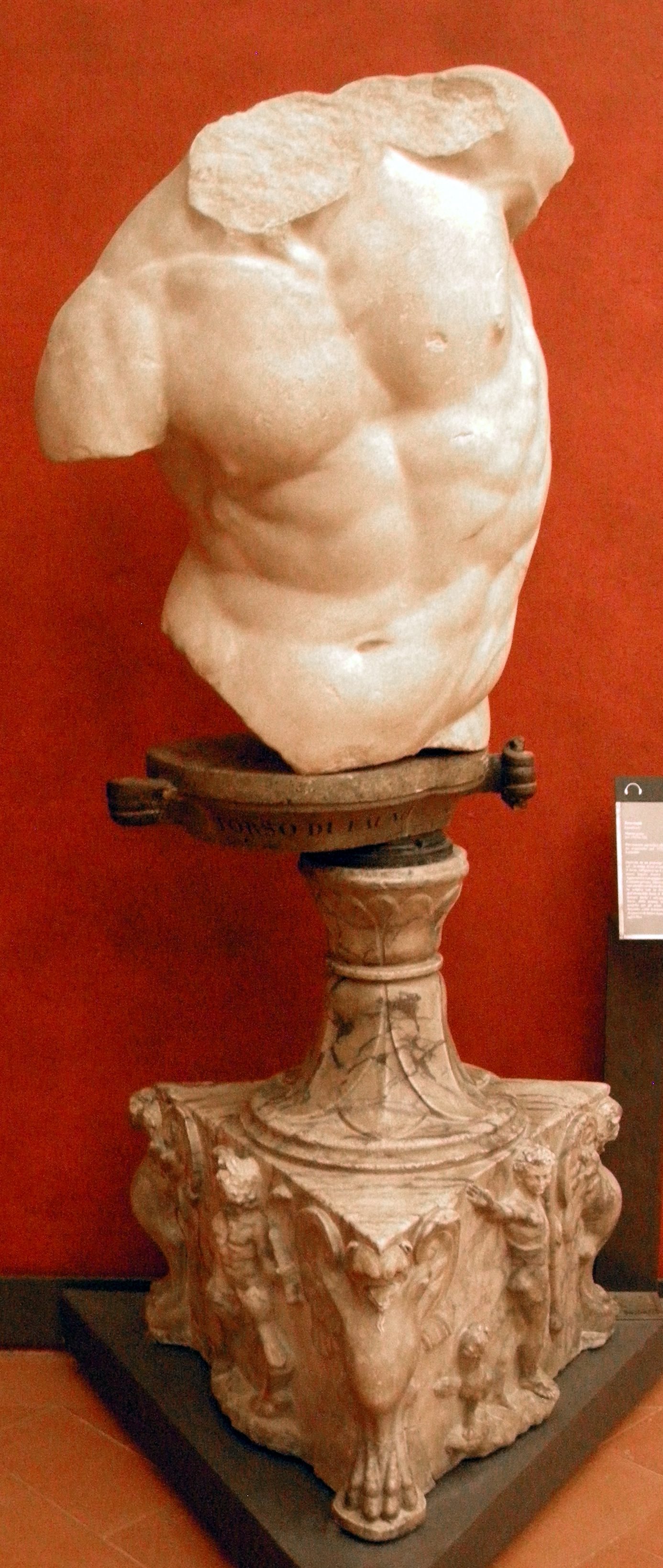
In Florence, another torso was, at the same time, playing an almost identical role: the one now known as the Gaddi Torso, named after the family who owned it in the early sixteenth century, before its purchase by the Grand Duke of Tuscany in 1778. Long mistaken for a satyr, it is now read as a centaur struggling against its bonds, a theme Hellenistic art treated more than once as the very image of self mastery. Ghiberti, Rosso Fiorentino, and the young Michelangelo knew it and drew on it: a taut musculature, caught in a torsion that seems to want to break free of the stone. Two cities, two fragments, the same gesture from Renaissance artists: looking at a broken body not as a problem to solve, but as the most demanding form there is to study.
This veneration eventually became institutionalized. From the earliest academies of painting and sculpture, plaster casts of these torsos became the daily bread of students, who first copied engravings, then plaster fragments, in strict sequence, before gaining access to the live model. One entered this progression through parts of the body, not the whole figure: a hand, a foot, a torso, long before being handed a complete body to draw. The fragment was therefore not a shameful stage before real sculpture, it was the real lesson, the one left only once fully exhausted. Cambridge’s Museum of Classical Archaeology, which has held one of these casts since 1884, sums up the double life of each copy in a single phrase: every cast tells two stories, one ancient, one modern. The Belvedere Torso, in this plaster form, thus trained generations of artists who never saw the original: the lesson of the fragment replicated far beyond the stone itself, in academies that had neither Rome nor the Vatican at their door.
What the fragment carries forward
From the academic studio, the idea of the fragmentary body as a complete object migrates toward three uses one might not expect from a ruin: the poem, the ring, and a sculpture studio a century later. In all three cases, someone takes up a fragment they did not create and chooses to make of it, without completing it, something new.
The first is the poem. In 1908, in the second part of his New Poems, Rainer Maria Rilke devoted a sonnet to an Archaic Torso of Apollo, a headless statue that nonetheless, he writes, keeps watching the one who looks at it: there is no place on this body, the poem says, that does not see you. The text closes on a line that remains one of the most quoted in German poetry, “Du musst dein Leben ändern,” you must change your life. There is neither head nor gaze in the literal sense, and it is precisely this absence that Rilke turns into a summons: the fragment is not an incomplete statue waiting for its head, it is an eye that no longer needs a face to see. The sonnet runs fourteen lines and turns just once, on that final line set apart from the rest: up to that point an almost cold, scholarly description of a museum object, then, with no transition, a command addressed to the reader themselves. Rilke does to the poem what the centuries had done to the stone: he leaves it incomplete, and it is that incompleteness that strikes.
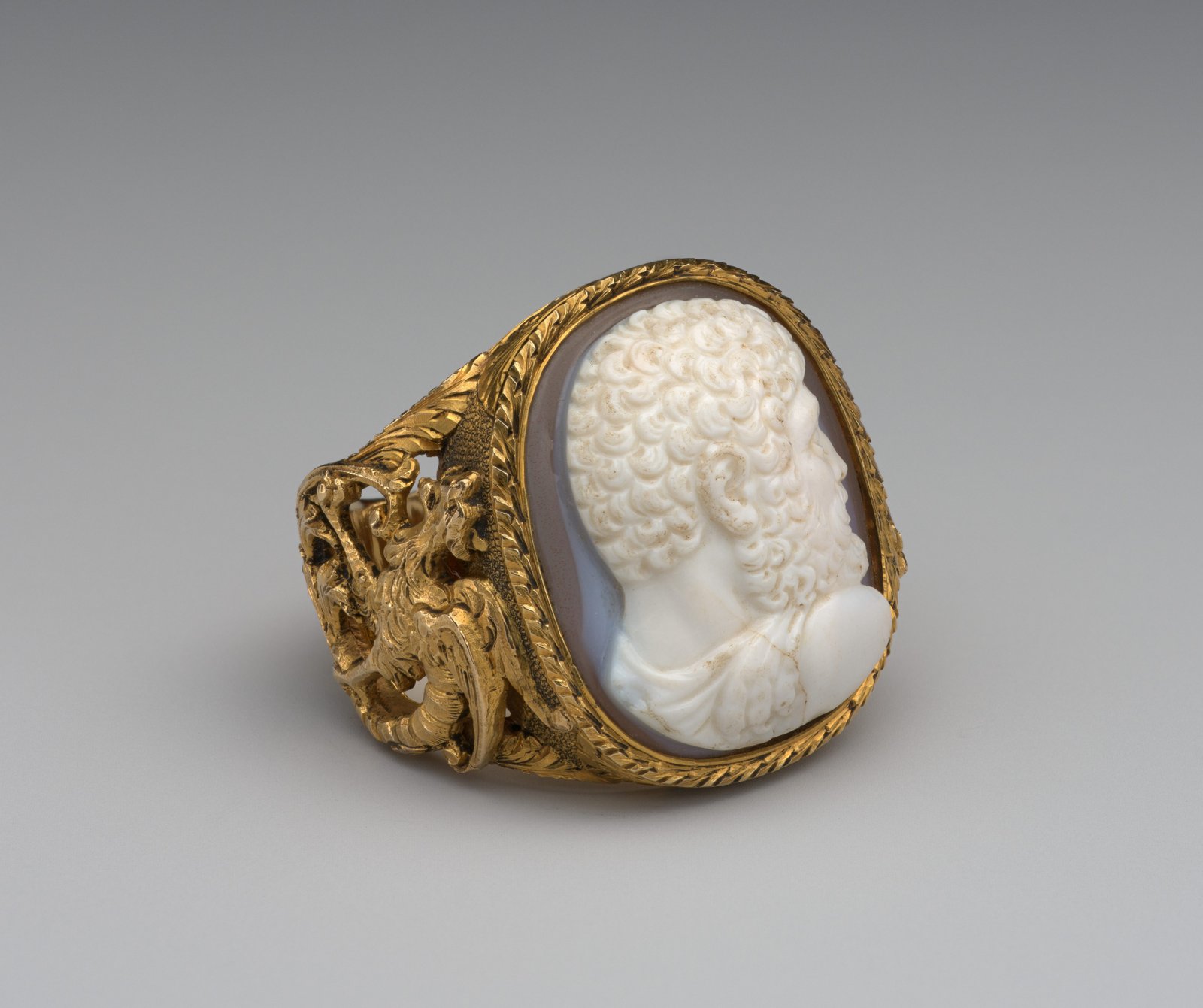
The second use is the finger. Gentlemen on the Grand Tour who visited Rome and Naples in the eighteenth century gladly returned home with a stone carved in relief, set in a ring, bearing one of the great ancient figures seen along the way. The Metropolitan Museum holds a cameo of this kind, dated to the late eighteenth century, carved in chalcedony and mounted in gold: a head of Hercules in profile, the shoulders barely suggested beneath a fold of drapery. No arms, no torso, no legs: a fragment of a body, already, chosen to fit in the palm of a hand before closing around a finger. The principle is already the one that concerns us here: museum sculpture, seen in a gallery or a garden, scaled down to a piece of jewelry worn right against the skin. Art was no longer only looked at, it was touched all day long.
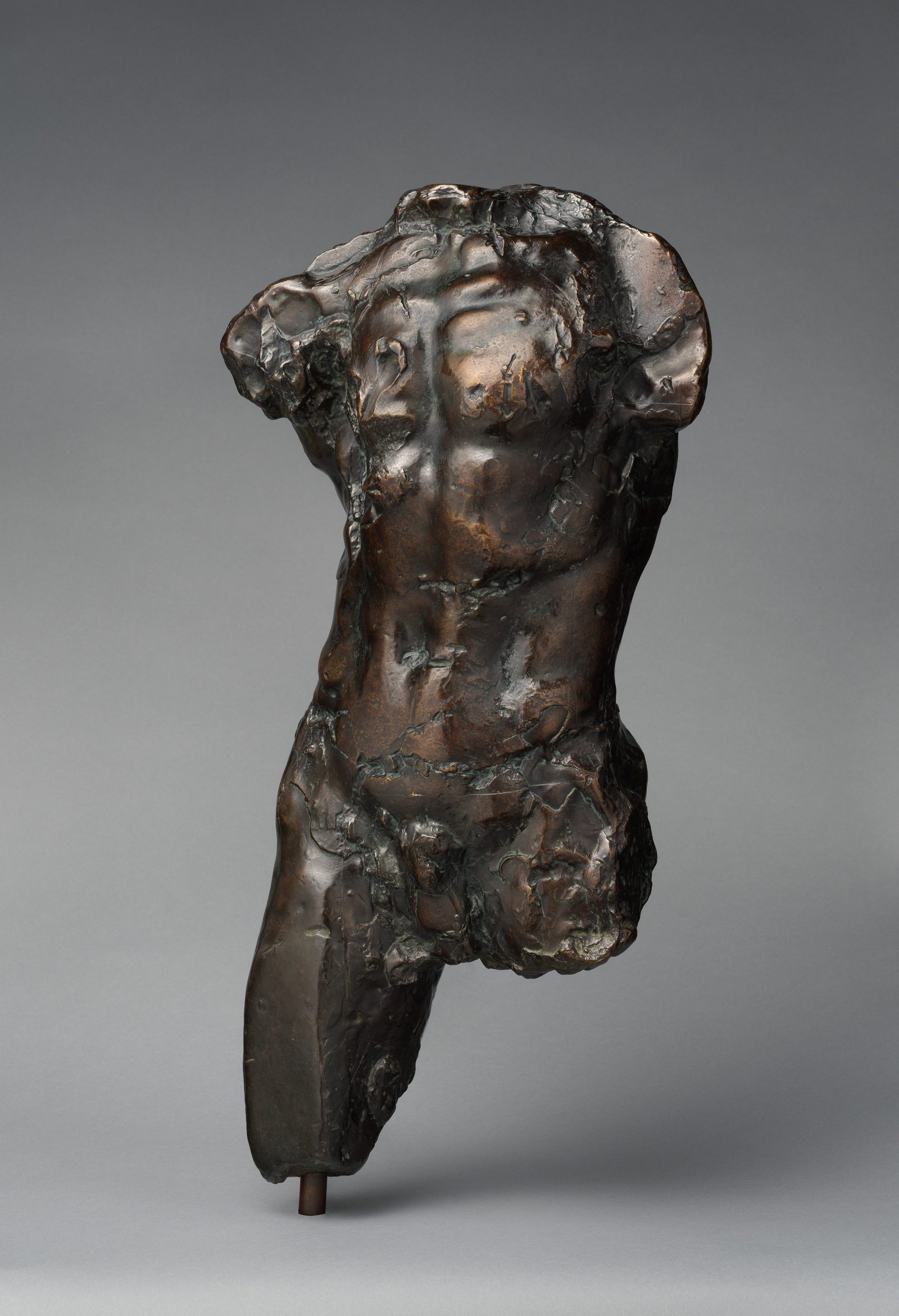
The third use, finally, is that of the sculpture studio itself, a century after the academies. Rodin, nourished by Michelangelo and by the ancient marbles that reached him incomplete, goes further than simple admiration: he turns the fragment into a work in its own right, detached from the body it originally came from, no longer an accident to be regretted. It is a break with the tradition that demanded the whole figure: from now on, a torso alone, with no head or arms added, can leave the studio signed and finished. Rodin even pushes the principle further than his ancient models: he sometimes assembles several fragments from different casts, joining a torso to legs that were not born together, in a process he himself called marcottage, and whose seams he deliberately left visible rather than concealing them. The Metropolitan Museum holds one of these bronze torsos, modeled around 1877 to 1878: the lesson of the broken marbles, received two thousand years earlier, in turn produces a new work, deliberately incomplete, where one can still sense, beneath the patina, the logic of the gesture that tore it from a larger body.
The torso in the living room
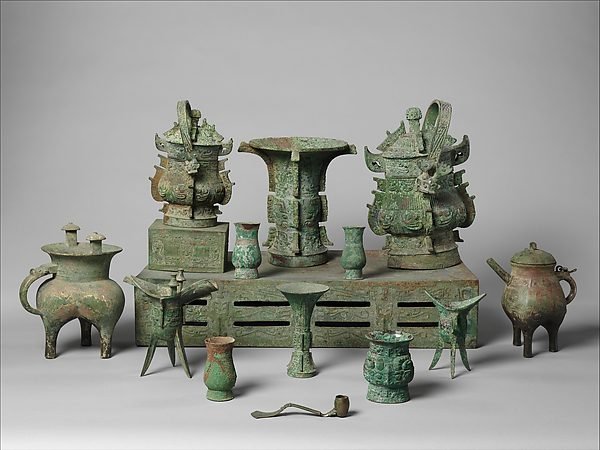
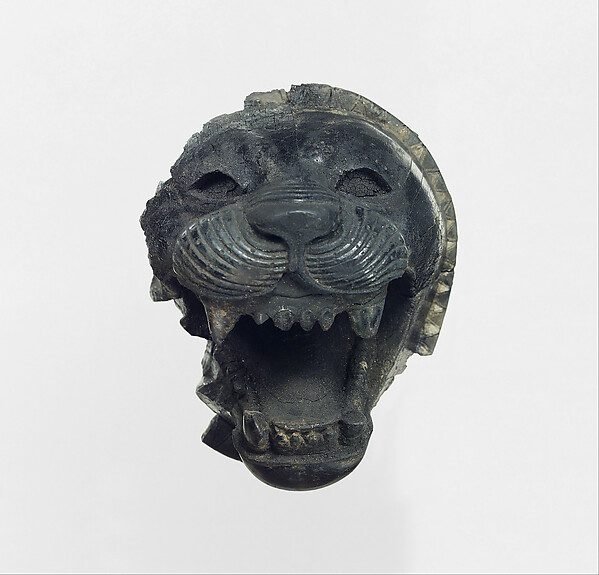
This lineage is nothing like a subject closed in on itself, reserved for museums and poetry books. It lives today in high-end decor, through an angle no one quite expected: a collaboration between a museum and a furniture house. The Metropolitan Museum chose Eichholtz, a Dutch house of objects and furniture founded in 1990, for a multi-year collection drawing, in the partnership’s own words, on more than five thousand years of history and culture gathered in its collections. Nearly one hundred sixty pieces of furniture, lighting, and objects, launched in New York before being shown at the major trade fair in High Point, North Carolina. Busts and torsos of antique inspiration hold pride of place there, alongside pieces that borrow even the museum’s architecture and the silhouette of its galleries: the same logic that once had Hercules engraved on a ring in the eighteenth century now has a patinated bronze torso displayed on a console, sold by a decor house. The museum no longer lends its works only to the study of artists, it lends them to furnishing the interiors that can afford it.
What plays out here, each time, comes down to one sentence: a fragment that survived by accident ends up worth more, to the contemporary eye, than a complete figure ever would have been. We no longer ask the sculpted body to be whole to be desirable. We ask it to have been through something.
This may be, in the end, where the answer to the paradox raised at the start of this essay resides. A complete statue tells a finished story, closed in on itself: you look at it, walk around it, move on to the next one. A fragment, by contrast, stays open. It forces you to imagine what’s missing, so to work, so to inhabit the object a little longer than its strict volume would require. Rilke understood this without needing a museum to prove it: an incomplete body looks back harder than a finished one, precisely because it leaves us the task of completing it ourselves.
Two torsos, one Parisian room
This same logic guided, in the atelier of Holdon Paris, the creation of the Statuary pattern: not an ornament applied to a handle, the way a rosette or a scrollwork would be, but an entire sculpture that stands in for the handle. The reversal isn’t just a matter of vocabulary: everywhere else in the catalog, a silhouette carries several patterns, a square or a round dressed in turn with a rosette, a lion, a scrollwork. Here, it’s the pattern that carries the silhouettes. Statuary isn’t placed on a neutral shape, it is the shape: every silhouette that carries it is already, in itself, a complete sculpture, not a support waiting for ornament.
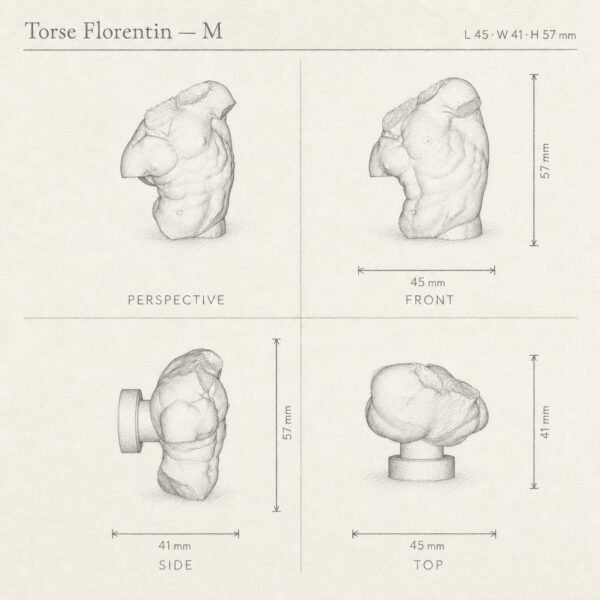
Two pieces carry this principle today, Venetian Torso and Florentine Torso, two fragmentary torsos, one feminine, one masculine, conceived as a diptych of register rather than as a pair. The first owes its softness to Venetian painting, to the soft modeling associated with Titian, shoulders and hips left bare like the antique torsos that open this essay. The second, whose source could be identified with precision, picks up the tension of the Gaddi Torso seen earlier: the same muscular torsion that already fascinated Ghiberti and Michelangelo reappears, at the scale of a hand, on a Parisian cabinet front.

Just as the Grand Tour cameo brought a garden statue down to the size of a finger, the Statuary pattern brings a gallery torso down to the size of a drawer front. Nothing here is applied as an afterthought, no ornament has come to decorate a neutral shape: the sculpture and the object are one and the same, exactly as the torso is one with the fragment that constitutes it. You wouldn’t place it on every door in a kitchen, any more than the Belvedere would have been multiplied down every corridor of the Vatican: it is reserved for the one piece you want to give to be looked at.

Both torsos come in several metals, from bronze to brass to copper, hand-patinated in the house’s Parisian workshop. Neither one tries to fade into a cabinet front: like their ancient models, they’re made to be stopped in front of, and that’s exactly why we never repeat them.
Sources and further reading
- Vatican Museums, the Belvedere Torso, official record of the work.
- Uffizi Gallery, the Gaddi Torso, official record of the work.
- Museum of Classical Archaeology, Cambridge, the cast of the Belvedere Torso, on the academic tradition of casting.
- Musée Rodin, Multiples, Fragments, Assemblages, on the fragment as a work in its own right.
- Rainer Maria Rilke, Archaic Torso of Apollo (1908).
- The Metropolitan Museum of Art, Hercules cameo ring, Open Access.