The Shell, Memory of the Wave: Archaeology of a Pattern
Hold a shell to your ear and you’ll hear, so the story goes, the sea. It’s only the rumor of your own blood amplified by the cavity, but the illusion has held for so long that it ended up saying something true: the shell has always been an object we hold close to hear something other than ourselves. Before it was a pattern, before it adorned a facade or framed a mirror, it was picked up, pierced, worn. This essay follows that path: from a meal’s discarded shell turned ornament to the goddess born from a half-open valve, from the pilgrim who sews a scallop shell to his hat to the Parisian decorator who lines an entire salon with them, all the way to the handle that, on a piece of furniture today, keeps the shape without ever keeping the sea.
Origins: from waste to symbol
The shell is likely the oldest material the human species chose to set itself apart. In the Blombos Cave, in South Africa, archaeologists uncovered dozens of small marine shells, Nassarius kraussianus, pierced and polished from wear: strung as a necklace or bracelet some 75,000 years ago, they rank among the oldest known personal ornaments. At that point, nothing yet set a shell apart from a pretty pebble or an animal tooth: it was an object chosen for its shape and its pearly gleam, before anyone gave it meaning.
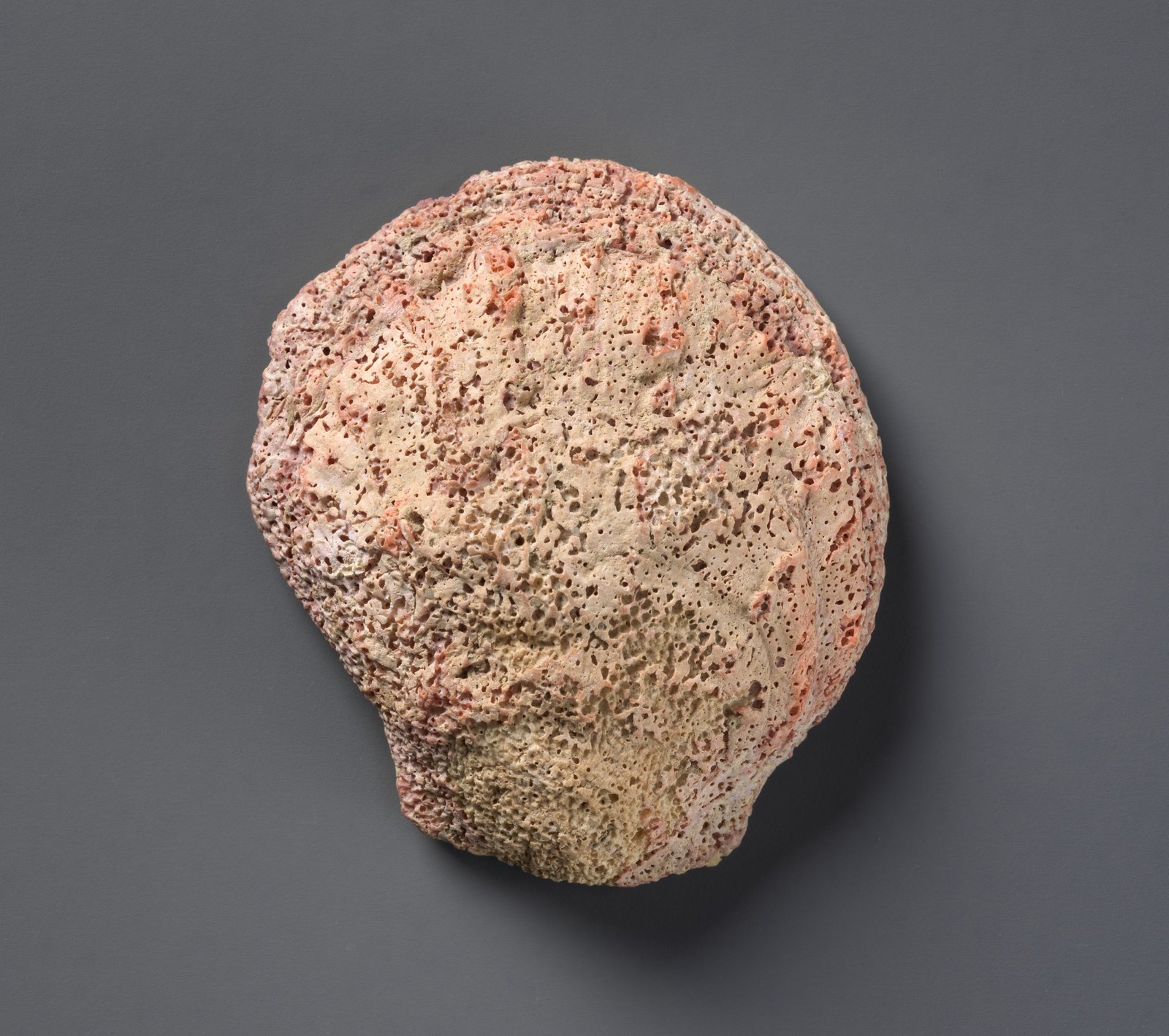
The shift happens later, when the urban societies of Mesopotamia and Egypt begin turning the shell into a consecrated object: engraved, inlaid in temple friezes, laid down as an offering, it leaves the register of jewelry to enter that of the sacred. Its very shape lends itself to this. A valve is a vessel born without a potter, a closed architecture that opens with a single gesture, visible proof that a living material can secrete its own dwelling. Long before any text said so, the shell must have fascinated for this very simple reason: it is at once the inhabitant and the house, the flesh and the armor, a thing that closes back over its own mystery. The pattern’s entire symbolic career, across millennia, would do no more than unfold this first intuition.
The shell also led another career, more prosaic but just as revealing of its power to fascinate: that of currency. The small cowrie, that smooth, rounded shell from the Indian Ocean, served as a trade currency for centuries, from West Africa to Asia and Oceania, prized for its consistent size, its durability, and the near impossibility of counterfeiting it. Starting in the 16th century, this monetary function took on a darker use: cowries imported in bulk from the Maldives became one of the currencies of the transatlantic slave trade, exchanged for goods and, more tragically, for human beings. The detail is worth recalling here, because it shows how far a single object, depending on the hand that wields it, can carry both ornament and debt, the sacred and the calculated, without ever changing shape.
The symbolic shift: the goddess and the half-open valve
The turning point has a name and an image. Pliny the Elder describes, with great emphasis, a Venus Anadyomene painted by Apelles for the temple of Asclepius at Kos: the goddess rising from the sea, wringing out her hair, a masterpiece so famous in antiquity that it became a commonplace before anyone alive today had ever seen it. Though lost, that painting went on haunting Western art in the form of a theme: Venus born of the waves. When Botticelli painted his own Birth of Venus in the late 15th century, he wasn’t citing Apelles: he was conversing with his ghost, and he chose, to set the goddess upon, a scallop shell opened to the size of a raft. In this scene, the shell is no longer an ornament: it is the entire narrative device, the machine that turns sea foam into a body, marine chaos into perfect form.

This choice is not arbitrary, but it is not as ancient as one might think, either. In Hesiod’s founding narrative, the Theogony, Aphrodite is born from the foam formed around the severed organs of Uranus cast into the sea, then drifts to Cyprus: the Greek text mentions no shell at all, only the foam and the goddess’s own name, Aphrogeneia, she who was born of foam. The shell is a later addition, an invention of painters and sculptors rather than poets, but one so fitting that it eventually became inseparable from the myth itself. In the Mediterranean imagination, the bivalve shell has in fact long been associated with the vulva and with birth: its shape, its opening, its inner mother of pearl make it a symbol of fertility that needs no text to explain it, a matter of pure visual evidence. Botticelli therefore invents nothing: he makes visible a connection the material already carried within it, one that generations of painters and sculptors had shaped before him. From this painting onward, the shell becomes, in Western art, Venus’s visual attribute on a par with the dove or the myrtle, and any object that borrows its form, a mirror, a basin, a console table, quietly summons that founding scene: something beautiful newly born from the sea.
Migrations: the pilgrim, the knight, the decorator
The motif does not remain confined to mythology. In the Middle Ages, the scallop shell changed sides: from the attribute of a pagan goddess, it became the badge of a Christian pilgrimage. The pilgrims of Compostela sewed it onto their hat or cape to prove, upon their return, that they had reached the tomb of Saint James in Galicia. The legend crediting the apostle with a rescue at sea, a knight or his horse emerging from the waves covered in shells, did the rest: the sea shell became a sign of protection as much as proof of a journey completed, the medieval equivalent of a passport stamp worn on the body itself. The pilgrimage’s success eventually turned the object into a small economy of its own: merchants set up near the cathedral sold shells to returning pilgrims, so much so that the clergy had, at certain times, to strictly regulate their sale to prevent counterfeit badges. On the road itself, the shell was not just a symbol worn on the hat: hollow and sturdy, it also served as a bowl to receive alms of a little food or water, which no doubt reinforced its status as an object at once practical and sacred, a utensil that never left the walker’s body.
This pilgrim’s prestige went on to have an unexpected career at the court of France. When Louis XI established the Order of Saint Michael in 1469, the kingdom’s highest distinction before the Golden Fleece, he required his knights to wear a very particular collar: a gold collar made of chained scallop shells, from which hung a medallion showing the archangel slaying the dragon. The choice was not decorative: Mont Saint Michel, seat of the order, is itself shell country, and the pilgrimage made there had made the shell inseparable from the archangel’s cult. To wear this collar was to carry around one’s neck proof of belonging to a brotherhood of warrior pilgrims. The medal below, a shell cameo set in a gold mount adorned with small shells at its four corners, belongs to this same register: the material of the jewel echoes the motif it depicts. The cameo itself draws on a craft Italy has kept alive since the late eighteenth century: in Torre del Greco, near Naples, workshops still carve shell in relief today to produce profiles and mythological scenes, following gestures passed down from generation to generation in a town that has made this single trade its identity.
Another setting turned the shell into a collector’s object in the most literal sense: the cabinet of curiosities. In the sixteenth and seventeenth centuries, princes and Europe’s great collectors had the rarest shells brought back by maritime trade mounted in chased silver or gold, foremost among them the nautilus shell, whose almost perfect spiral fascinated goldsmiths. A nautilus cup from the Waddesdon Bequest, held at the British Museum, illustrates this taste: the shell’s polished mother of pearl becomes the body of a vessel, extended and elevated by a metal mount that does not seek to cover it but to make it stand, the way a base pays tribute to what it carries. The burgau shell cup that opens this essay, a mother of pearl shell set in gilded silver and engraved in the eighteenth century, belongs to this same family of objects: nature supplies the form, and the goldsmith need only give it a foot.

Heraldry generalized this prestige. The shell, or escallop in the language of blazon, became in the Middle Ages a charge that many families adopted on their coats of arms to signal that an ancestor had completed a pilgrimage, to Compostela or the Holy Land. There it became a sign of endurance and of faith held fast to the end of the journey, on a par with the cross or the palm. The poet and explorer Walter Raleigh remembered this in a moving way: imprisoned in the Tower of London and awaiting his execution, he opened his poem The Passionate Man’s Pilgrimage with the line that has remained famous, “Give me my scallop shell of quiet”. The medieval pilgrim asking for his shell for the road becomes, under his pen, a condemned man asking for the trappings of the final journey: the motif crossed the centuries without losing its meaning as a viaticum, it only changed destination.
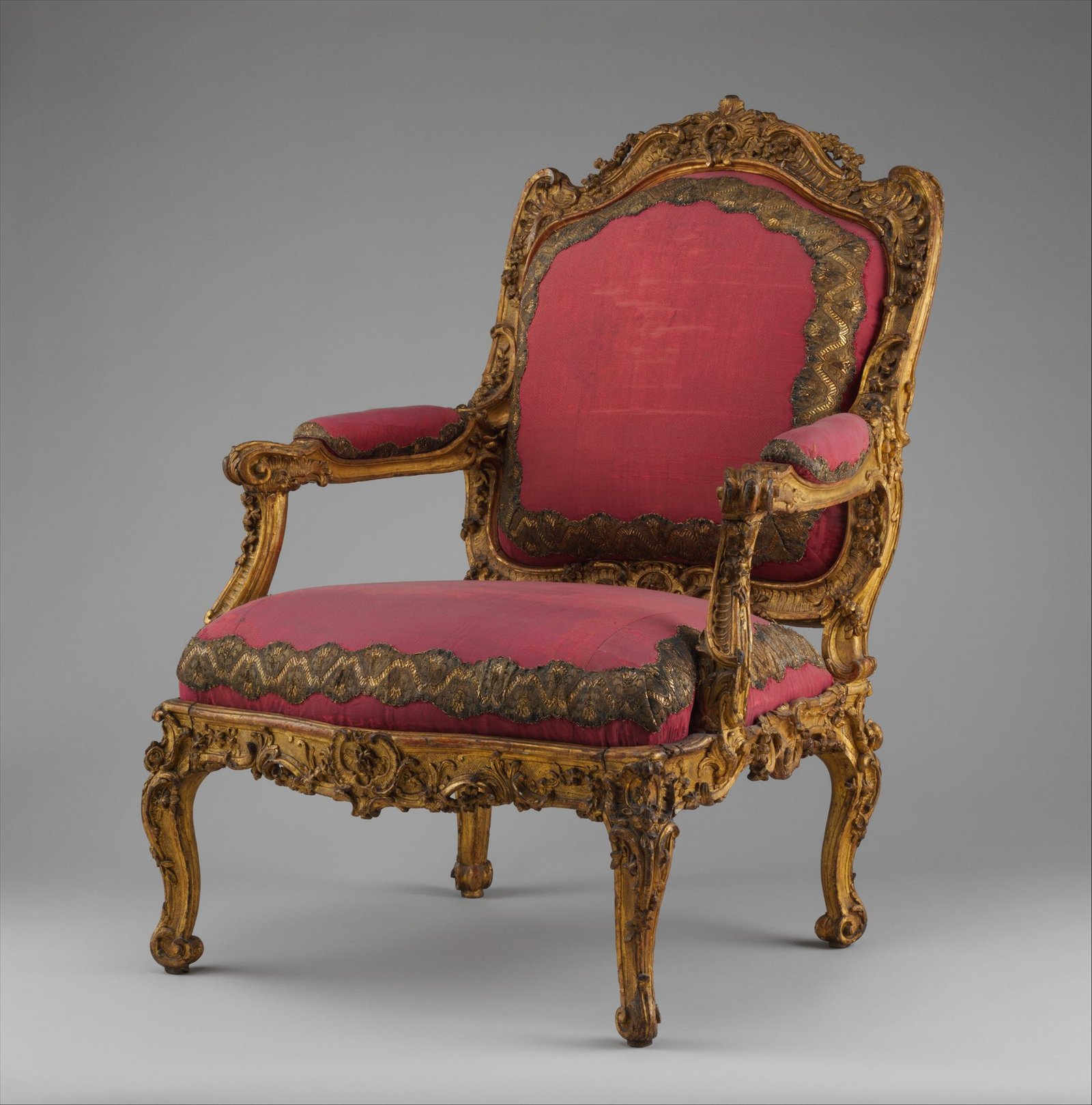
In the eighteenth century, the shell changed register one last time before the modern era: from a religious and heraldic sign, it became pure ornamental language. The very word rococo comes from rocaille, that mix of stone and shell used to decorate the artificial grottoes of princely gardens, a technique so associated with the shell that the entire style inherited its vocabulary of curves and mother of pearl from it. Cabinetmakers and sculptors of the century covered seats, frames, and mantelpieces with it, until the shell became the graphic signature of French taste across Europe. In Paris, two centuries later, the decorator Serge Roche carried this taste to the point of obsession: he built consoles, sconces, and entire mirrors shaped like shells for clients such as Coco Chanel, giving the rococo motif a modernist elegance that major specialized auctions still seek out today.
The philosopher Gaston Bachelard closes, in the following century, this long migration with an almost opposite reading: rather than admiring the shell from the outside, as a decoration, he proposes in The Poetics of Space (1957) to inhabit its logic from within. A seashell, he writes in essence, is not built like a house one would construct and then live in: it grows from the inside, secreted by the being that carries it, in the manner of a garment that would also be an architecture. This image of The Shell, one of the most cited meditations in Bachelard’s book, brings the motif back to its oldest intuition, the one already sensed at Blombos: the shell as the perfect image of intimacy, of that which protects without ever ceasing to be shaped by what it protects. Reading Bachelard, one understands why so many artisans lingered on this form rather than another: a shell is never a decoration applied to a neutral material, it is the visible trace of a growth, the proof that a form took time to become what it is. This may be what distinguishes the shell from most other natural motifs adopted in ornament, the acanthus or the palmette: one senses in it less a design than a duration.
Contemporary anchoring: the shell in today’s decor
The pattern has never left high-end decor. In Los Angeles, the house founded by decorator Tony Duquette, now led by his former apprentice Hutton Wilkinson, made it a full-fledged signature: Duquette, whom his friends affectionately nicknamed Tony Abalone for his devouring love of abalone and mother-of-pearl, used to say that a single abalone shell would be enough, if it were the only one in the world, to make people go to war to possess it. This house continues, under the direction of Hutton Wilkinson, to produce furniture and objects where mother-of-pearl and shell hold the same place as a rare marble or a precious lacquer: a material that one doesn’t try to imitate, but lets speak for itself. Far from being a retro mannerism, this taste remains one of the markers of contemporary high-end decor, the kind that prefers raw material and its long history to ornament manufactured from scratch. It joins, by another path, the lesson of the cabinet of curiosities: nature provides a form that no designer would have dared invent, and the decorator, in the end, need only know how to recognize it and give it a place.
Back to the object: the shell on the handle
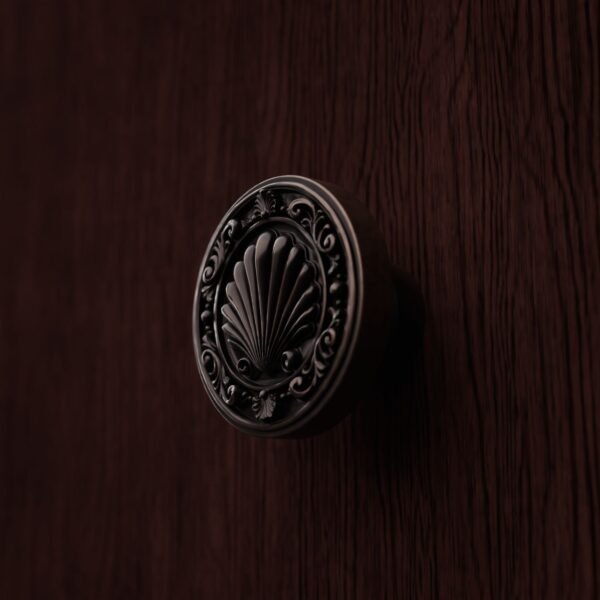
At Holdon, the Shell pattern picks up this genealogy without keeping its religious lyricism or its grand rococo gesture: it keeps the drawing. On our handles, a scallop shell valve opens fan-like, its deep ribs animating the surface the way they did on the eighteenth-century armchair we just encountered, but brought down to the scale of an object you touch every day rather than a salon you look at. The pattern sits just as well on a round silhouette like the Classica Round, where the shell fills the entire disc, as on a more architectural form like the Florentine Medallion, which frames it with a Florentine profile, or on a straighter line like the Palazzo Square, where the pattern softens an otherwise very architectural outline. In all three cases, the material carries the pattern the way bronze, copper, or brass always have at Holdon: each piece is born from a mold, cold cast and then hand patinated, and it is this patina that ultimately decides how light catches on the shell’s ribs, whether dark as an antique bronze or golden as a satin brass.

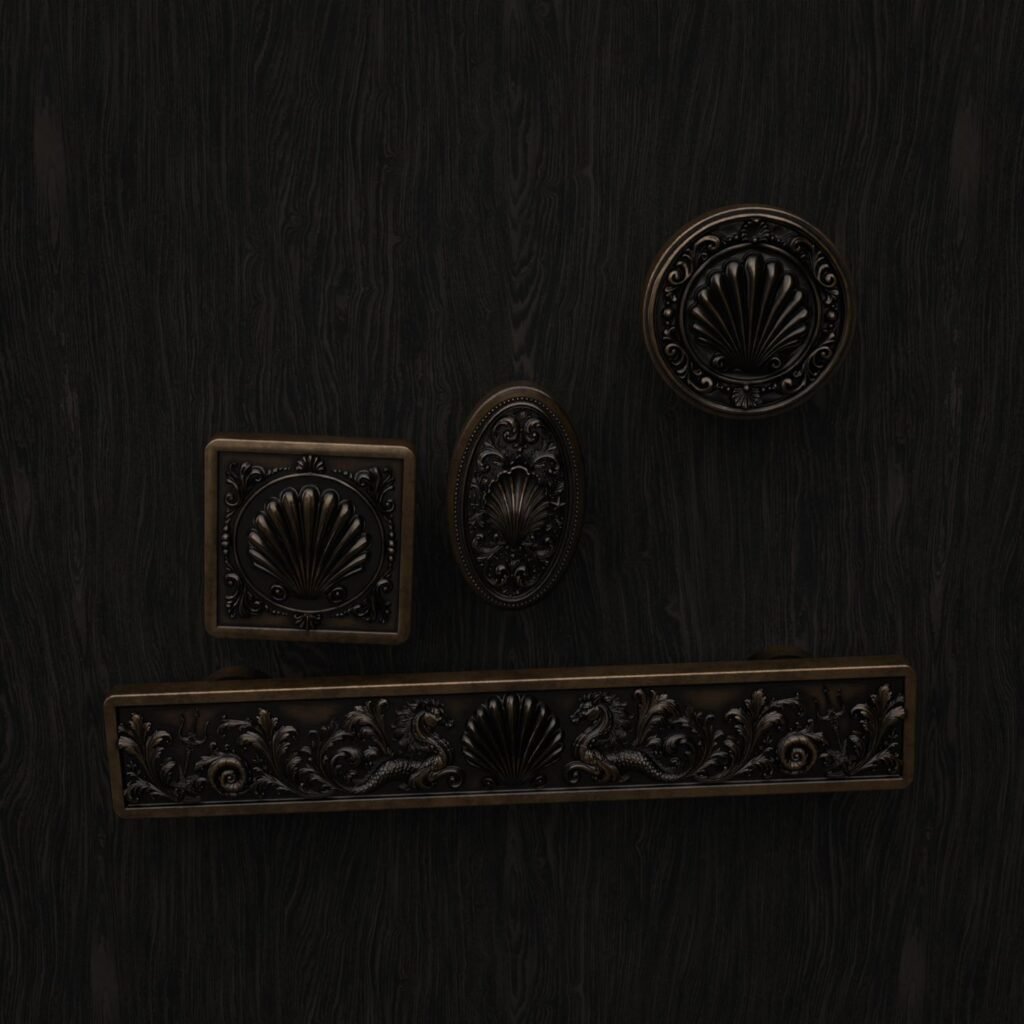
One last clarification, worth stating plainly for anyone searching for one while meaning the other: the Shell pattern has nothing to do with a cup pull, the hardware term for a recessed handle, inset into the wood, with a hollowed, cup-shaped form. Our Shell handles remain solid, raised handles, which the shell simply ornaments without ever changing how they’re mounted. If you’re looking for that second object, a recessed, cup-shaped pull, that’s not yet something we offer; if you’re looking for a marine ornament on a classic handle, you’re in the right place.
Sources and further reading
- The Metropolitan Museum of Art, on shell ornaments from Blombos Cave
- Uffizi Gallery, official record of Botticelli’s The Birth of Venus
- Victoria and Albert Museum, on Saint James and the pilgrimage to Compostela
- Victoria and Albert Museum, style guide on rococo and rocaille
- Grande Chancellerie de la Légion d’Honneur, on the collar of the Order of Saint Michael
- Poetry Foundation, full text of The Passionate Man’s Pilgrimage by Walter Raleigh