Which Scrollwork Handles to Choose? Silhouettes, Materials, and Finishes Reviewed
There are patterns adopted for a season, and others that have held the façade since the Roman friezes. Scrollwork belongs to the second family: acanthus leaves coiled into volutes, running along capitals, woodwork, and grilles for more than two thousand years without ever going out of style. At Holdon Paris, it’s the most widely used ornamental pattern in the Classica Europa collection, and probably the easiest to live with: it dresses a surface without shouting, reads just as well up close as from afar, and pairs with almost any front.
There’s a very practical question left when redoing a kitchen, waking up a dresser, or fitting out a closet: which Scrollwork handle should you choose? Knob or pull? Patinated bronze or colored resin? Discreet or bold? Here’s the full tour of what the house offers, silhouette by silhouette, then material by material and finish by finish, with our advice for matching each piece to your furniture. For the history of the pattern, the Scrollwork page and the rinceau entry do the work. Here, we’re talking decoration.
Scrollwork in two minutes
Scrollwork is a plant stem that coils back on itself, launching a new volute with every turn. The Greeks carved it in marble, the Romans unrolled it into friezes, Versailles gilded it onto its paneling, Art Nouveau twisted it in iron. If it has lasted through the centuries, it’s because it keeps two promises at once: it’s alive, since it mimics a growing plant, and it’s ordered, since each curve answers the one before it.
Scaled down to a cabinet handle, it takes on a different role. From a distance, it’s a texture that gives grain to a front. Up close, it’s foliage you can trace with a finger, with hollows that hold the patina and ridges that catch the light. It’s this dual nature that makes it so easy to live with in decoration: it doesn’t demand a period interior, it simply slips into one.
Seven silhouettes for the same foliage
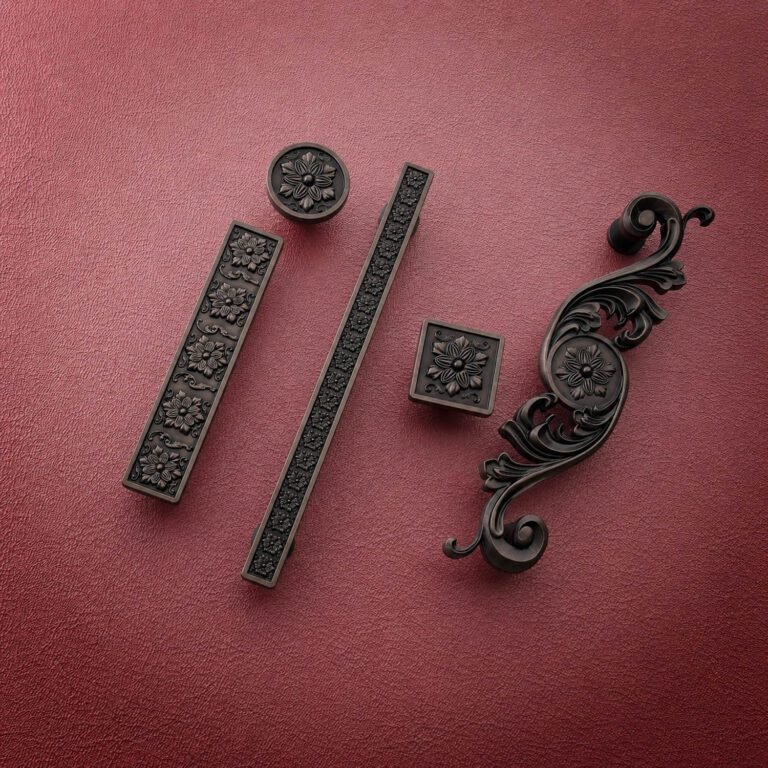
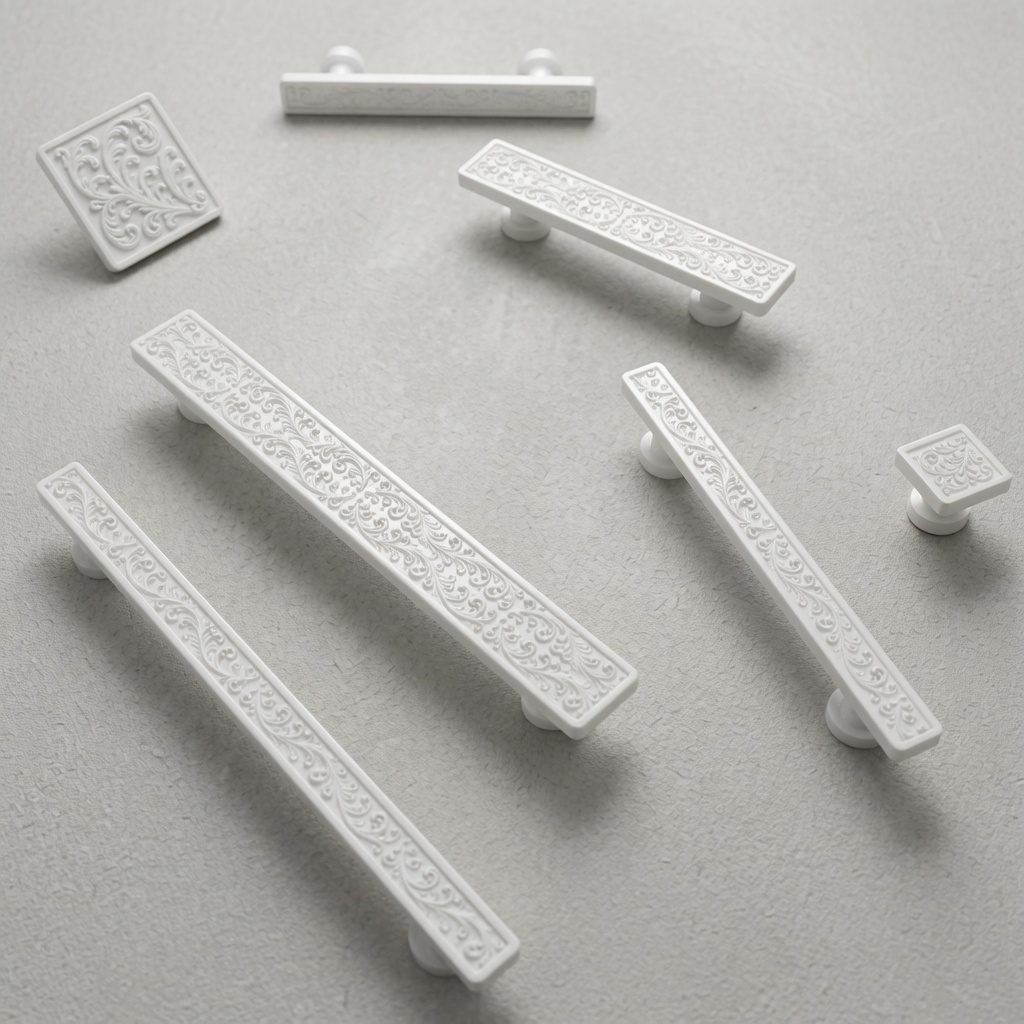
The pattern is the same, but it never sits the same way twice. On a knob, it closes into a frame and concentrates. On a bar, it stretches into a frieze. On a cylinder, it wraps all the way around. Seven silhouettes carry Scrollwork at Holdon Paris today: three single-point knobs, four center-to-center pulls. Before getting into the details, one piece of advice that holds for all of them: choose the silhouette based on the piece of furniture (its size, its drilling, its use), then only the material and finish based on the room and the color of the front.


The knobs: Classica Round, Palazzo Square, Florentine Medallion
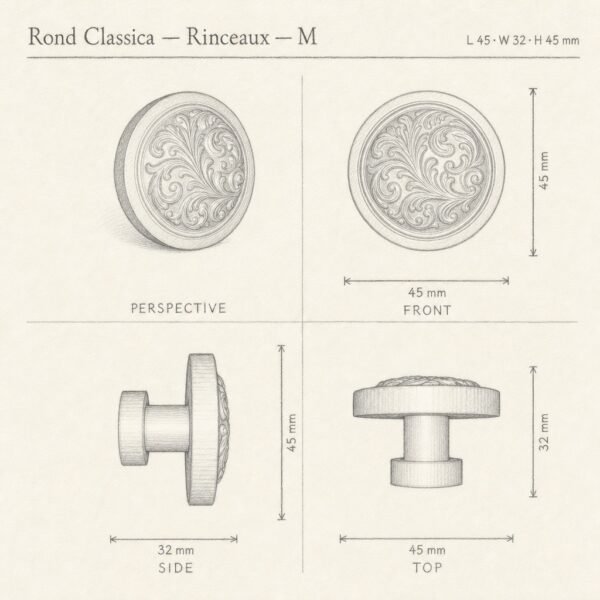
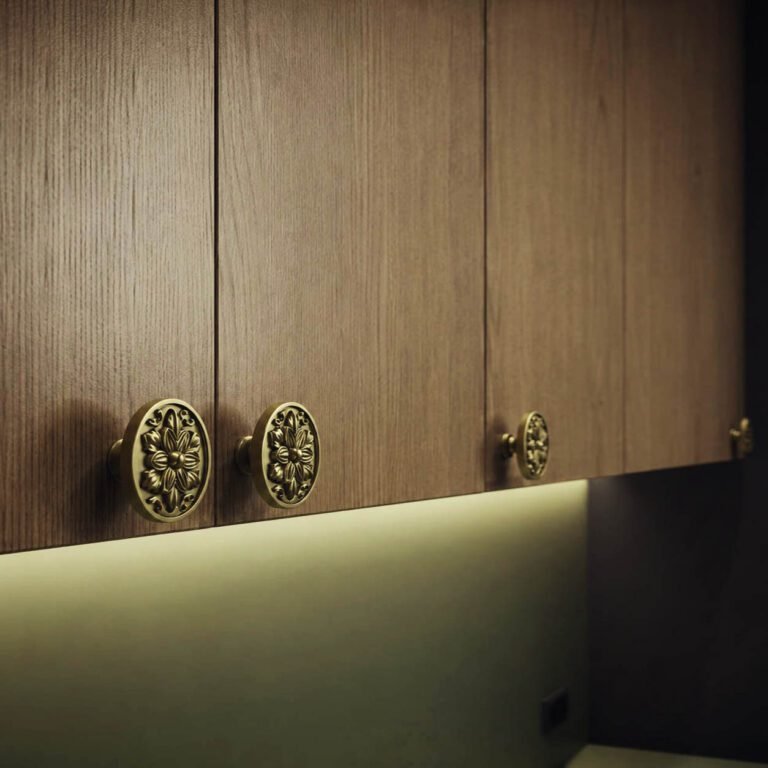
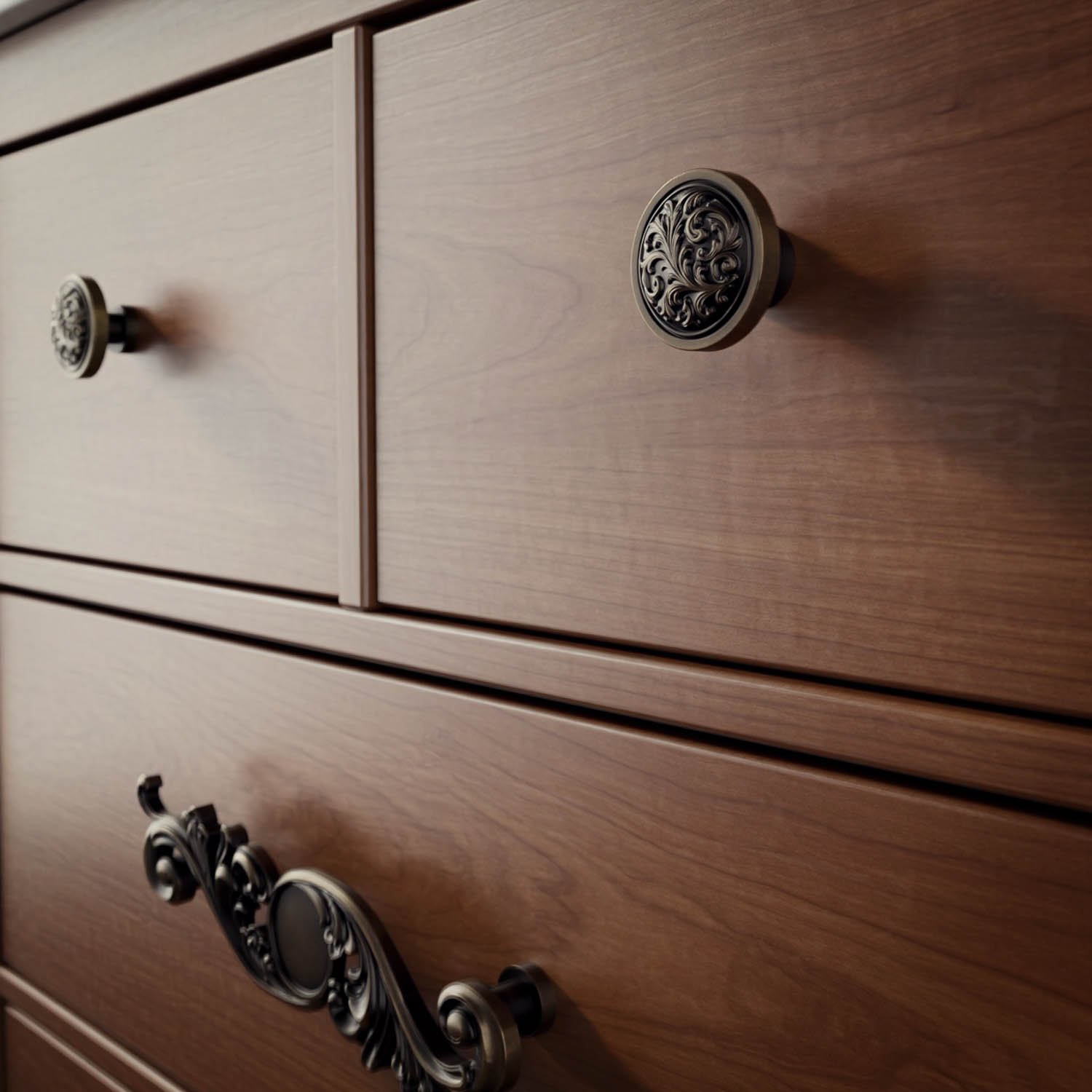
The Classica Round Scrollwork is the knob you put anywhere without a second thought. Its rounded curve gives the foliage the look of an antique cabochon, and the round shape works with any style, from a Louis XVI dresser to a Scandinavian cabinet. Three sizes, from 3 to 6 cm in diameter: the small one for the drawers of a sideboard, the large one for a buffet door that deserves a point of focus. It’s the safest choice if you’re hesitating, and the simplest to fit on a piece already drilled with a single center hole.
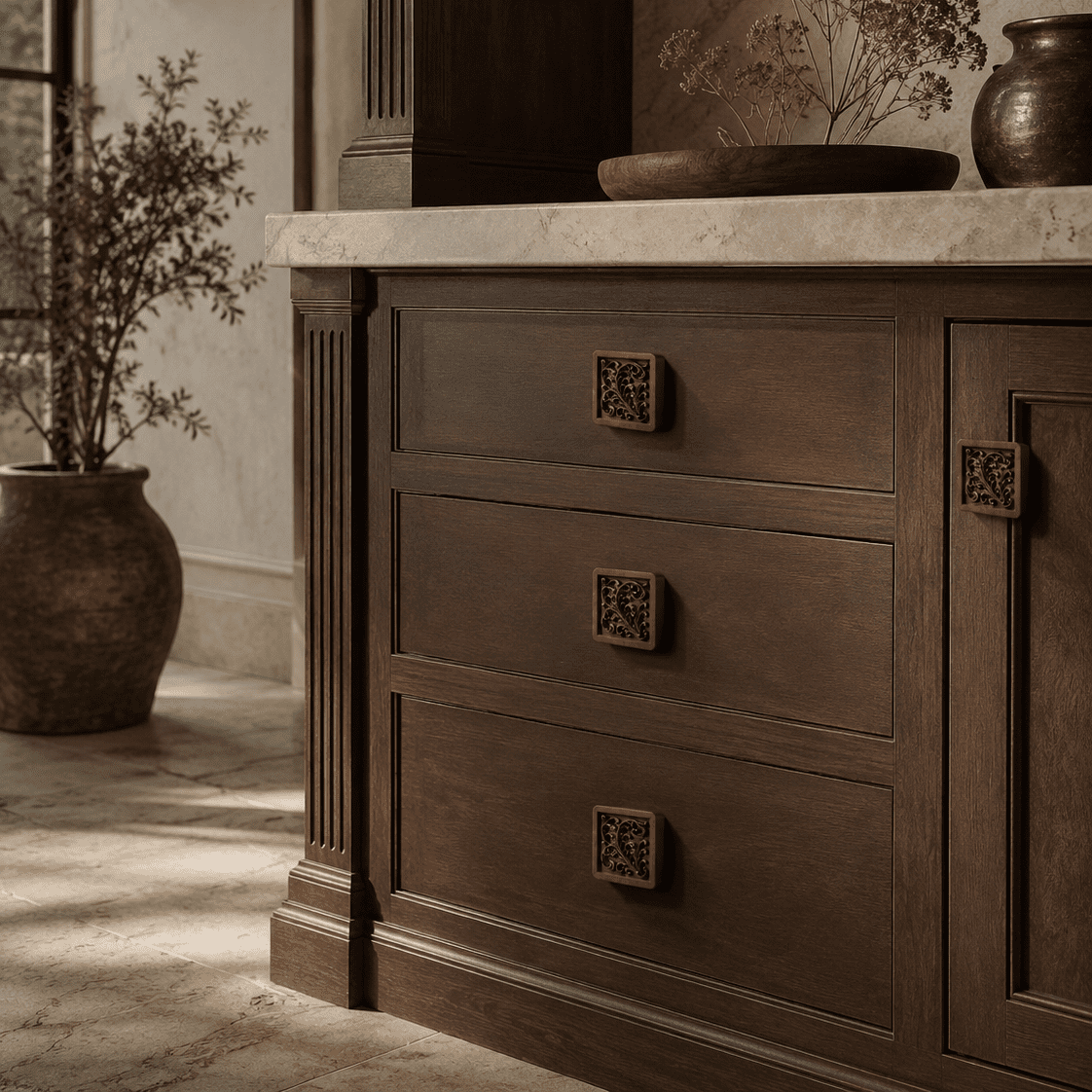
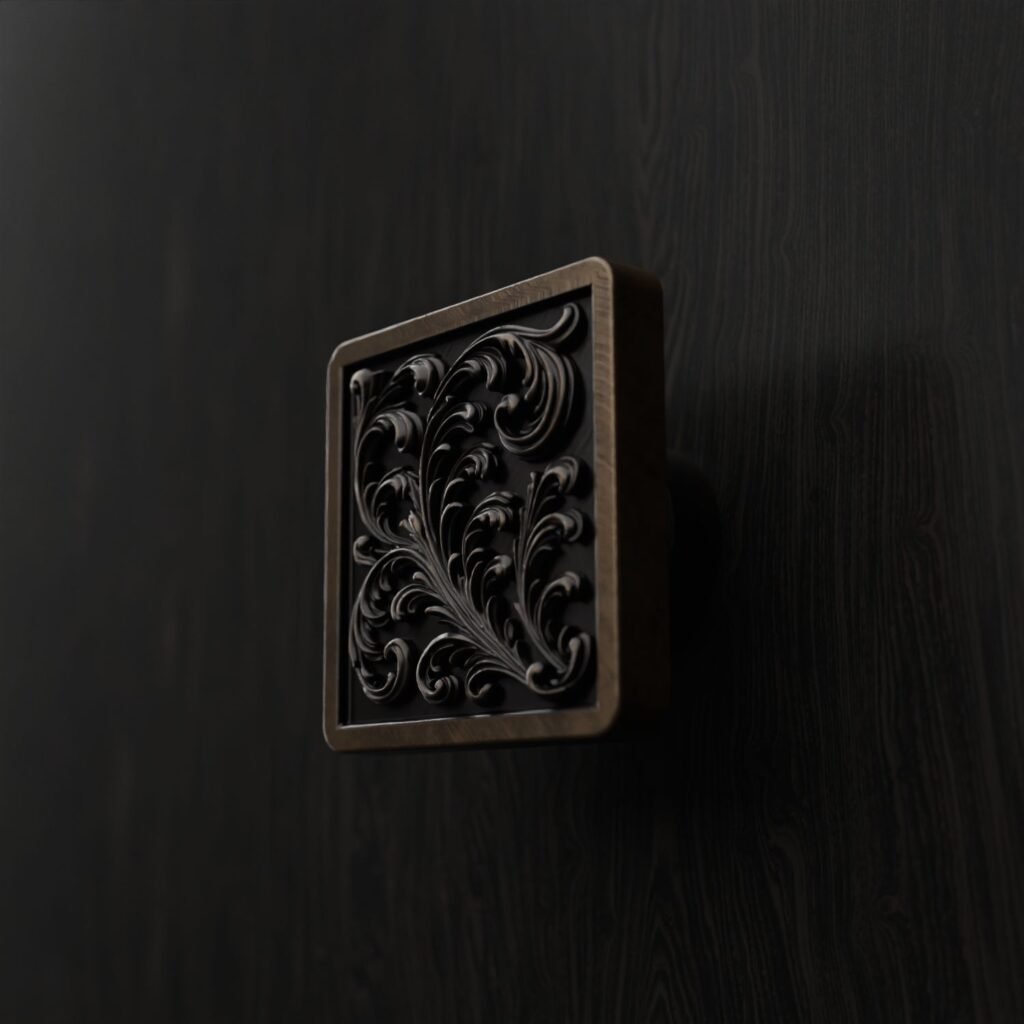
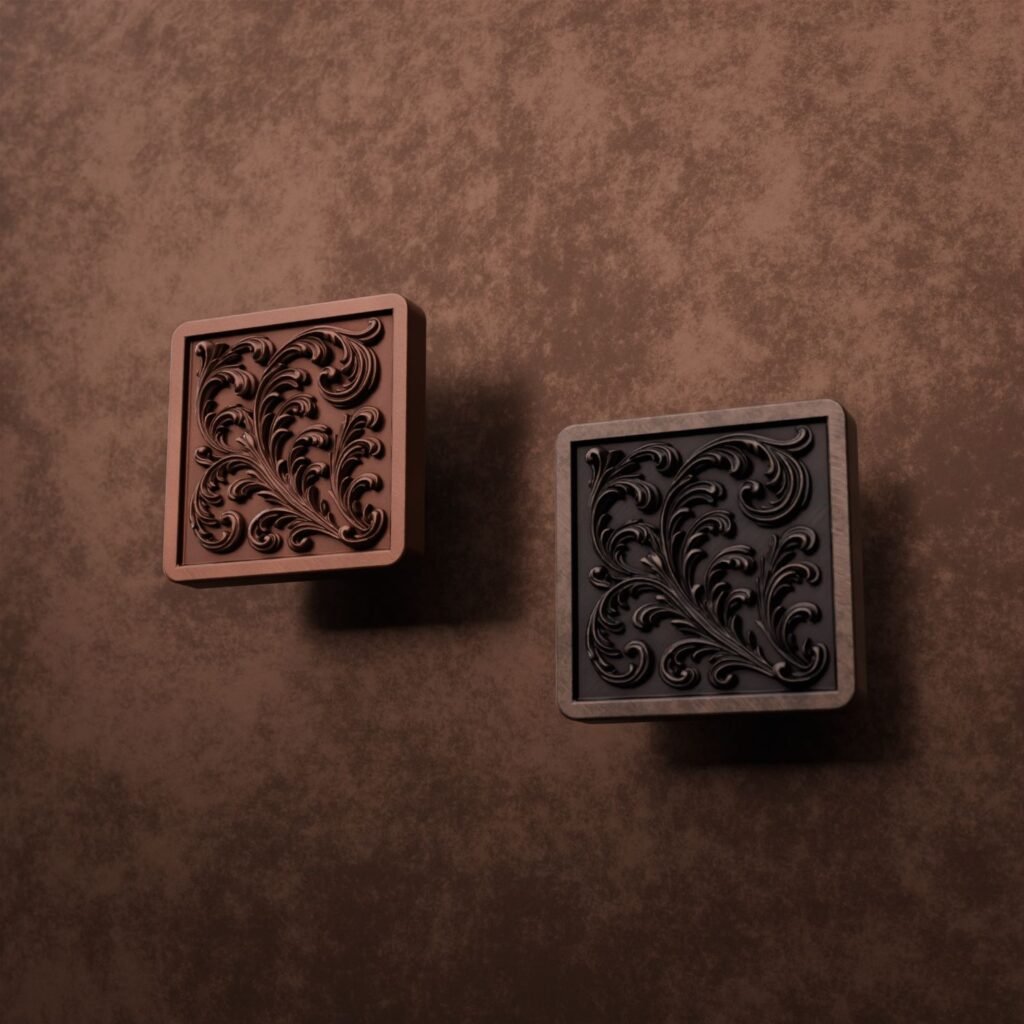
The Palazzo Square Scrollwork shifts the register: the raised frame, borrowed from Italian palazzo facades, encloses the scrolls the way a stone molding frames a bas-relief. The result is more architectural, crisper, and it pairs beautifully with flat fronts, kitchens included. Same sizes as the round version, from 3 to 6 cm per side. Our advice: for a kitchen, choose it in metal, and go with the medium size on drawers, the large on upper doors.

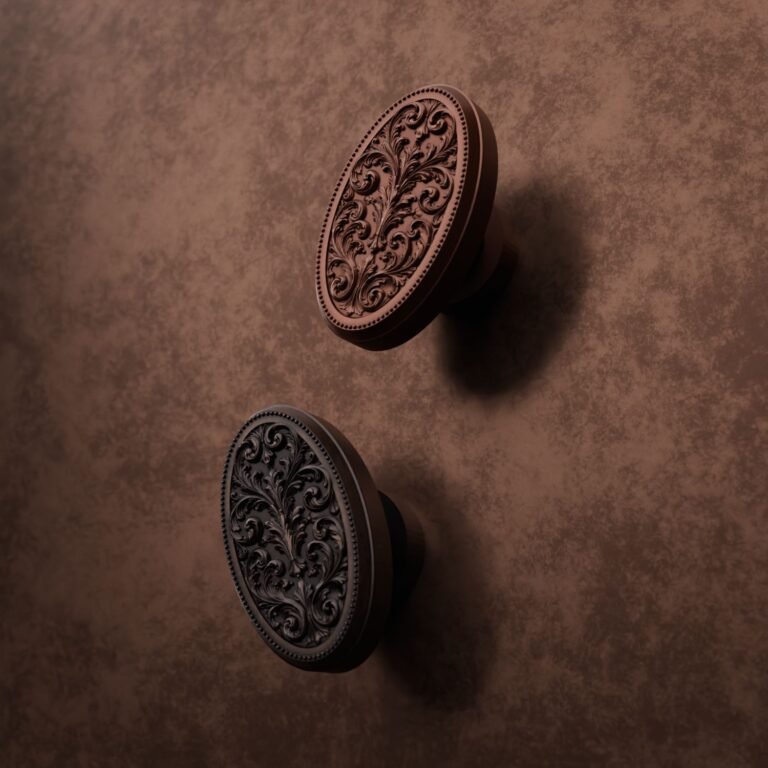
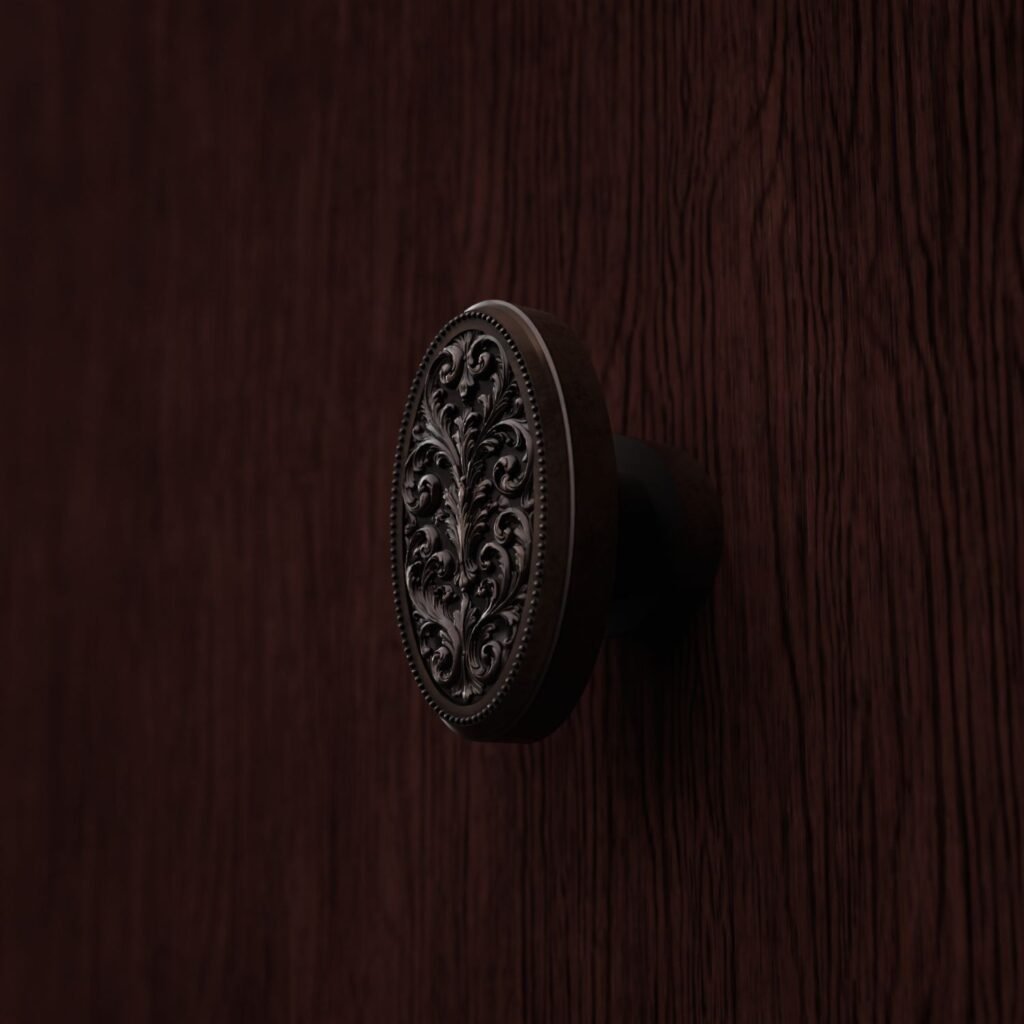
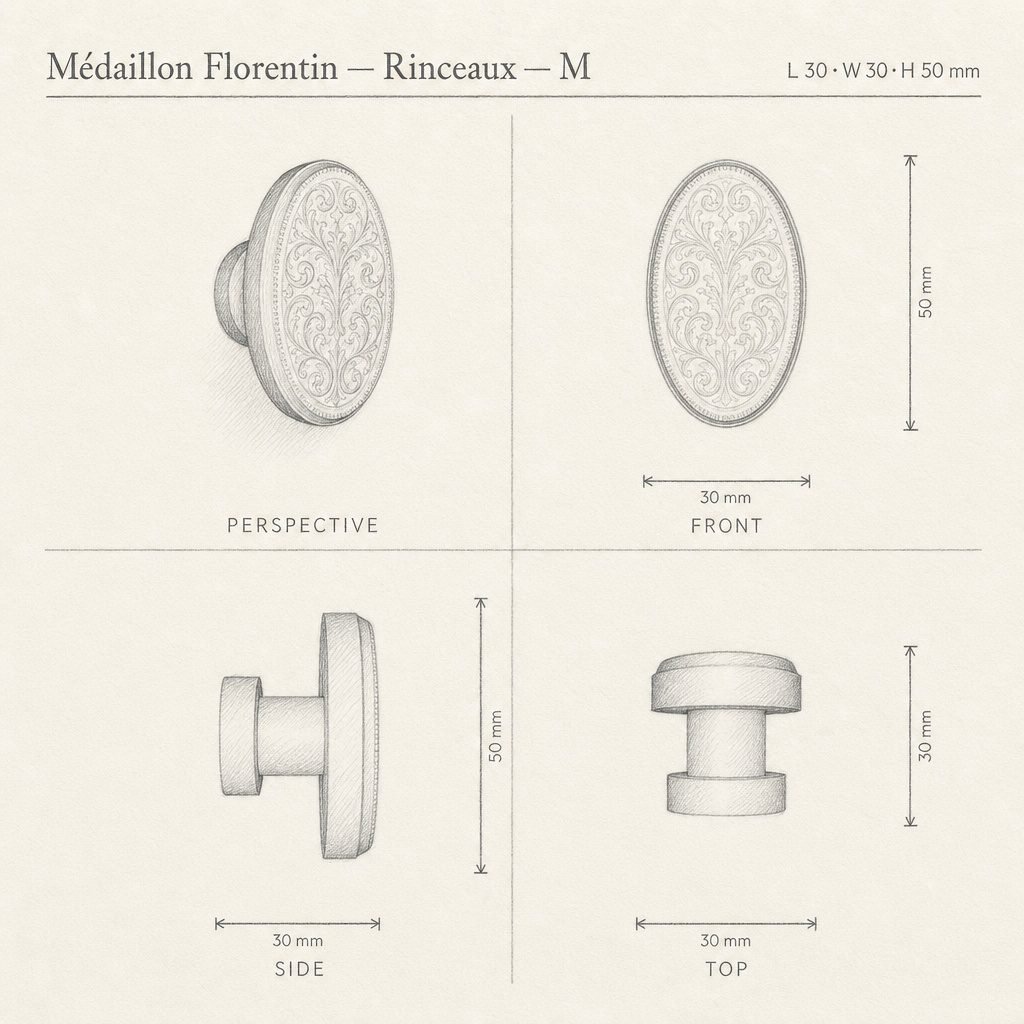
The Florentine Medallion Scrollwork is the newest of the three and, in our view, the most romantic. An oval knob with the profile of a cameo, ringed by a beaded border, with a sheaf of acanthus rising from bottom to top. It’s the densest of the three knobs and yet the most discreet, because the oval blends into the front like a jewel on a garment. Three sizes, from 4 to 6.5 cm in height. It’s made for bedrooms: a dresser, a nightstand, a secretary desk in pale wood.
The pulls: Slim Bar, Bar, Column, Arabesque
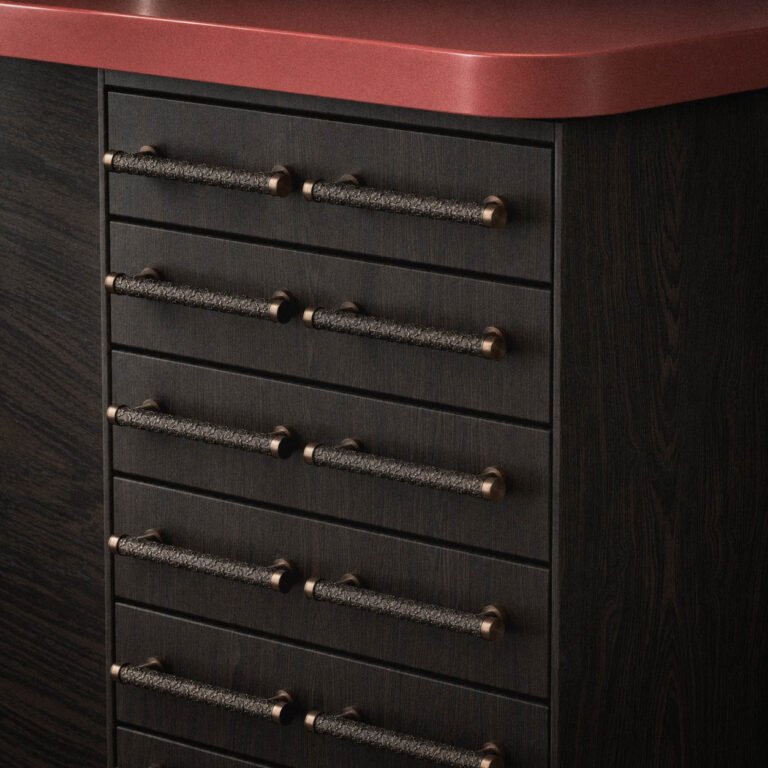
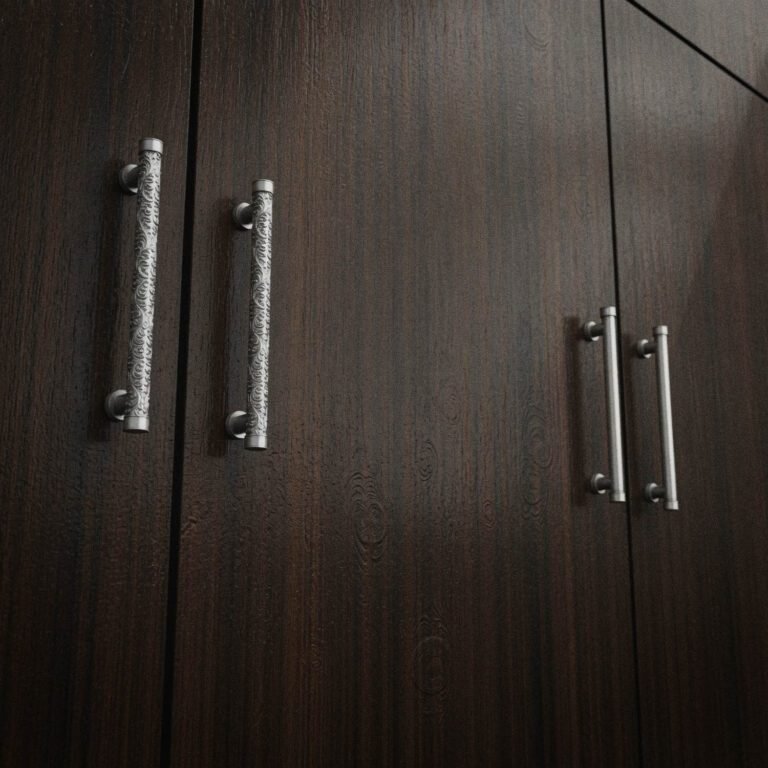
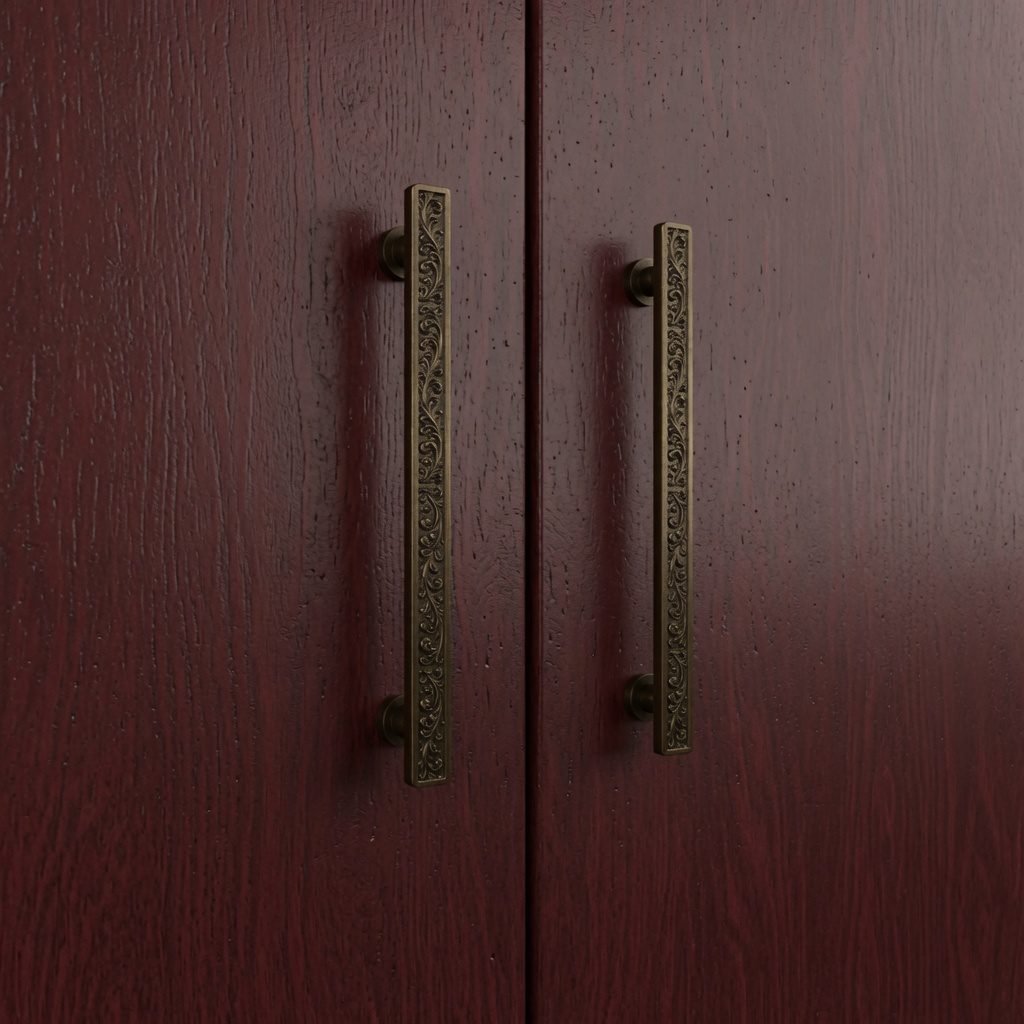
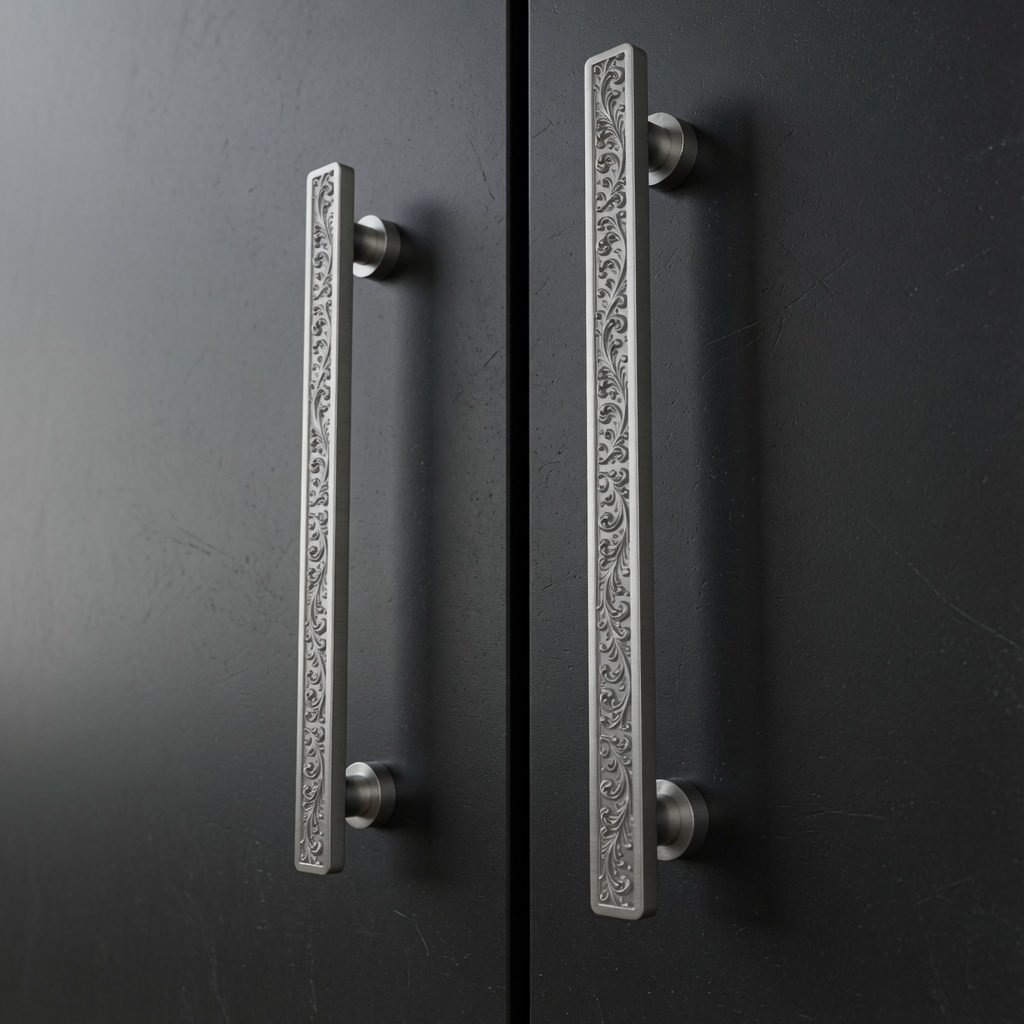
As soon as the front widens, a knob loses its footing, and that’s where the bar takes over. The Palazzo Slim Bar Scrollwork is the family’s middle ground: the same frame as the Square, stretched into a compact format, where the acanthus frieze runs from end to end. Perfect on a kitchen drawer, a small door or a row of cabinets. The Palazzo Bar Scrollwork takes the same design wider and more present, for large wardrobe or closet doors, where it’s happily mounted vertically. Both come in lengths from 15 to 24 cm, and each length accepts several common center-to-center spacings.
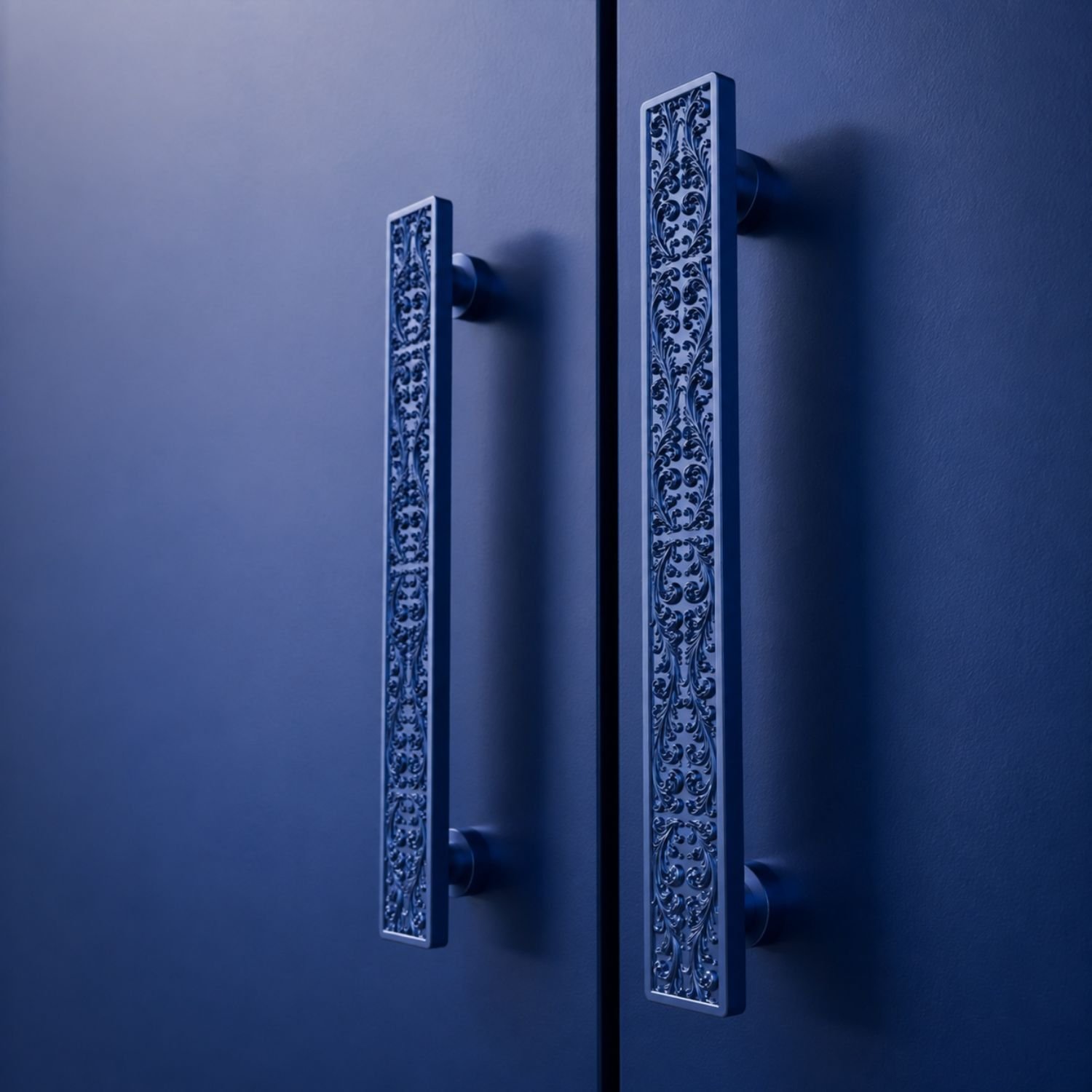
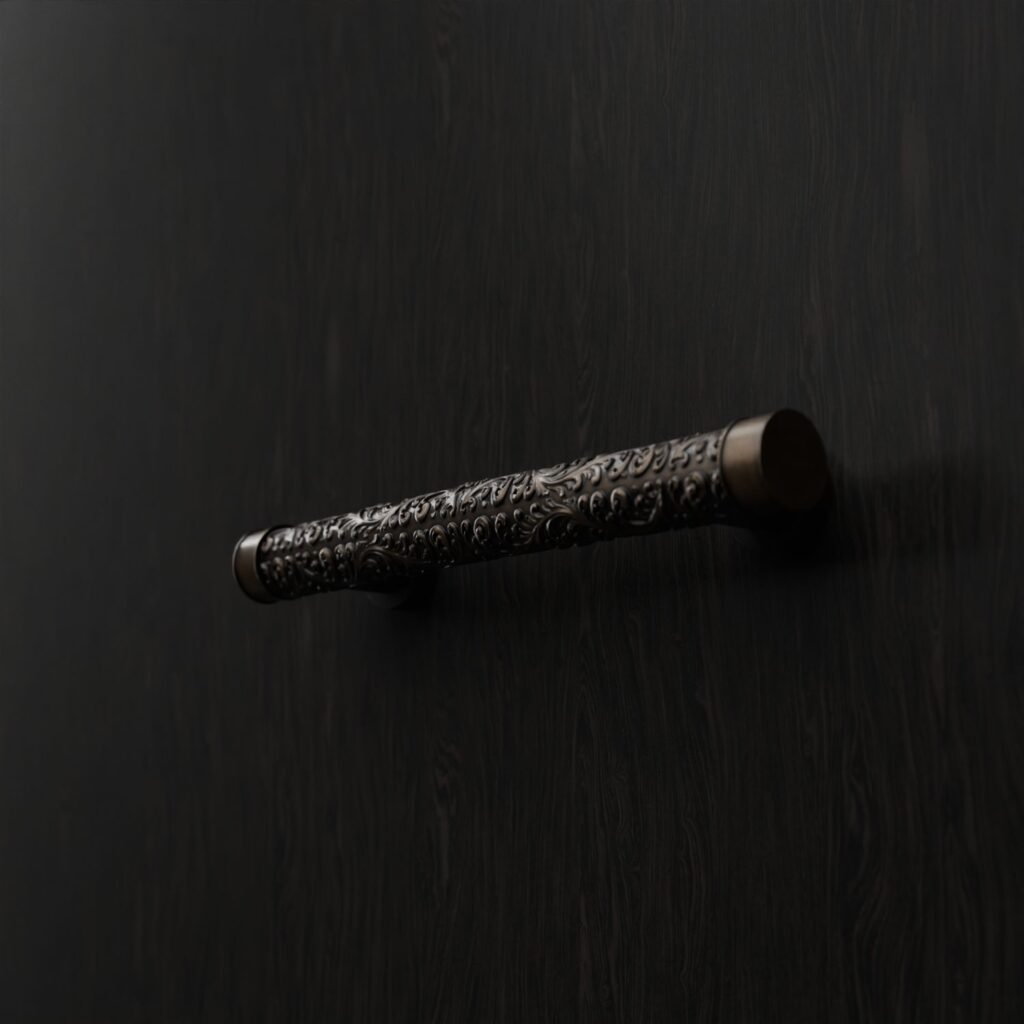
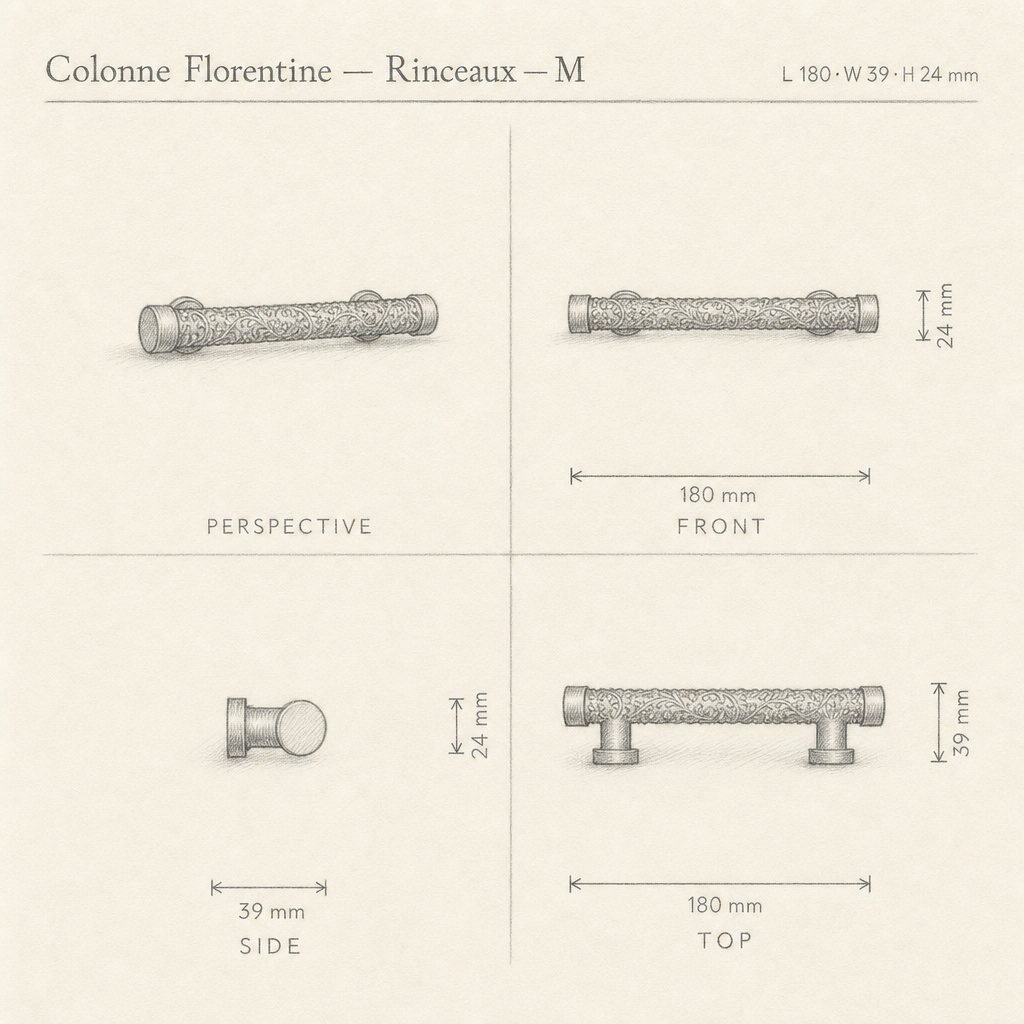
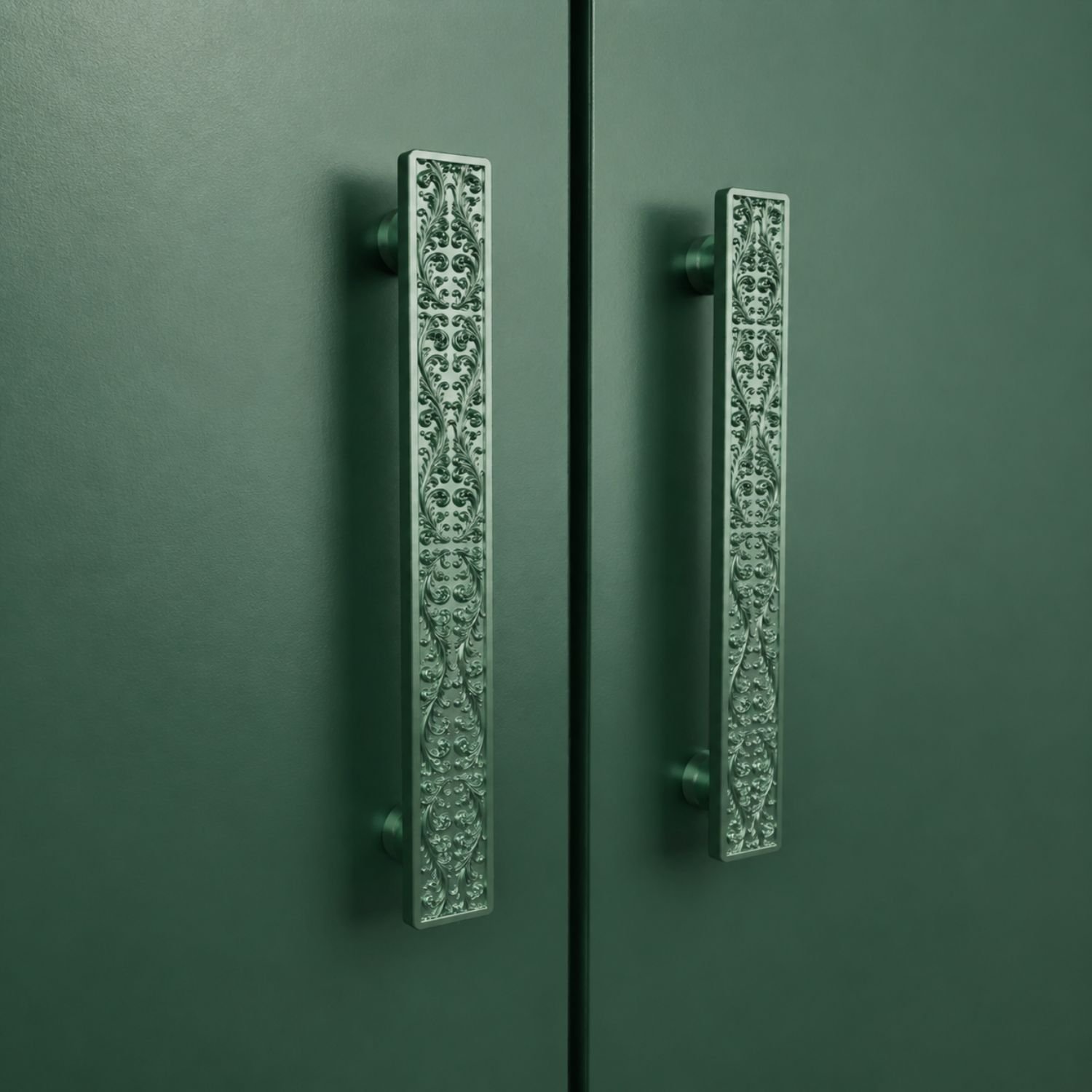
The Florentine Column Scrollwork is the most sculptural of the four. Its cylindrical shaft emerges from the front the way a column emerges from a wall, and the foliage wraps all the way around: no frame, no edge, a continuous relief that reads from every angle, exactly like the climbing foliate candelabra that Florentine workshops carved along their pilasters. You grip it with your whole hand, which makes it an excellent handle for a heavy door or a large cabinet. And if you’re torn between bare and ornamented, the same column also exists in an Essential version, pattern free, with the same dimensions: you can mix both on the same piece of furniture without any visual break.
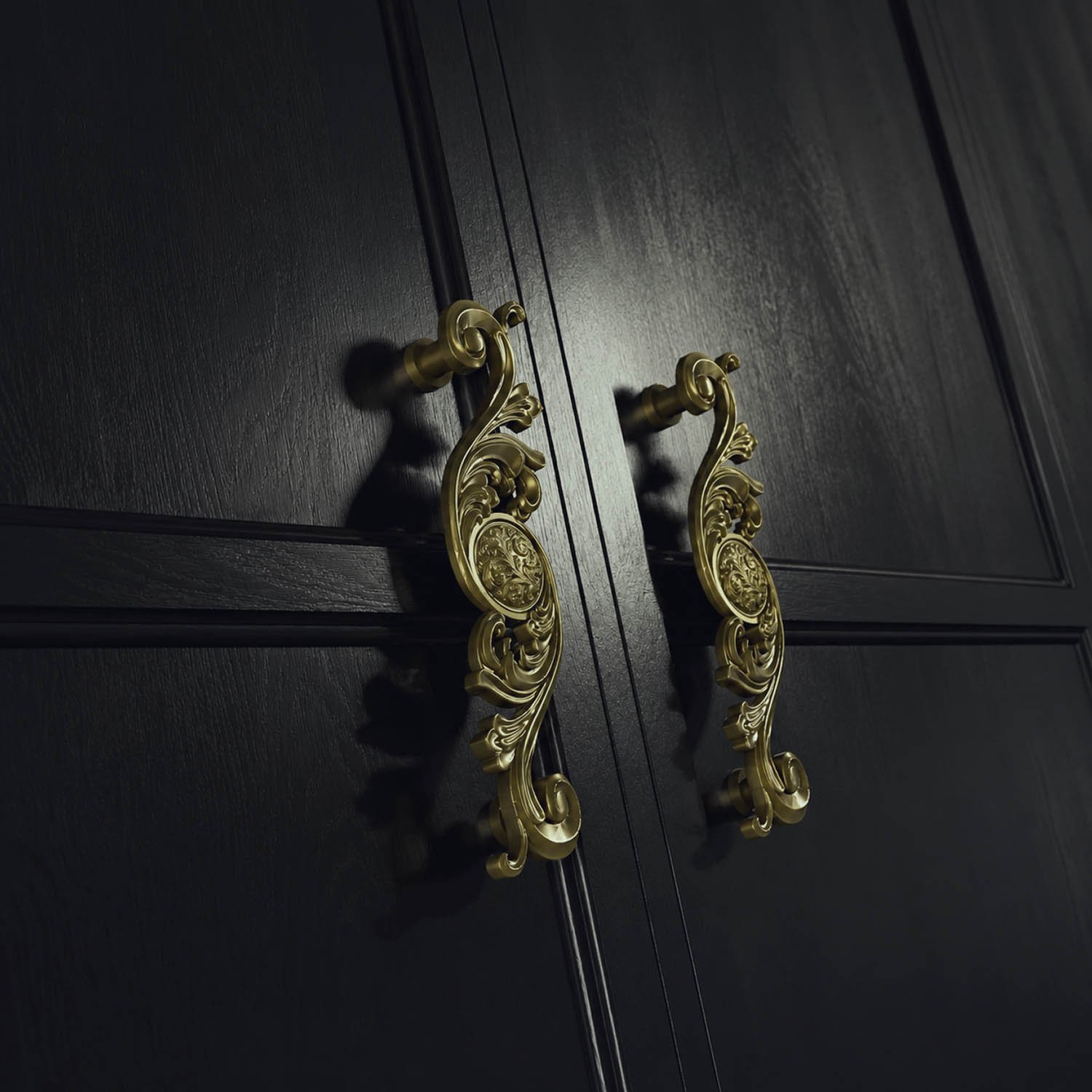
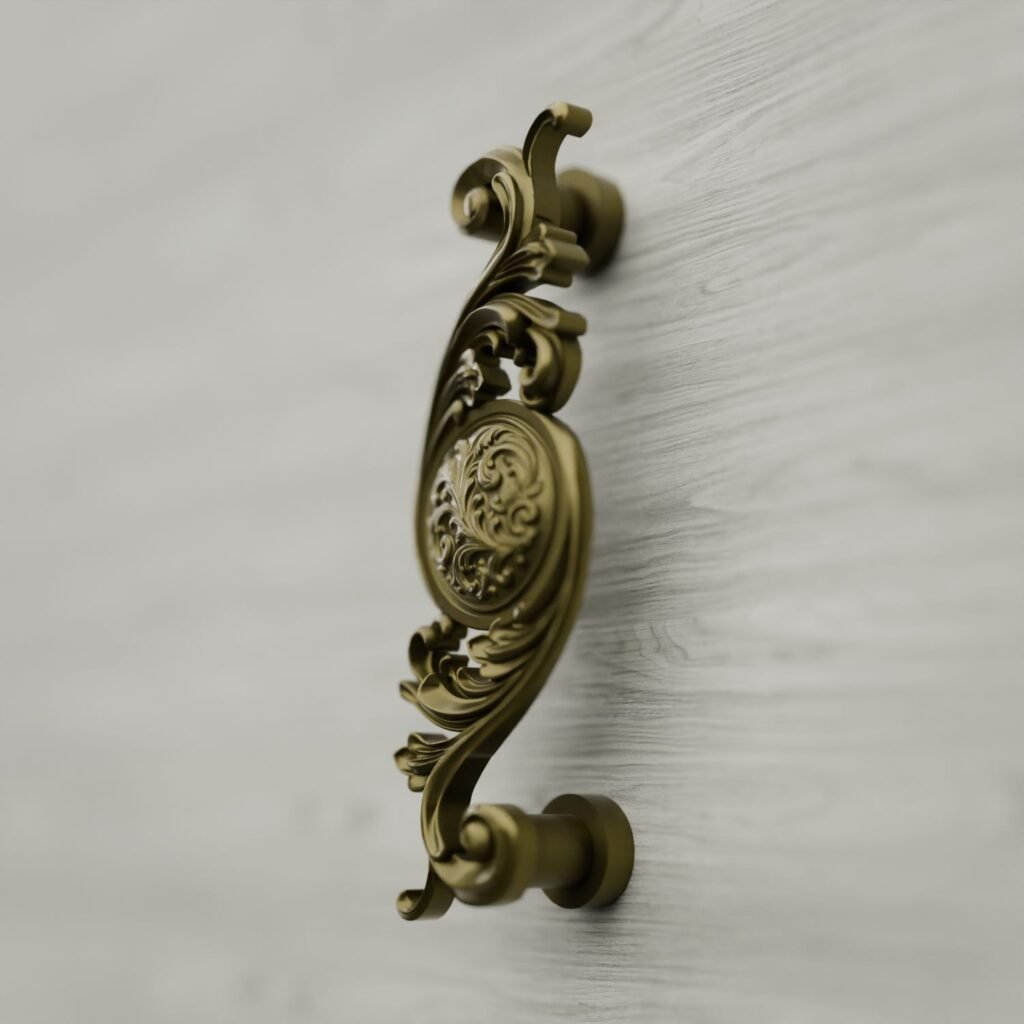
Finally, the Classica Arabesque Scrollwork is the statement piece. The silhouette itself is a cartouche of scrolls, the baroque framing of a townhouse pediment brought down to hand height, and its central medallion carries the Scrollwork at a tighter scale: scrollwork within a scroll, a vegetal mise en abyme. It’s a pull that stands on its own: one per door, on a dark, unbroken front, and the piece is dressed. Three sizes, from 15 to 24 cm in height.
Five materials, two ways to read the pattern
All Scrollwork silhouettes come in the same materials, cold cast in our Paris atelier and then hand finished. But the foliage doesn’t tell the same story depending on what carries it. Metal makes it speak through relief and patina: the hollows darken, the raised edges catch light, and the pattern gains depth. Resin makes it sing in color: the scroll becomes a drawing set on a pearled hue, and it’s the hue you notice first. One rule of thumb above all: in kitchens and bathrooms, stay with metal.
Bronze is the historic material of ornament, and the one we favor for this pattern. It comes in Antique Bronze, hand patinated to a warm brown veined with gold that brings out every leaf, or in Matte Bronze, smooth and contemporary, for those who want the relief without the period effect. Copper plays the same part in a warmer, redder register: Antique Copper, a deep orange brown that seems to carry a memory, or Satin Copper, polished and bright. Both are at home in a kitchen, on a heavy door, or in a bathroom.

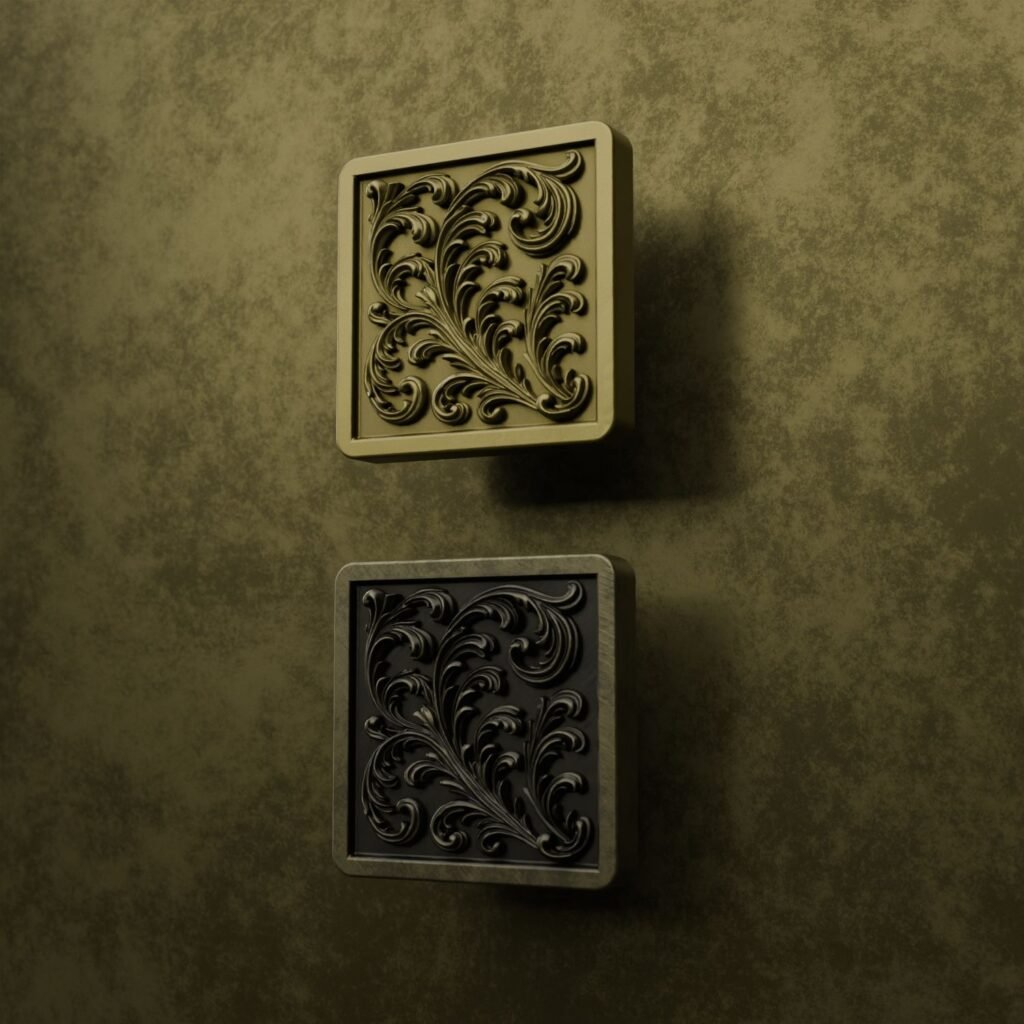
Brass is the quintessential golden metal, the one found on antique dressers and today’s chic kitchens. In Antique Brass, aged tones and oxidized patches give Scrollwork the look of period hardware; in Satin Brass, the golden glow is warm, silky, very of the moment. Aluminum, on the other hand, exists only in Satin Aluminum, our most universal finish: a soft silver gray, neither glossy nor matte, that coordinates with everything and holds up beautifully to humidity. If your kitchen mixes stainless steel, wood, and lacquer, this is the finish that ties it all together.
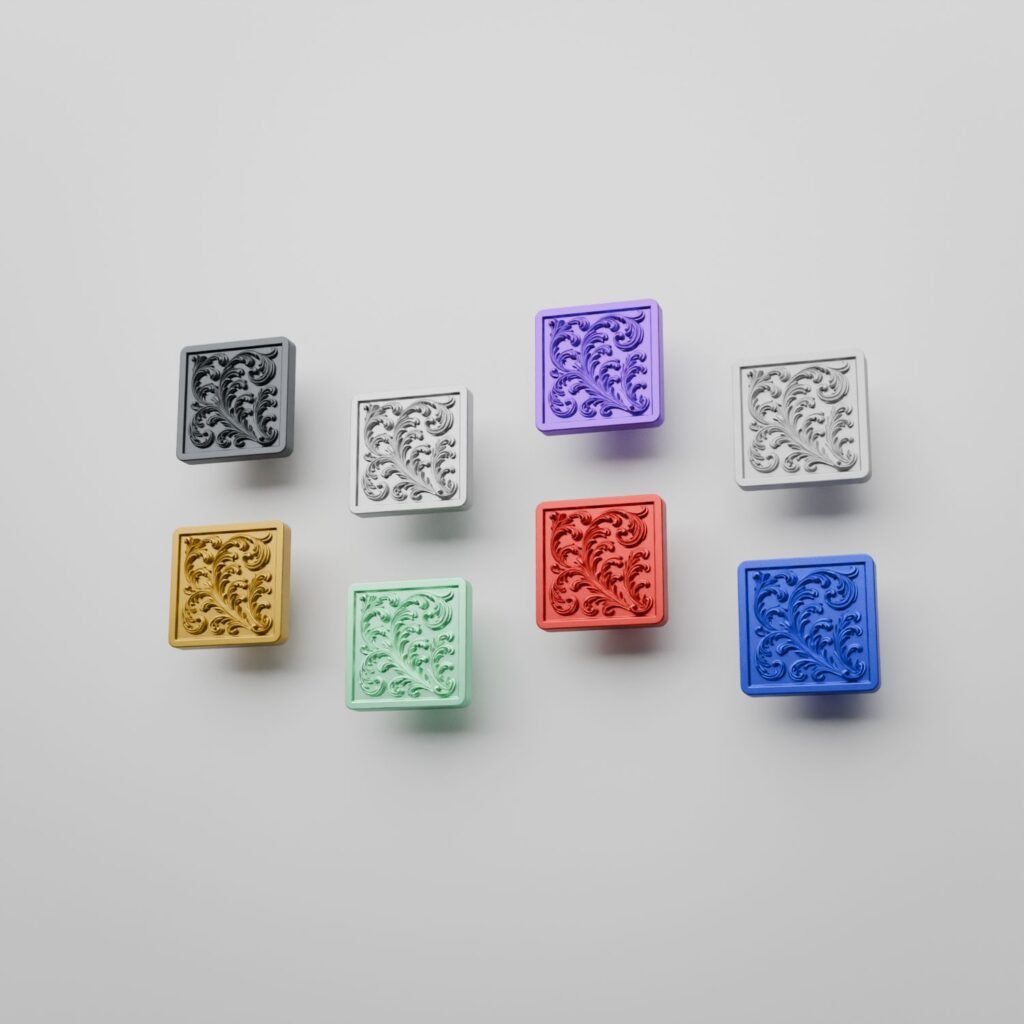
Lastly, bioresin is the material of color. Made from plant-based resources, light, pearlescent, it displays the Scrollwork pattern in shades no metal can reach, from pure white to deep lilac, through red, blue, green, and gold. It’s also the most accessible of the five, making it an ideal entry point for testing the pattern on a dresser before outfitting an entire kitchen in bronze. Its limit is well known, and we’re happy to repeat it: this is a delicate material, suited to living rooms, bedrooms, and closets, not the kitchen, the bathroom, or heavily used drawers.
Which finish for which front?
This is where decorating really begins. Scrollwork finishes fall into three families, and each one calls for its own pairings.
Antique patinas (Antique Bronze, Antique Copper, Antique Brass) are Scrollwork’s best friends, because the patina, applied by hand, settles into the hollows of the foliage and draws each leaf dark on light. They love dark, warm woods: walnut, smoked oak, teak, mahogany, and deep lacquers, black or bottle green. On an antique piece being restored, it’s the obvious choice. On very light wood or pure white, the contrast is strong: beautiful if intended, to be handled with purpose. We told, in an essay, how patina makes time, on a scroll, it also makes legibility.
Satin and matte finishes (Matte Bronze, Satin Copper, Satin Brass, Satin Aluminum) give the pattern a more contemporary feel: the relief is there, but the surface stays smooth, with no aged effect. They pair well with today’s fronts, off-white, natural wood, linen gray, and hold up beautifully against matte black, where the light metal stands out clearly. Matte Bronze is the most versatile of the four; Satin Aluminum the most understated; Satin Brass the warmest; Satin Copper the most graphic against a dark background.
Resin colors play two ways. Tone on tone, the handle blends into the front and Scrollwork exists only through its relief: White Snow on a white or ivory front, Electric Blue on midnight blue, Light Emerald on sage green, Titanium Gray or Silver Gray on a pearl gray front. It’s the most tailored pairing, the one that gives a sculpted front rather than a decorated one. As an accent, by contrast, the color takes center stage on a neutral front: Candy Red on white, Dark Lilac on light wood, Golden Sun on black or bottle green. One rule only: one strong color at a time, never two competing on the same piece.

And on what furniture?
In the kitchen, the Scrollwork pattern brings what flat fronts lack: texture. The Palazzo Square on the drawers, the Palazzo Slim Bar or Bar on the doors, all in Antique Bronze on dark wood or Satin Aluminum on white, and a standard kitchen takes on the look of a designed one. Center screw knobs and bars with common center-to-center spacing mount easily on IKEA fronts, METOD above all.
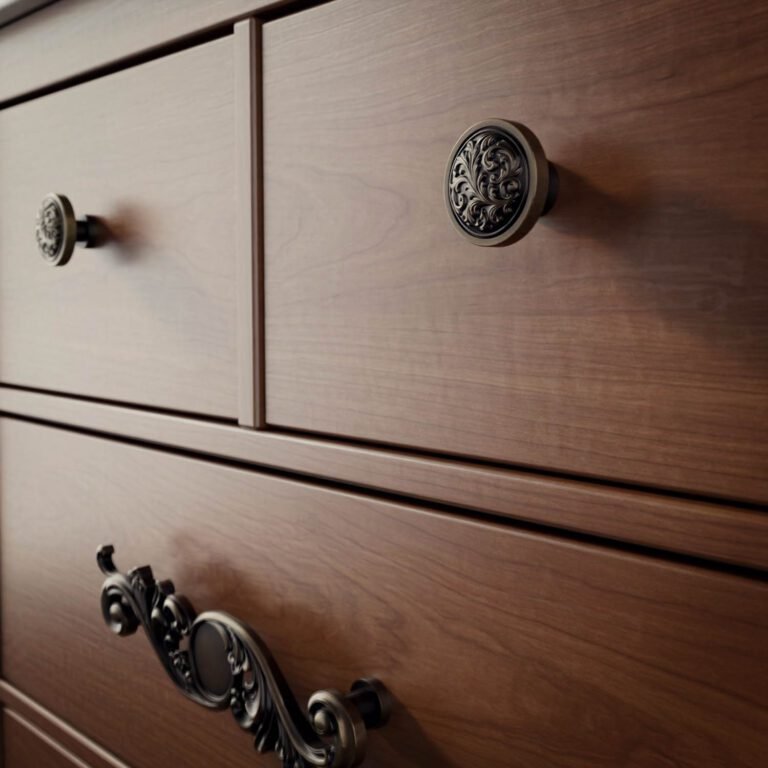
On an antique dresser, it’s the most natural pattern in the catalog: the Classica Round or the Florentine Medallion in antique patina put the piece back in its period without freezing it there. If the dresser has wide drawers, the Classica Arabesque mounted horizontally restores its formal fittings.
In a dressing room or on an armoire, the Palazzo Bar and the Florentine Column mounted vertically structure large doors, and that’s where colored resin truly earns its place, tone on tone on a lacquered front or as an accent on light wood. For a living room piece or a bookcase, the Medallion and the Round in resin are enough to wake up an overly quiet set: we showed the principle on a restyled Kallax.
One last tip, the most useful one: nothing says you have to dress every front. The same silhouette exists in Scrollwork and in Essential, at the same dimensions, and a single silhouette can carry several stories. Keep the Essential on the quiet drawers, save the Scrollwork for the doors people actually look at: the piece gains a rhythm, and the pattern, value.


Concrete reference points
- Scrollwork knobs: Classica Round and Palazzo Square from 3 to 6 cm (three sizes), Florentine Medallion from 4 to 6.5 cm tall (three sizes). A single fixing point, no center-to-center to match.
- Scrollwork pulls: Palazzo Slim Bar, Palazzo Bar and Florentine Column from 15 to 24 cm long (four sizes), Classica Arabesque from 15 to 24 cm tall (three sizes).
- Center-to-center: 96, 128, 160, or 192 mm depending on size, several center-to-center options accepted per length; a custom drilling can be requested in the order comments to replace an old handle without redrilling.
- Materials for the kitchen, bathroom, and heavy doors: bronze, copper, brass, aluminum. Bioresin: bedroom, living room, dressing room, dry rooms only.
- Made to order in Paris, cold casting and hand-applied patina; ships in 5 to 10 business days.
- The Scrollwork pattern belongs to the Classica Europa collection; all Scrollwork handles can then be filtered by silhouette, material, finish, and size.
Frequently asked questions
Which Scrollwork handle to choose for a kitchen?
A metal handle: bronze, copper, brass, or aluminum, which stand up to humidity and heavy use. The Palazzo Square in Scrollwork on the drawers and the Palazzo Slim Bar or Palazzo Bar on the doors form the most cohesive set. Bioresin should be reserved for dry rooms.
Can several Scrollwork silhouettes be mixed on the same piece of furniture?
Yes, and it’s even recommended: a knob on the drawers and a bar on the doors, in the same pattern and the same finish, give a piece of furniture a clear, rhythmic look. The silhouettes in the Palazzo family (Square, Slim Bar, Bar) share the same frame and pair naturally.
Does the Scrollwork pattern come in both knob and pull versions?
Yes. As a single-point knob on the Classica Round, the Palazzo Square, and the Florentine Medallion; as a pull on the Palazzo Slim Bar, the Palazzo Bar, the Florentine Column, and the Classica Arabesque.
What center-to-center spacing for a two-point Scrollwork pull?
The common center-to-center spacings, 96, 128, 160, and 192 mm, are covered depending on the size chosen, and each length accepts several. If your existing holes don’t match any of these values, custom drilling can simply be requested in the order notes: the handle’s length stays the same, only the screw positions shift.
Resin or metal for a bedroom dresser?
Both work well in a bedroom. Choose the patinated metal if you want the foliage relief to lead, and the bioresin if color is what you’re after, tone on tone or as an accent. The resin is lighter and more affordable; the metal is more durable and holds up to heavily loaded drawers.
At Holdon Paris, Scrollwork isn’t a period quotation: it’s a vocabulary we’re putting back into circulation on today’s furniture, at the scale of a hand. Seven silhouettes, five materials, a palette of finishes, and each time the same foliage telling a different story. The rest of the Classica Europa collection explores other figures; this one is the easiest to invite into your home.